



The Story
Kinetic Age has raised around $250,000, about ₹2.4 crore, in a round led by ajvc and Agrasar Ventures. The money goes into expanding the company's healthcare offering and reaching more customers.
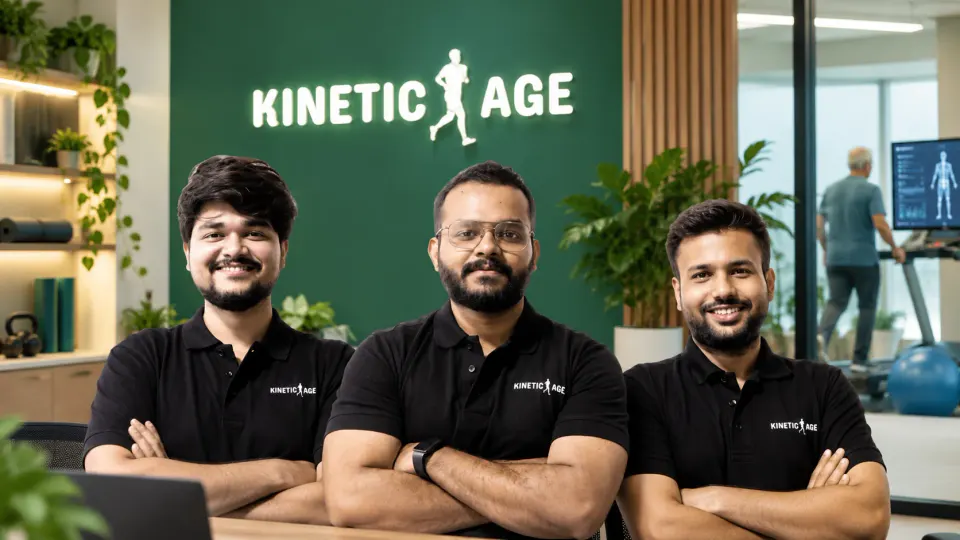
Akshat Saxena and Amogh Saxena founded the Bengaluru company, which operates as KineticAge Health Training Private Limited. It began as a physiotherapy pilot and now provides coordinated care at home, combining doctor consultations, physiotherapy, physical training, nutrition, diagnostics and emotional wellbeing under a single subscription and care plan. Each client's team includes a health consultant, a doctor, a physiotherapist or trainer, a nutritionist and an emotional wellbeing coach, with a relationship manager who coordinates the plan and keeps the family informed.
Its flagship is a three-month doctor-led programme, alongside a physiotherapy and training plan and a ₹499-a-month app tier with daily live yoga and a video library. The app also tracks sessions, medicines, vitals, meal plans and medical reports, and lets family members join for shared care.
The service has largely been marketed to older adults and to the children arranging care for them. With this round, the company describes its focus as personalised, coordinated care for adults over 40, helping them maintain their health through regular interventions and follow-through.
It says it has served more than 600 patients in Bengaluru over the past year, delivered more than 12,000 sessions, and now runs more than 150 sessions a day through a network of 25 providers using AI-driven care protocols. It reports monthly retention above 70 percent, a net promoter score above 75, an annual revenue run rate above ₹2.5 crore, and says about one in three customers arrives through referrals.
Why It Matters
The person who buys Kinetic Age is often not the person who uses it.
Its website opens with an appeal to give your parents the care they deserve, and its care model includes a relationship manager whose job is to keep the family informed. That reflects how ageing increasingly works in Indian cities. Parents grow old in the family home while their children work in another city or another country. The children have the income and the worry; the parents have the needs, and often a reluctance to make a fuss about them. A service that arrives at the parent's door and reports back to the child is selling to both at once.
The need itself is one conventional healthcare handles badly. Ageing well depends less on the occasional specialist appointment than on things done every week: strength and balance work that keeps someone steady on their feet, physiotherapy that stops a stiff knee becoming an immobile one, meals that suit a diabetic diet, someone to talk to. Falls in particular turn independent older people into dependent ones, and the training that prevents them is repetitive, unglamorous and rarely prescribed in any form that actually gets followed.
That is the second gap. An older adult in an Indian city may see an orthopaedist, a diabetologist and a cardiologist, each of whom gives advice and none of whom checks whether it happened. Nobody is paid to make sure the exercises get done or the diet changes, and coordination between those doctors rarely exists. Kinetic Age's proposition is to be the layer that follows through: one plan, one team, and one person accountable for making it happen. It is the same adherence problem the physiotherapy platform Physioplus is working on from the clinician's side, approached here from the household's.
India is ageing quickly enough to make this a large market. The UN Population Fund projects that the share of Indians aged 60 and over will roughly double to about a fifth of the population by 2050, and much of that care will happen at home, arranged by families rather than by institutions.
The Strategic Read
Kinetic Age is the seventh ajvc company on these pages and the first in healthcare. Here the fund shares the lead with Agrasar Ventures, and at about ₹2.4 crore the round is larger than ajvc's standard ₹1.5 crore cheque.
The number that matters most is the retention figure, and it needs a definition before it means anything. If monthly retention above 70 percent means 70 percent of subscribers renew each month, roughly a sixth of a starting group would remain after five months, which would be weak for a service built on ongoing care. If it measures something else, or if many clients join the three-month programme and finish it as intended, the figure may describe completion rather than loss. The tension is built into the product. Ageing is permanent, but programmes end, and a high net promoter score alongside heavy turnover is exactly what a satisfying programme that people complete and leave would look like. Whether customers stay after 90 days is what decides the economics.
The delivery model sets the other limit. One hundred and fifty sessions a day across 25 providers is about six home visits each, which in Bengaluru traffic is a full day. Revenue grows with the number of providers, and margins depend on how tightly clients cluster, because travel between visits is time nobody pays for. A provider whose clients live in the same few apartment complexes does more sessions than one crossing the city, so expansion becomes a neighbourhood-by-neighbourhood exercise. The ₹499 app tier looks like part of the answer: a cheap entry point that reaches people the home-visit team cannot, and a funnel into the service that can.
Then there is the change in description. The product, the app and the marketing were built for seniors and their families. The funding announcement describes the market as everyone over 40. A 45-year-old paying to stay fit is a different customer from a son in another city arranging physiotherapy for his mother. The motivation differs, so does price sensitivity, and the competition from gyms, fitness apps and diabetes programmes is far heavier. Widening the definition makes the market larger on paper; whether the same service sells to the younger group is untested.
The closest comparison is Even Healthcare, also in Bengaluru, which runs subscription-based managed care through its own clinics and a hospital, backed by investors including Khosla Ventures and Founders Fund. Kinetic Age sits at the lighter end of the same idea, keeping people well at home rather than treating them when they are not. That end needs far less capital, and it depends almost entirely on whether people keep paying once they feel better.
For daily, sharp analysis of the biggest moves in the Indian business and startup ecosystem, follow StartupFox.