

The Story
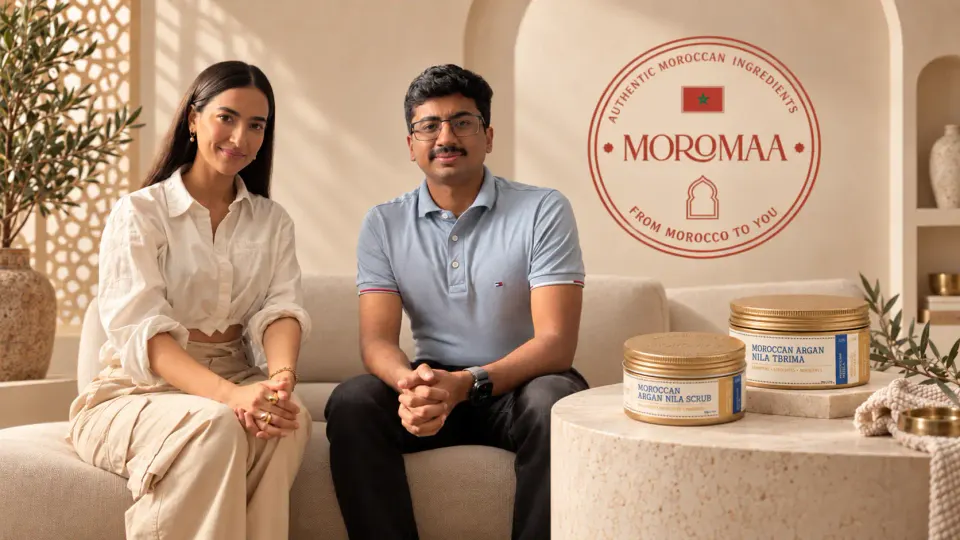
MoroMaa has raised ₹1.5 crore from Aviral Bhatnagar's ajvc in exchange for a 9 percent equity stake, which implies a post-money valuation of roughly ₹16.7 crore. The investment comes less than three months after the brand launched.
Soundous Moufakir founded the Mumbai company and is its solo founder and chief executive. She is Moroccan, worked in finance before moving into India's entertainment industry, and launched MoroMaa on 27 June 2026.
The brand is building what it calls M Beauty, a Moroccan beauty category for Indian consumers, using ingredients sourced directly from Morocco and positioning itself around Moroccan rituals, traditions and artistic influences across beauty, lifestyle and body care.
"MoroMaa started with a simple idea: to bring the beauty rituals and ingredients I grew up with in Morocco to India," Moufakir said. "Over time, that idea has developed into a larger vision of building M Beauty as a category and making Moroccan beauty more accessible to Indian consumers."
The company says two of its products sold out within its first two months of operations. It has not disclosed volumes, revenue or the size of its production runs.
The capital goes towards expanding the product portfolio, strengthening distribution and building awareness of Moroccan beauty practices among Indian consumers.
The round follows a similar cheque from the same investor two days earlier. ajvc led a ₹1.5 crore pre-seed into the fashion discovery platform Slayd at a post-money valuation of about ₹16.66 crore, and had previously written a ₹1.5 crore pre-seed into the fabric care company Iztri.
Why It Matters
Category creation is the most ambitious thing a consumer brand can attempt, and almost nobody manages it. Most brands compete inside a category somebody else defined. MoroMaa is trying to define one, and the template it is working from is the clearest success of the past decade.
K-Beauty did not begin as a marketing idea. It began because Korean manufacturers were iterating on formulations faster than anyone else, launching products in weeks where Western brands took years, and selling into a domestic market so demanding that only the good ones survived to be exported. By the time the rest of the world encountered sheet masks and ten-step routines, the category had a decade of product development behind it. The ritual was the story; the laboratories were the reason it held up.
That is the bar M Beauty is measuring itself against, and it is worth being clear that Morocco's position is different. What Morocco has is ingredients with genuine provenance and a long tradition of use: argan oil, rhassoul clay from the Atlas mountains, black soap, rose water, the hammam ritual. What it does not have is a beauty manufacturing industry of the kind that made Korea's category durable. And argan oil has already travelled without a Moroccan brand attached to it, sitting in shampoos and serums on shelves from Mumbai to Manchester.
So the question for MoroMaa is whether a category can be built on ritual and origin alone, without the industrial base underneath. India is a reasonable place to test that, because Indian consumers have demonstrated over the past few years that they will adopt imported beauty routines enthusiastically, and because the beauty tradition Morocco offers, oils, clays, steam, slowness, is closer to what many Indian households already recognise than Korea's was.
The founder is the strongest argument. Moufakir is not an entrepreneur who researched a trend; she is selling what she grew up using, to a market she has since lived and worked in. Origin-led brands fail when the origin turns out to be a story bought from an agency. This one at least starts from something real.
The Strategic Read
The most interesting thing about this round may be that it is not bespoke.
₹1.5 crore for 9 percent puts MoroMaa's post-money at about ₹16.7 crore. Two days earlier ajvc led a ₹1.5 crore pre-seed into Slayd at roughly ₹16.66 crore post-money. It wrote a ₹1.5 crore cheque into Iztri last year. The terms are not approximately similar; they are the same terms.
That is a deliberate operating model rather than a coincidence, and it explains something the fund's founders keep remarking on. Iztri's founders said ajvc went from first call to signed term sheet in six days. Beijan's said the fund bypassed the usual bureaucracy. A standardised price does that: if the cheque and the stake are fixed, there is nothing to negotiate, no valuation argument, no back and forth over the cap table. The only question left is whether the fund wants to invest, which is a decision one person can make quickly.
It is essentially an accelerator's terms without the cohort, the programme or the demo day. For a founder three months into a brand, speed and certainty are worth more than squeezing the price, and 9 percent for a first institutional cheque is unremarkable by pre-seed standards. The trade-off is that a standard price cannot reward an unusually strong company, so the fund's returns rest entirely on selection rather than on terms.
On MoroMaa itself, the category claim deserves scrutiny, because it is borrowed from somewhere specific.
M Beauty is constructed to sound like K-Beauty, and the comparison does the brand no favours under examination. Korean beauty became a global category because Korea had an actual industry behind it: formulation laboratories, product cycles measured in weeks rather than years, and a demanding domestic market that road-tested everything before it was exported. The ingredients were the marketing; the manufacturing capability was the moat. Morocco has the ingredients, argan oil, rhassoul clay, black soap, rose water, but no comparable beauty industry, and argan in particular is already a commodity input sitting in products on shelves worldwide, including in India.
What MoroMaa has instead is authenticity, and in an origin-led brand that is not a small thing. A Moroccan founder selling the rituals she grew up with is a different proposition from an Indian marketing team deciding Moroccan sounds exotic this season. Consumers detect the difference more often than brands expect, and Indian buyers have already shown a real appetite for imported beauty rituals through the K-Beauty boom.
The claim to treat carefully is the sold-out one. Selling out is a function of how much you made, and a three-month-old brand's first production run may be a few hundred units. It tells you the brand found some demand. It does not tell you how much, and no volume, revenue or run-size figure has been published.
For daily, sharp analysis of the biggest moves in the Indian business and startup ecosystem, follow StartupFox.