



The Story
Profound, an AI-native platform that builds a personal representative for working professionals, has raised $1.5 million, about ₹14 crore, in a seed round from Stellaris Venture Partners and 3one4 Capital. The round was announced on 3 August 2026 as the company came out of stealth.
Six angel investors participated: Swiggy chief executive Sriharsha Majety, Swiggy co-founder Nandan Reddy, Razorpay chief executive Harshil Mathur, CRED founder Kunal Shah, OfBusiness co-founder Bhuvan Gupta and Zomato co-founder Pankaj Chaddah.
The valuation, the dilution and the split between the two institutional investors have not been disclosed. Neither has the company's founding date, its registered office or whether the round included any debt component.
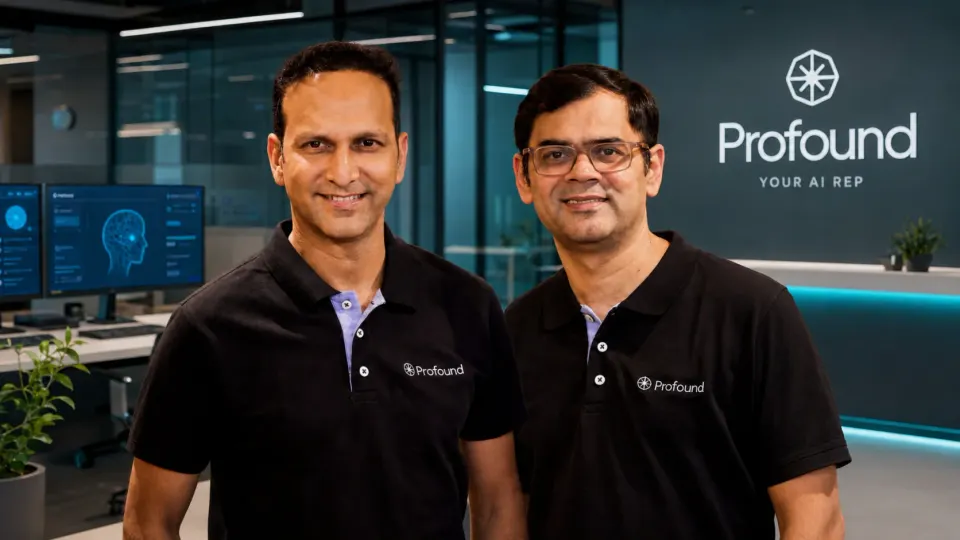
Profound was founded by Anuj Rathi and Prashant Parashar. Rathi was most recently chief business and growth officer at Cleartrip, led product and marketing at Jupiter, and spent seven years at Swiggy scaling Instamart, Swiggy Labs and Genie. Parashar, the chief technology officer, previously headed technology functions at Delhivery, Snapdeal and Ola.
The product gives each user what the company calls an AI Rep. Profound says its system conducts a 30-minute voice conversation, from which it learns the user's expertise, experience, working style and career ambitions, and then represents them to recruiters and collaborators. It describes a technology stack divided into four layers and a business-to-business vertical aimed at helping startups with recruitment.
The capital is earmarked for developing the AI platform, expanding product capabilities and building out both the consumer and B2B offerings.
Every claim about how the product works is the company's own. Profound opened early access to a first cohort on the day of the announcement, following what it describes as several months of product development and user research. No user numbers, pricing, revenue or hiring outcomes have been published, and none exist yet in a form that could be verified.
Why It Matters
The problem Profound describes is one of asymmetry. A person's competence is legible to the handful of colleagues who have worked alongside them and almost invisible to everyone else, who see a title, a company name and a date range. Recruiters compensate by screening on proxies, which is why hiring correlates so poorly with performance and why referrals remain the highest-yield channel in almost every organisation.
The mechanism Profound proposes is to move the description of a professional from something they write to something a system extracts. A voice conversation surfaces context a person would not think to put on a profile and would feel awkward asserting about themselves. The output is not a document but an agent that can be queried, which is what makes it useful to a recruiter with a specific vacancy rather than a generic search.
The money follows the employer, not the professional. The consumer side builds the supply of represented people; the B2B recruitment vertical is where a company pays for access to it. That is the same shape as the incumbent professional network, and it means the business's economics depend on hiring demand rather than on individual subscriptions.
None of that is currently a business. Profound has not published pricing for either side, has no disclosed users beyond a first cohort admitted today, and no hiring outcome has been attributed to the product. A $1.5 million seed is a modest cheque against the stated ambition, which is to replace how professionals are discovered. It funds an experiment, not a rollout, and the next round will be priced on whether the first cohort produced anything an employer paid for.
The Strategic Read
The market assumption being underwritten is that the professional profile, as a static document a person writes about themselves, stops being how hiring decisions get made. Résumés and profile pages record titles and dates. They do not record judgement, working style, or what someone is actually good at, and the people best placed to describe that are colleagues who will never write it down.
If an AI system can extract that from conversation and then answer questions about a person on demand, the profile becomes queryable rather than readable. That is a genuine shift in the primitive, and it is the same bet several AI-first recruitment companies are making from the employer side rather than the candidate side.
Where the model has to prove itself is the cold start. A representation layer is worth nothing to a professional until employers consult it, and worth nothing to an employer until enough professionals are on it. Profound is opening with a curated first cohort, which is the sensible way to attack that, but it means the network has to be assembled one cohort at a time while the incumbent already holds the entire graph.
That incumbent is the obvious risk. The product's own positioning is a direct attack on LinkedIn, which owns the professional graph in India and globally and is shipping AI features into it. Competing on quality of representation against a platform that already has the distribution requires the new representation to be enough better that professionals maintain two presences, and that employers trust an AI-generated account of a candidate over a self-written one.
The syndicate is the strongest asset here and also the one most easily misread. Majety, Shah, Mathur, Reddy, Chaddah and Gupta collectively hire thousands of people, which gives Profound a credible first market and a distribution channel most seed companies do not have. It does not tell anyone whether the product works. On a $1.5 million round with no users, that remains entirely unproven.
For daily, sharp analysis of the biggest moves in the Indian business and startup ecosystem, follow StartupFox.