
 Smallest.aiSSeligman Ventures
 Sierra Ventures
 3one4 Capital
 Better Capital
 Upsparks Capital
 Schema Ventures
 Tiny VC
 DeVCMMission Street Capital
The Story
Smallest.ai has raised $13 million, about ₹108 crore, in a Series A round led by Seligman Ventures. The round was announced on 30 July 2026 and takes total funding past $21 million.
Existing backers Sierra Ventures and 3one4 Capital participated, alongside Better Capital, Upsparks Capital, Schema Ventures, Tiny VC, DeVC, Mission Street Capital and a group of angel investors. The company raised $8 million in a seed round led by Sierra Ventures in October 2025.
No valuation was disclosed for either round, nor the dilution, the split between investors or any board changes.
Alongside the round the company launched Voice 4.0, a platform built on an asynchronous speech-to-speech architecture it calls Hydra. Its stated model portfolio includes Pulse STT Pro for speech recognition and Lightning V3.1 for speech generation, supporting 38 languages with emotion detection, speaker diarisation and automated redaction of personal and payment data. The capital is earmarked for financial services, healthcare, contact centres and business process outsourcing, and for hiring against a current headcount of about 60.
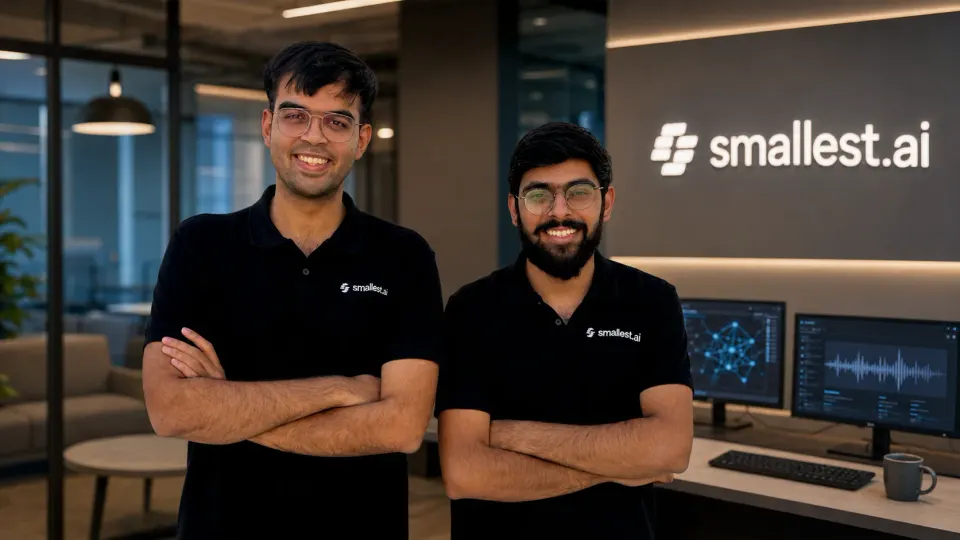
Accounts of the company's origins disagree. Reporting accompanying the round describes it as founded in late 2024; other coverage dates the founding to 2023. It was set up by IIT Guwahati alumni Sudarshan Kamath, the chief executive, and Akshat Mandloi. The company describes itself as headquartered in San Francisco and is incorporated as Smallest Inc., though Indian coverage of the round refers to it as Bengaluru-based.
Existing customers named by the company include RingCentral and Truecaller.
The performance claims, the language count and the customer list all come from the company. No revenue figure, contract value, call volume or retention data has been published.
Why It Matters
The problem Smallest.ai is attacking is not whether an AI agent can answer a question. It is the half-second before it starts. A large language model receives a complete prompt, then begins generating. In text that pause is invisible. On a phone call it is the tell, and no amount of voice quality disguises it.
The company's answer is architectural rather than a matter of scale. Its model is designed to process speech as it arrives, so listening and reasoning overlap the way they do between two people, one of whom is already forming a reply and may interrupt. When a query falls outside the small model's knowledge, the system hands off to a large foundational model and puts the caller on hold to look it up, which is what a human agent does.
That design choice determines the cost structure. Running a small specialised model continuously is cheaper per call than running a frontier model, and the company has put numbers behind that: a partnership with Tenstorrent in May claimed 550 simultaneous calls on 27 P100 accelerators costing roughly $27,000, against about $100,000 of Nvidia L40S GPUs for the same load. Those figures are the companies' own.
What has not been shown is that the output clears the bar the company has set for itself. Kamath's stated goal is that a caller cannot tell the difference, and no independent test of that claim exists. Nor has Smallest.ai disclosed revenue, contract values, call volumes or how many of its named customers are in production rather than trialling. A sixty-person company selling infrastructure to enterprises in regulated industries has a long procurement cycle ahead of it, and none of the evidence for crossing it is public yet.
The Strategic Read
The market assumption being underwritten is that voice becomes a distinct layer of the AI stack rather than a feature of the model that sits behind it. If that holds, the companies building customer support agents buy their voice from someone rather than building it, in the way they buy payments or telephony today.
Kamath's argument for why they would is that getting voice right is a distraction from a support company's actual business. That is true until it is not. The same argument was made about search, payments and infrastructure by companies that later watched their largest customers internalise the function once it became strategic. RingCentral and Truecaller are exactly the sort of customer with the engineering depth to reconsider.
What makes the position more defensible than a typical model wrapper is the specificity of the problem. Accents, noise, interruption, forty languages and regulated-industry redaction are not glamorous research problems and they do not get solved as a by-product of scaling a general model. They are solved by working on voice for years. That is a moat made of accumulated unglamorous work, which is the durable kind.
The capital gap is the harder issue. ElevenLabs and Cartesia have raised far more, and Sarvam is contesting the Indian language position with sovereign backing and a valuation ten times larger. A $13 million Series A against those balance sheets funds focus, not a race. It works only if the narrow bet is right and the broad players stay distracted.
The lead investor is worth noting for what it signals about price. Seligman Ventures launched in November 2025 and this is among its earliest cheques. A new fund leading a Series A in a category where the established names have already placed their bets suggests the round was available rather than contested, which is consistent with no valuation being disclosed.
For daily, sharp analysis of the biggest moves in the Indian business and startup ecosystem, follow StartupFox.