
 Minimalist
The Story
Minimalist reported operating revenue of ₹690.2 crore in FY26, up 36% from ₹506.5 crore in FY25, in its first full financial year under Hindustan Unilever. The figures come from consolidated financial statements filed with the Registrar of Companies.
Profit after tax was ₹25.9 crore. Profit before tax and exceptional items was ₹32.5 crore, against ₹11.9 crore in FY25. EBITDA more than doubled to around ₹40.2 crore, at a margin of 5.82%.
The headline comparison with last year requires care. Minimalist recorded a net loss of ₹271.9 crore in FY25, but that was driven almost entirely by a ₹283.8 crore fair value loss on compulsorily convertible preference shares, an Ind AS adjustment tied to the change in ownership rather than to trading. On an operating basis the company was already profitable.
Non-operating income added ₹7.2 crore, taking total income to ₹697.4 crore. Product sales accounted for all operating revenue.
Advertising and promotional spending remained the largest cost head at ₹235 crore, a 55% increase year on year and more than 35% of total expenditure. Cost of materials consumed rose 28% to ₹184.8 crore. Distribution expenses, mainly marketplace commissions, were ₹97.4 crore. Employee benefits rose 32.5% to ₹48.5 crore, and other overheads including rent, transportation, legal fees and warehousing came to ₹99 crore. Total expenses were ₹664.8 crore, up from ₹497 crore.
Return on capital employed was 11.6%, and the company spent ₹0.96 to generate each rupee of operating revenue. As of March 2026 it held current assets of ₹346 crore, including ₹75 crore in cash and bank balances.
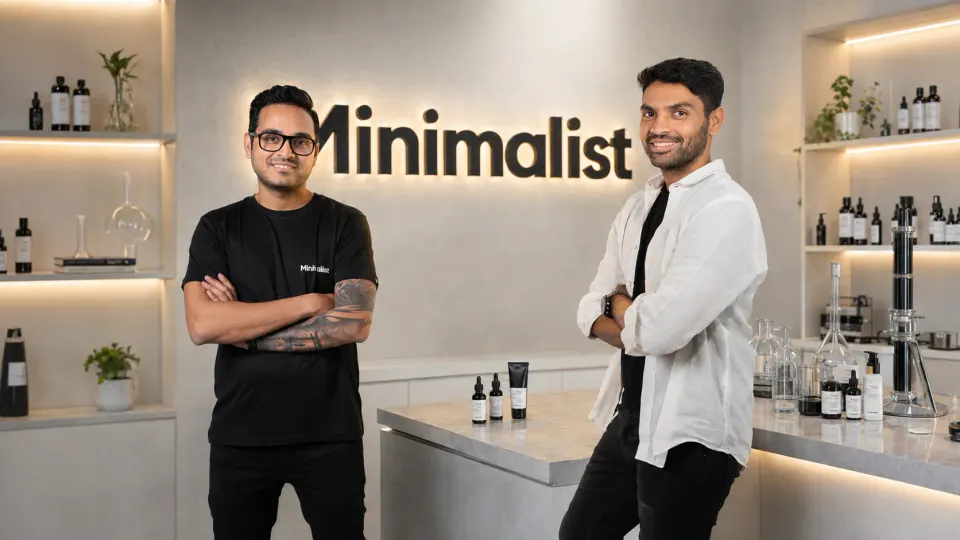
Minimalist was founded in 2020 by brothers Mohit Yadav and Rahul Yadav and is based in Jaipur. It sells serums, toners, moisturisers and other skin and hair care products through its own website and through Amazon, Nykaa and Flipkart. HUL announced the acquisition of a 90.5% stake in January 2025 at a stated valuation of ₹2,955 crore, and completed the purchase of that stake in Uprising Science, which operates the brand, for ₹2,706.44 crore in April 2025. The remaining 9.5% is due to be acquired within two years of completion.
Before the acquisition, Minimalist had raised about $17 million. Peak XV led its seed round through Surge in late 2019 and held 27.9% at the time of the deal, with Unilever Ventures participating in the Series A.
Why It Matters
Minimalist sells actives-led skincare, where the pitch is that the label states exactly what is in the bottle and at what concentration. That positioning attracts a customer who reads ingredient lists, which is a narrower audience than mass beauty but one that pays more and switches less on price.
The cost structure tells you where the money goes. Materials consumed were ₹184.8 crore against ₹690.2 crore of revenue, so the physical product costs roughly 27% of what it sells for. That is a healthy gross position and it is what makes a digital-first beauty brand attractive to acquire.
Everything else eats it. Advertising and promotion ran to ₹235 crore, more than the cost of the goods themselves and over a third of total spending. Marketplace commissions took another ₹97.4 crore. Between them, acquiring the customer and reaching them through Amazon, Nykaa and Flipkart consumed ₹332 crore, nearly half of revenue. What survives is a 5.82% EBITDA margin.
That is the arithmetic of the category rather than a failure of management. A brand that exists online has to buy its shelf space in the form of advertising every quarter, and it cannot stop without volumes falling.
The number that does not sit comfortably is the direction of that spending. Advertising grew 55% while revenue grew 36%. A brand acquired eighteen months ago specifically to plug into HUL's offline distribution might reasonably be expected to lean less on paid acquisition over time, not more. Either the offline shift has not yet moved volumes, or growth is being bought at a rising price. Nothing in the filings distinguishes between those two readings.
The Strategic Read
The assumption HUL underwrote in January 2025 was that a digital-first brand with a loyal ingredient-literate following would grow faster inside a distribution machine than outside one. Roughly ₹2,706 crore bought 90.5% of a business now turning over ₹690 crore, which is about four times sales. On FMCG multiples that is expensive; on the logic that Lakmé and Ponds cannot easily be repositioned for a consumer who reads concentration percentages, it is a purchase of relevance rather than revenue.
Eighteen months in, the evidence is mixed in an instructive way. Revenue is growing well ahead of HUL's own portfolio, and the brand is profitable, which most acquired D2C names are not. But growth is slowing on a clear trend: 88% in FY24, 45% in FY25, 36% in FY26. Deceleration is normal as a base grows. The question is whether the parent's distribution arrests it or whether it continues.
That matters because the offline case has not yet shown up in the numbers. HUL's stated reason for buying was to take Minimalist into general trade and modern retail, where its own strength lies. If that were working at scale, the expected signature would be revenue growth accelerating relative to advertising spend. FY26 shows the reverse.
The integration risk is the one nobody quantifies. Minimalist's founders agreed to lead the business for two years from completion, which points to April 2027. Actives-led brands are built on a specific voice and a refusal to overclaim, and that survives acquisition only as long as the people who set it are still deciding what goes on the label.
What FY26 establishes is that the brand did not break on contact with a conglomerate, and that it earns money. What it does not establish is whether HUL bought a growth engine or a premium shelf position at four times sales.
For daily, sharp analysis of the biggest moves in the Indian business and startup ecosystem, follow StartupFox.