
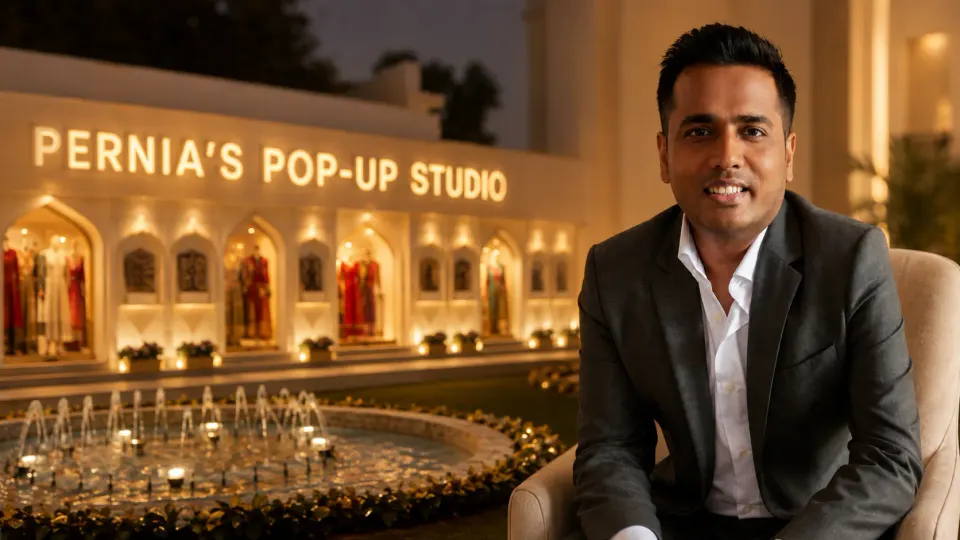

 Purple Style Labs
The Story
Purple Style Labs, the parent company of luxury fashion platform Pernia's Pop-Up Shop, has raised nearly ₹306 crore from anchor investors ahead of its initial public offering. The company disclosed the anchor allotment on 29 August 2026, two days before its IPO opens.
The company allotted 53.21 lakh equity shares to 10 anchor investors at ₹575 each, the upper end of its IPO price band. ICICI Prudential Mutual Fund was the largest, taking shares worth nearly ₹88 crore, followed by Jupiter India Fund at ₹75 crore and Aditya Birla Sun Life Insurance at nearly ₹68 crore. ITI Mutual Fund, Singularity Equity Fund I, Integrated Core Strategies, Morgan Stanley Asia and BofA Securities Europe also participated.
The anchor round precedes Purple Style Labs' ₹680 crore IPO, which opens for subscription on 31 August and closes on 2 September, with a price band of ₹546 to ₹575 per share. The issue is entirely a fresh issue of equity, with no offer-for-sale component, so all proceeds go to the company rather than selling shareholders. Its post-issue implied market capitalisation has been estimated at ₹4,406 to ₹4,604 crore. Axis Capital and IIFL Capital Services are the book-running lead managers, and KFin Technologies is the registrar; the shares will list on the BSE and NSE.
Founded in 2015 by Abhishek Agarwal, who is whole-time director and chief executive, Purple Style Labs operates an omnichannel luxury fashion model spanning its website, a mobile app and physical experience centres, and served customers in around 100 countries in FY26. As of March 2026 its catalogue carried products from 1,109 active designer brands. For FY26, the company reported revenue from operations of ₹557.8 crore, up 13.9% from ₹489.9 crore in FY25, and a net loss of ₹285.4 crore, which widened from ₹188.4 crore a year earlier. Its net worth was negative ₹52.3 crore as of March 2026.
Why It Matters
Purple Style Labs is built on a specific bet about Indian luxury: that designer fashion, long sold through a fragmented mix of standalone boutiques and trunk shows, can be aggregated onto a single trusted platform. Pernia's Pop-Up Shop is that platform, curating apparel and accessories from more than a thousand Indian designers and selling them online and through physical experience centres. For designers, it offers reach without building their own retail; for buyers, particularly for weddings and occasion wear, it offers selection in one place.
The revenue model is omnichannel retail of high-value goods. The average order value is large, roughly ₹75,500 in FY26, which suits a category where a single outfit can cost lakhs, and the company earns on the spread between what it pays designers and what customers pay. Its expansion into large-format experience centres in cities and abroad is meant to bring the tactile, try-before-buying element that luxury buyers expect.
The cost structure is what the financials expose. Large experience centres carry heavy lease and fit-out costs, inventory in luxury fashion ties up significant working capital, and serving 100 countries adds logistics complexity. Those fixed and working-capital costs are why the company remains loss-making despite rising revenue.
However, the reported revenue growth does not by itself make the case that the model works. Revenue rose 13.9% in FY26, but the net loss widened faster, to ₹285.4 crore, and the company's net worth is negative. A business going public while consuming cash at that rate is asking public investors to fund a path to profitability it has not yet demonstrated.
The Strategic Read
The market assumption behind this IPO is that India's luxury fashion market is large and fast-growing enough to support a dedicated, scaled platform, and that Purple Style Labs is positioned to lead it. The anchor book lends that thesis institutional weight: ICICI Prudential, Jupiter, Aditya Birla Sun Life and global names taking ₹306 crore two days before the issue is a meaningful vote, and anchor participation of that quality often signals a smoother subscription. It does not, however, resolve the question the financials raise.
That question is whether a loss-making, cash-consuming retailer with negative net worth should be valued near ₹4,600 crore. The IPO is entirely a fresh issue, which is the reassuring part: no promoter or investor is cashing out, and the full ₹680 crore goes to the company, much of it earmarked for its retail subsidiary and lease payments on experience centres. The company needs this capital, which is precisely why the structure carries no offer for sale. But raising primary capital to fund store expansion only works if the new stores turn profitable, and the FY26 accounts, revenue up 14% while losses widened 51% to ₹285 crore, show expansion currently deepening the loss rather than narrowing it.
The durable risk is structural to luxury retail. Experience centres are expensive to run, wedding and occasion demand is seasonal and discretionary, and the model competes both with individual designer boutiques and with global luxury houses expanding in India. EBITDA of about ₹30 crore in FY26 shows the core can generate an operating surplus before the heavy below-the-line costs, but the gap between that and a ₹285 crore net loss is where the interest expense on ₹371 crore of borrowings and the fit-out costs live. The largest execution risk is that public-market investors, unlike late-stage private ones, reprice quickly, and a luxury retailer listing into negative net worth has to show a credible path to profit before the market's patience, and its own cash, runs short.
For daily, sharp analysis of the biggest moves in the Indian business and startup ecosystem, follow StartupFox.