
 Peeko
PeekoThe Story
Peeko, a Bengaluru-based babycare quick commerce platform that delivers baby and kids-care essentials within 60 minutes, has raised ₹67.4 crore (over $7 million) in a Series A funding round led by Chiratae Ventures. The round was announced on 20 August 2026.
Existing investor Stellaris Venture Partners participated alongside angel investors, including MakeMyTrip co-founder Deep Kalra. Peeko and its backers have not disclosed the company's valuation, the equity dilution, or the split between primary and secondary capital.
The round takes Peeko's total funding to roughly ₹95 crore. It follows a $3.2 million (₹28 crore) seed round in August 2025, also led by Stellaris, with angels including Maninder Gulati, V3 Ventures co-founder Arjun Vaidya, Titan Capital's Kunal Bahl and Rohit Bansal, Tracxn's Abhishek Goyal and Uni's Nitin Gupta.
The company said the fresh capital will go towards technology aimed at building a broader "parenting partner" proposition alongside its commerce business, expanding its dark store network and improving its product assortment.
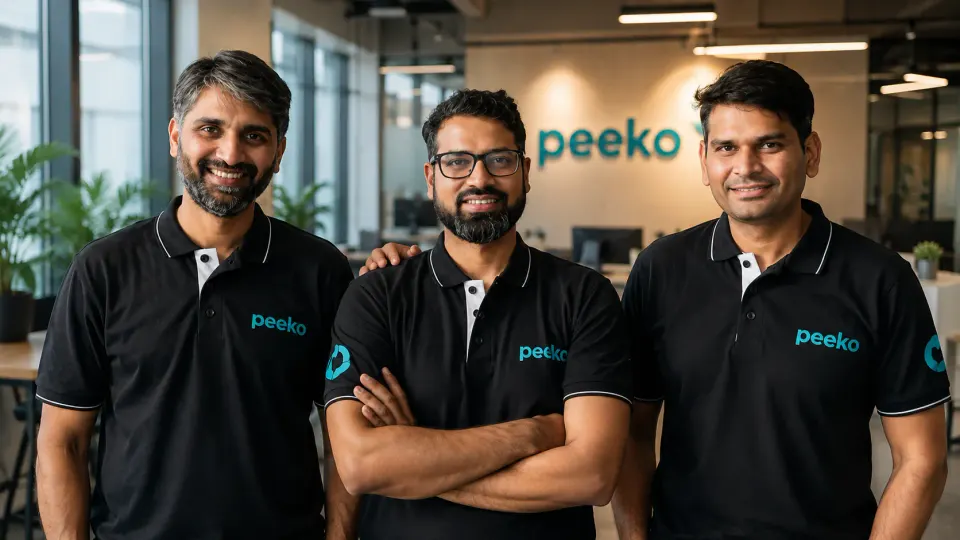
Founded in 2025 by Chetan Sharma, Abhijit Gairola and Vivek Khetan, Peeko runs a vertical quick commerce platform for baby and kids-care products. Sharma and Gairola are former Leap Finance executives and Khetan was previously at OYO, and all three are IIT alumni. The platform offers apparel, diapers, toys and baby food, and its defining feature is a try-and-buy model: a rider delivers the order and waits while the parent inspects it, taking back anything unwanted with an instant doorstep refund.
Peeko said it has grown nearly two-fold every quarter over the past six months and that more than one lakh parents have shopped on the platform since launch. It operates three dark stores in Bengaluru covering around 55% of the city, and plans to reach six stores by the end of 2026 before entering two more cities next year. Its assortment has expanded from around 6,000 SKUs at launch to between 27,000 and 30,000, with an average order value of about ₹1,000. Those figures are company-stated.
Why It Matters
Peeko is built on the premise that buying for a baby is a category unto itself. A parent choosing diapers, apparel or feeding essentials cares about fit, safety and product quality in a way that does not map onto the speed-and-price logic of grocery quick commerce. The company's argument is that this warrants a dedicated platform with a curated assortment rather than a baby aisle inside a general one.
The operating model is vertical quick commerce: owned dark stores, curated inventory and in-house delivery within 60 minutes. The distinctive part is the try-and-buy layer. Because parents traditionally want to physically check a product before paying, Peeko sends the order with a rider who waits while the customer inspects it, then takes back whatever is unwanted and refunds it on the spot. The company says most customers use this option on their first order, and that it is central to building the trust the category runs on.
The economics of this are demanding. Owned dark stores carry rent, inventory and staffing, and a wait-and-return delivery model adds rider time and reverse logistics to every basket. An average order value of around ₹1,000 has to absorb all of that. The trade-off Peeko is making is higher cost per order in exchange for retention, on the theory that a parent who trusts the platform buys repeatedly across a child's early years.
However, the reported two-fold quarterly growth does not by itself establish that the model works financially. Growth multiples off a small base and a one-lakh customer count show demand, not contribution margin, and the company has not disclosed whether its three dark stores run at a profit or what the try-and-buy model does to per-order economics once returns are counted.
The Strategic Read
The market assumption changing behind this investment is that babycare is different enough from general quick commerce to sustain its own vertical platform. The bet is that parents will not be served well by a horizontal player treating diapers as one more category, because the babycare purchase is driven by trust, fit and product quality in a way a ten-minute grocery run is not. Peeko's whole model is built around that claim.
The try-and-buy mechanism is the sharpest expression of it and the most expensive. Sending a rider to wait at the door while a parent inspects apparel and returns what does not fit solves a real problem, catalogue fatigue and fit uncertainty, that has kept baby apparel stubbornly offline. It also loads cost onto every order: rider time per delivery is longer, return rates are structurally higher, and reverse logistics on a ₹1,000 average order value is not cheap. Whether that converts into retention strong enough to justify the unit cost is the question the Series A is funding, and the company has disclosed growth multiples but not the economics underneath them.
Concentration is the striking fact. Two rounds and roughly ₹95 crore in, Peeko still operates in a single city. Three dark stores covering 55% of Bengaluru is deliberate density over breadth, which is defensible, tight geography is how quick commerce makes delivery pay, but it also means the entire business is one city's unit economics, unproven against the cost of replicating dark stores, supply and riders in a second and third market. The plan to reach six stores and two new cities is where the model gets tested.
The competition arrives from both directions. FirstCry owns the babycare category with national reach and a decade of brand trust, and can add faster delivery without rebuilding demand. From the quick commerce side, Qzi raised $6.2 million to chase the same niche, and the large horizontal players can bolt on a baby aisle whenever the category proves itself. Peeko's defensibility rests on assortment depth and the trust its return model builds, neither of which is a structural moat yet. The largest execution risk is that a capital-intensive, single-city model funded to ₹95 crore has to prove it travels before a better-capitalised incumbent decides the niche is worth taking seriously.
For daily, sharp analysis of the biggest moves in the Indian business and startup ecosystem, follow StartupFox.