


The Story
Kepler Aerospace has raised $8 million in a seed round led by Blue Ashva Capital, with Finvolve, India Accelerator and other investors participating. It is the Bengaluru company's first external funding since it was founded in July 2018.
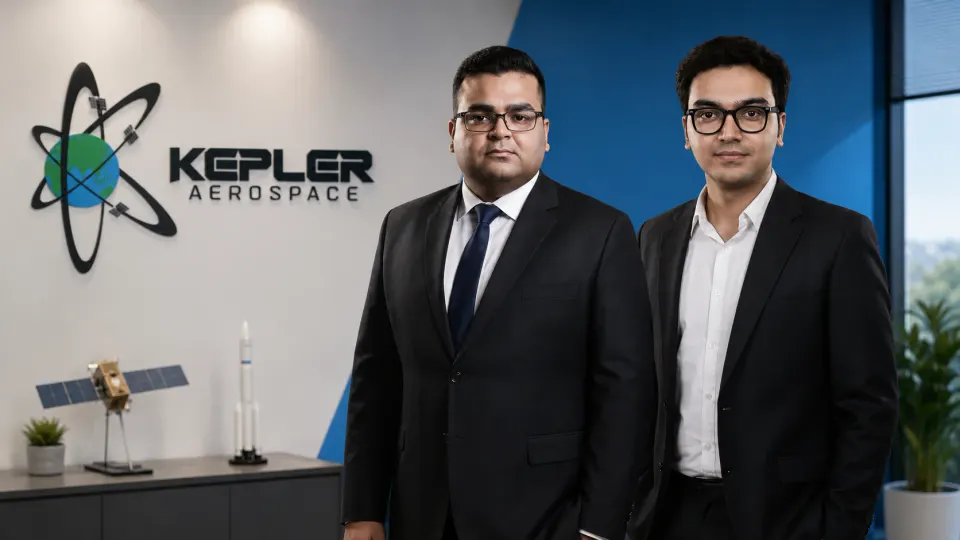
Navneet Singh and Kiran V. Sharma started the company after meeting at ISRO. Singh had worked on India's nanosatellite programme; Sharma worked on a lunar nano-rover project at Delft University of Technology in the Netherlands. Singh is chief executive, Sharma chief strategy officer.
The money is earmarked for six autonomous swarming ISR satellites — intelligence, surveillance and reconnaissance — being built under two iDEX Prime contracts with the Ministry of Defence, in coordination with the Defence Space Agency and Headquarters Integrated Defence Staff. Those programmes carry about $4 million in iDEX grants, and the constellation is scheduled to launch in December 2027. Kepler also plans to scale its mission operations and avionics-as-a-service lines, move to a new facility and add roughly 40 engineers over the next 12 to 24 months.
The pitch is latency. Kepler says the satellites will task themselves and coordinate with each other in orbit without waiting for ground instructions, carrying optical, thermal and RF payloads, and that this compresses the time from observation to usable intelligence from months to minutes. Nothing of the kind has flown yet.
The existing business is less exotic. Kepler operates a network of more than 70 ground stations providing tracking, telemetry, command and mission operations, and supplies components and satellite services for ISRO's 21 satellites under the Space Based Surveillance-III programme. It also ships components to buyers across the Global South.
Why It Matters
Read the round against what the company actually is, and the interesting number is not $8 million.
Kepler bootstrapped for seven years. Filed accounts show revenue of ₹1.48 crore for the year to March 2024 — a genuinely small company, with paid-up capital of ₹2.5 lakh. In July 2025 Singh told Orbital Today that revenue was running at ₹7.3 crore, roughly $850,000, and that he was in the market for $10 million. Fourteen months later Kepler closed $8 million. The FY25 accounts have been filed but are not public, so that jump rests on the founder's word. Either way, this is a business that grew into its raise rather than one that raised to find out whether a business was there.
What it built is infrastructure, not spacecraft. Seventy-plus ground stations, avionics, components — onboard computers, reaction wheels, inertial measurement units, S-band transceivers — and mission operations. These are the parts of a space programme nobody writes about and every operator needs. Kepler already sells into ISRO's SBS-III work. That is a services base with real customers, and it is exactly the position from which expensive hardware bets become financeable.
The iDEX contracts are the hinge. Two prime contracts plus about $4 million in grants means the Ministry of Defence has already funded roughly half the value of this round and committed to buying the output. For a spacetech seed, that is rare: demand risk substantially retired before anything reaches orbit.
Blue Ashva is not a tourist in the sector either. It backed Dhruva Space, another Indian satellite and ground-segment company, through its Series A, which suggests the fund understood what it was underwriting rather than buying a space story.
We're not just building satellites; we're creating an autonomous intelligence network. — Navneet Singh, founder and CEO, Kepler Aerospace
The Strategic Read
The risk is that everything Kepler has proved so far is on the ground.
Ground stations, avionics and components are a services business with a working track record. A six-satellite constellation flying an autonomous swarming architecture, where spacecraft task each other in orbit without ground control, is a different engineering problem, and Kepler has yet to fly one. The company said in mid-2025 that its first cubesat would reach orbit soon. A December 2027 target leaves roughly two years to build, integrate, qualify and launch six spacecraft carrying a capability nobody has demonstrated at this scale. Space schedules slip as a rule, and defence space schedules slip inside classification, where the market finds out late.
Eight million dollars is also thin for the stated plan. Six satellites, launch services, a new facility and 40 additional engineers is a great deal to carry on a seed round even with $4 million of grant money alongside it. The likely arrangement is that iDEX money and ISRO service revenue carry the constellation while the equity funds the team and the facility. That works only if the services business keeps growing on schedule. If launch slips, the equity is funding burn rather than milestones.
Customer concentration cuts both ways. The Ministry of Defence and ISRO are exceptional references and difficult cash flow. Defence procurement pays late, changes scope and rarely explains itself, and a company whose two largest customers are arms of the same government has limited leverage in either relationship. Component sales into the Global South are the diversification hedge, and they are small.
The market backdrop is genuinely favourable. India had roughly 440 registered spacetech startups as of August 2026, and SBS-III, cleared in October 2024, calls for 52 military surveillance satellites by 2029 with 31 of them coming from private firms. That is a defined, funded pipeline rather than an analyst projection, and it is the reason a company at Kepler's stage can raise at all right now.
The same pipeline is why Digantara raised $50 million at Series B, and why Pixxel, Dhruva Space and GalaxEye are all further up the capital curve. Kepler's advantage is that it is already inside the procurement system. Its problem is that it brought $8 million to a contest where the others brought several times that.
For daily, sharp analysis of the biggest moves in the Indian business and startup ecosystem, follow StartupFox.