



The Story
Zoppler Systems has raised ₹6.5 crore, about $0.7 million, in a round co-led by Finvolve and India Accelerator. The transaction was announced on 4 August 2026.
The valuation, the dilution, the split between the two investors and whether the company had raised previously have all not been disclosed. No board changes have been stated.
The company said the proceeds will go towards product development, field validation of its technologies, expanding engineering capabilities and scaling deployments across defence and dual-use sectors.
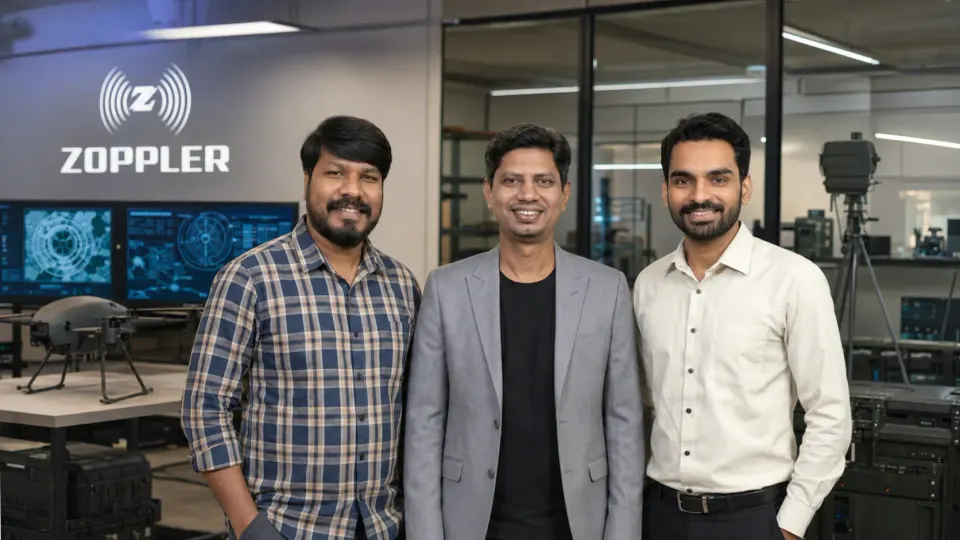
Zoppler Systems was co-founded in November 2024 by Om Rana, Prakash Ramachandra and Shridhar YB, and is based in Bengaluru. It develops RF sensing products alongside a vendor-agnostic decision and autonomy platform, with the two combined to handle sensing, intelligence and response. Its stated applications cover airborne, ground and naval domains, with space described as a future one. The company says its open architecture allows defence organisations to add sensing and decision intelligence to compatible existing systems rather than replacing them, and that beyond defence it sees uses in critical infrastructure, ports, airports, energy and logistics.
The reporting on this round is thin. The announcement carries no customer names, no contract or trial with any defence organisation, no revenue figure, no headcount and no prior funding history. The product description is the company's own and has not been demonstrated publicly. No other publication has covered the round, and Zoppler Systems has no meaningful press record before it.
Registry filings are not yet available. A company incorporated in November 2024 closed its first full financial year in March 2026, and those accounts have not reached the public record.
Why It Matters
The commercial argument Zoppler makes is about what a customer does not have to do. Defence organisations run equipment bought over decades, and the cost of a capability upgrade is rarely the sensor itself but the replacement of everything the sensor connects to. A vendor-agnostic layer that adds sensing and decision-making to systems already in service is a way around that, and it is the reason the company describes its architecture as open.
Selling it is the harder half. Defence procurement runs on trials, field validation and certification, not on product demonstrations, and the cycle from first contact to a signed order is measured in years. The stated use of proceeds reflects exactly that: field validation is named before scaling.
What a ₹6.5 crore round buys in that context is time to get through trials, not deployment at scale. Hardware development consumes capital before any of it returns, and a company 21 months old has not yet reached the point where an order would be expected.
None of the usual evidence is available. Zoppler has disclosed no customer, no trial with any service or agency, no revenue and no headcount. Nothing in the announcement establishes that the technology has been tested outside the company.
The Strategic Read
The investors are the most informative part of this announcement. Finvolve and India Accelerator have been assembling a defence and unmanned-systems portfolio together for some time, with Zulu Defence, IG Defence, Indrajaal and Integra Robotics among the shared names. India Accelerator has a vertical dedicated to robotics, unmanned systems and space. This is a thesis cheque from a pair that writes them regularly, not an outlier.
That thesis rests on Indian defence procurement shifting towards domestic suppliers, and on emergency and fast-track routes giving small companies a way in that did not exist a decade ago. Several of the co-investors' earlier bets have converted that into orders. Zoppler has not said whether it has.
Which is where the caution sits. A defence technology company is ultimately valued on trials passed and orders received, and this announcement contains neither. The retrofit positioning is commercially sensible and unverified. Nothing here establishes that the RF sensing products work at the standard a defence customer requires, or that any customer has agreed to find out.
For daily, sharp analysis of the biggest moves in the Indian business and startup ecosystem, follow StartupFox.