
 Fymble
The Story
Fymble has launched Kyra, an AI-powered Personal Health Companion inside its fitness app, which went live on 10 August 2026.
The launch represents a broader evolution in Fymble's proposition. The company began by addressing the access problem in fitness. Users can discover and access partner gyms on a pay-per-use basis, starting at ₹99 per session, without committing to an annual membership.
Kyra is designed to address what happens after access.
Instead of functioning as a conventional chatbot that simply answers questions, Kyra is designed to build an ongoing understanding of the user's health and fitness journey. It can converse in English and Hindi, help users plan workouts and nutrition, analyse food through photographs, track activity and workout behaviour, and provide personalised guidance based on the user's goals and progress.
The company also positions Kyra as a broader wellness companion. Depending on the information users provide, it can help track hydration, sleep and stress, support medication reminders, and help users understand medical reports. Fymble describes Kyra as a health companion rather than a medical service; it does not diagnose conditions or prescribe treatment.
Kyra also connects with Fymble's GymMate feature, which helps users discover compatible people training at the same gym and around similar schedules, adding a social and accountability layer to the experience. Kyra is available inside the Fymble app.
The underlying Fymble business continues to operate as a pay-per-use fitness marketplace. The company says it has more than 500 partner gyms, over 17,000 registered users and more than 1,600 bookings to date. Fymble also reports 50% retention at 30 and 60 days. These figures are company-stated and have not been independently audited.
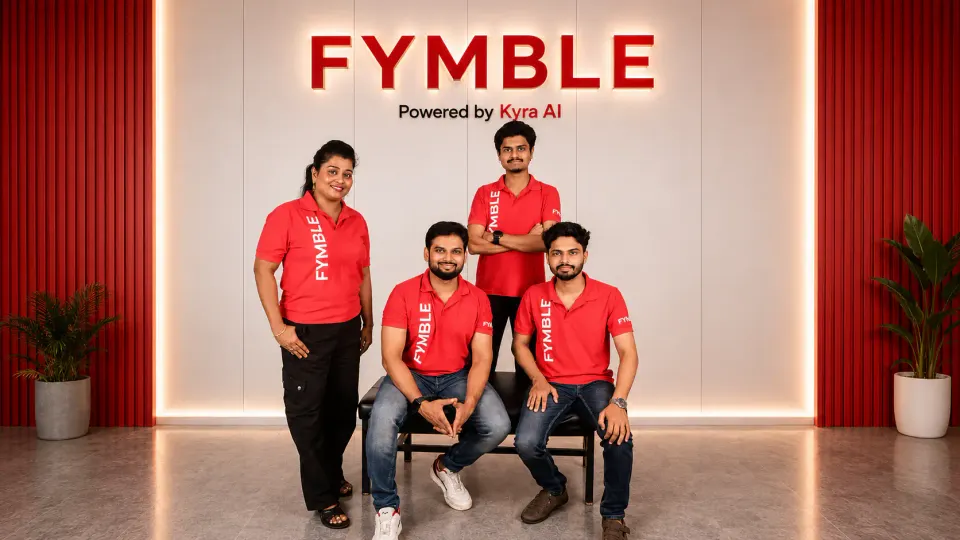
Fymble is operated by NFCTech Fitness Pvt. Ltd. and was previously known as Fittbot. It is led by four co-founders: Nishad Shaik, founder and chief executive, who brings more than 15 years of entrepreneurial experience across sales, marketing and operations; Shama Ara, co-founder and chief human resources officer, with professional experience at Wipro and ABB India; Naveen Kumar, co-founder and chief technology officer, previously at Vedanta Engineering and responsible for Fymble's technology and infrastructure; and Martin Raju, co-founder and chief information officer, who leads digital product development and technology execution.
Alongside its consumer marketplace, the company also operates Fymble Business, its gym management platform, which provides gym owners with tools for managing clients, trainers, memberships, day passes, session bookings and day-to-day operations.
Why It Matters
Fymble's proposition is built around a simple problem: getting someone access to a gym is relatively easy, helping them consistently follow through is much harder.
Traditional gym memberships often create a mismatch between what customers pay for and how they behave. Users may purchase a long-term membership with good intentions and then gradually stop attending. Fymble's pay-per-use model changes that equation. The company earns when users actually return and train, which makes repeat behaviour strategically important to the business.
Kyra is designed to operate at that point in the journey. Rather than treating fitness as a series of isolated transactions, the company wants the app to become an ongoing layer between the user's goals and their daily behaviour. A user can enter a goal, receive a personalised workout or nutrition plan, log activity, photograph a meal, ask Kyra questions, track progress and receive guidance over time. GymMate adds another accountability mechanism by connecting users with people training in similar environments and schedules.
The ambition is therefore larger than simply adding an AI chatbot to a gym marketplace. Fymble is attempting to combine physical fitness access, verified gym behaviour, social accountability and an AI health companion into a single consumer experience.
The interesting part of Kyra is not that it can generate another workout plan or answer another nutrition question. Those capabilities are increasingly easy to replicate. The more important question is whether an AI companion can make fitness guidance more contextual and continuous.
Fymble already operates at the physical point of fitness through its partner-gym network and QR-verified check-ins. Those interactions create a connection between what users say they want to do and what they actually do, and Kyra is being built on top of that broader behavioural context.
Over time, the company believes this can allow the AI layer to become more personalised: not simply telling a user what they should do, but understanding their goals, habits, activity patterns and progress, and using that context to provide more relevant guidance. That is a different proposition from a generic AI fitness chatbot.
The Strategic Read
Fymble's initial wedge is affordable and flexible access to fitness. Its longer-term proposition is personalisation and continuity.
The company is effectively building two connected layers: a marketplace that helps users access physical fitness infrastructure, and an AI layer designed to help them navigate the journey after they enter that infrastructure.
The marketplace also creates an important supply-side advantage. Gyms have fixed infrastructure and capacity, while Fymble can help them monetise unused capacity through pay-per-use access and provide operational software through Fymble Business.
The consumer side then adds another potential advantage: every physical check-in and interaction happens in the real world rather than only inside a fitness-content application. That creates a different data environment from an app that knows only what a user has typed into a chatbot.
However, the company's AI defensibility remains unproven. A conversational health companion, meal analysis and personalised recommendations can be replicated by larger technology and fitness companies. The harder asset to reproduce is likely to be the combination of local gym supply, physical user behaviour, verified check-ins and the accumulated behavioural context that can eventually make Kyra more useful.
The critical question now is whether Kyra can translate that context into measurable improvements in engagement, frequency and long-term fitness adherence. Kyra is newly launched, so that question remains open.
But the strategic direction is clear. Fymble is no longer positioning itself simply as a more affordable way to enter a gym. It is attempting to build a fitness ecosystem where access gets users started and an AI companion helps them continue.
More information on the company and its partner network is available at fymble.app, with the consumer app at fymble.app/download and the gym-owner platform at Fymble Business.
For daily, sharp analysis of the biggest moves in the Indian business and startup ecosystem, follow StartupFox.