



The Story
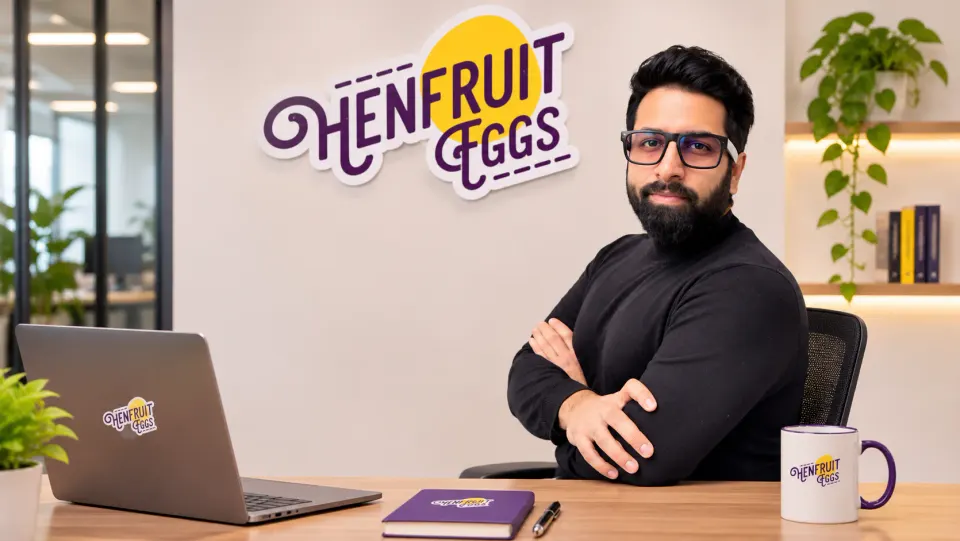
Henfruit, a branded egg company founded by Tarun Gupta in 2014, has raised $15 million (about ₹142.5 crore) in a Series A round co-led by Lok Capital, DSG Consumer Partners and RPSG Capital Ventures. It is the company's first external investment. Henfruit ran as a bootstrapped business for more than a decade, and Gupta has said he started it with ₹5 lakh borrowed from his father.
The company says it processes more than four crore eggs a month, serves consumers in 15 major cities and employs over 300 people. It says its scale has grown tenfold over the past three years and that it expects revenue to cross ₹350 crore in FY27. Figures Gupta shared earlier this year put revenue at ₹136.8 crore in FY25 and ₹210 crore in FY26. All of these are company-reported numbers.
Henfruit sells eggs that it says are produced without antibiotics or hormones. The eggs are washed and graded by machine, and the company says it tests them daily at in-house and independent labs, publishing the reports on its website. Its range runs from standard farm white eggs to higher-protein and cage-free variants.
The company says the money will go into expanding across India and adding production capacity, along with scaling its supply chain and widening online and offline distribution. It did not disclose a valuation, how the round was split among the three investors, or whether any existing shareholders sold. It also has not said what share of its eggs comes from its own farms.
Why It Matters
India's egg market is still overwhelmingly loose and unbranded. Most eggs reach kitchens unwashed and ungraded, and shoppers have little way of knowing how old an egg is or how the hen was raised. A branded producer charges a premium for removing that uncertainty, which is why Henfruit leads with hygiene and published lab reports rather than taste.
The premium has to cover real costs. Washing and grading lines are capital equipment, and daily lab testing is a recurring expense. Branded packs also need packaging and tighter distribution than eggs sold loose by the tray. Feed, the largest cost in egg farming, moves with maize and soybean prices, and a brand cannot pass every swing on to shoppers who compare its price with loose eggs at the corner shop.
Gupta has described Henfruit as taking charge of the chain from production to final delivery. If that means producing most of its own eggs, the company gets tighter control over feed and hen health, which is what its no-antibiotics claim rests on. It also ties up capital in farms and processing, and the round's emphasis on production capacity suggests that model will continue. Eggoz, the most heavily funded rival, went the other way, moving from owned farms to an asset-light network of partner farmers.
The Strategic Read
The investors are backing the view that eggs can follow packaged milk and become a branded staple in Indian cities, and that the leader will be whoever controls quality at scale. The syndicate fits that thesis. DSG Consumer Partners, a Singapore-based consumer specialist, has backed food brands such as Epigamia and Veeba. RPSG Capital Ventures is the consumer fund backed by the RP-Sanjiv Goenka Group, and it pitches access to the group's retail and FMCG network. Lok Capital is an impact investor whose remit includes food and agriculture.
What sets the round apart is the order of events. On figures the two companies have shared, Henfruit and Eggoz reported similar revenue in FY25, about ₹137 crore and ₹130 crore respectively. Eggoz has raised more than $32 million in total, while Henfruit had raised no outside equity until now. That points to a business that funded its growth from operations or debt, though Henfruit has not disclosed whether it is profitable.
The headroom is large, and so is the fragmentation. India produces more than 140 billion eggs a year. Henfruit's four crore eggs a month comes to well under 1% of that, and branded players together remain a small slice of the market.
The risks are structural. Egg prices are seasonal and volatile, and feed costs can squeeze margins quickly when maize prices rise. Bird flu outbreaks have repeatedly forced culls in Indian states, and a producer that owns its flock carries that risk directly. Branded eggs also compete with large integrated poultry companies, and quick-commerce platforms could push their own labels into the category.
Execution now shifts toward distribution. Eggs are fragile and perishable, so entering new cities means building supply close to each market rather than shipping from a single base. The ₹350 crore FY27 target implies growth of roughly two-thirds over the ₹210 crore Henfruit reported for FY26. Delivering that while adding capacity will test whether the discipline of the bootstrapped years survives a funded expansion.
For daily, sharp analysis of the biggest moves in the Indian business and startup ecosystem, follow StartupFox.