
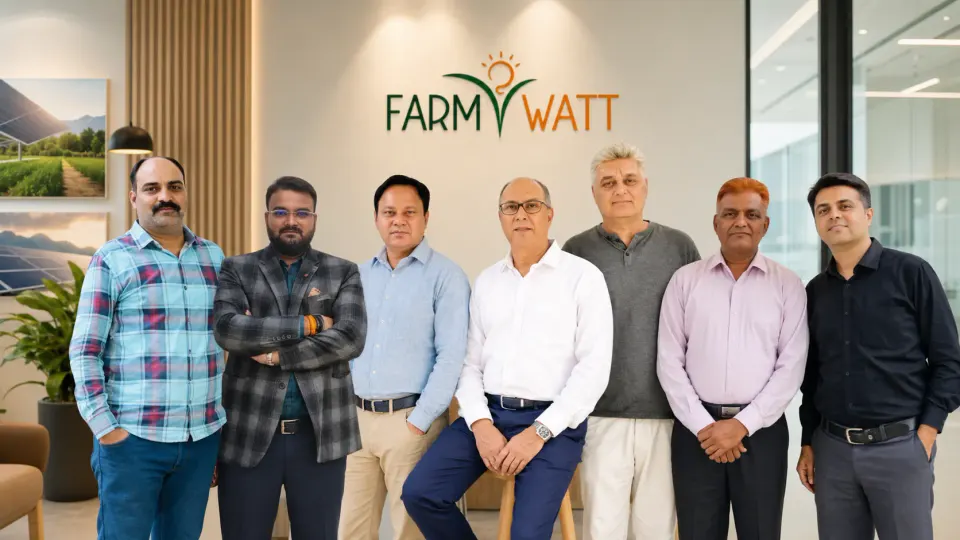

 Farm Watt Innovations
The Story
Farm Watt Innovations has raised ₹32.5 crore ($3.36 million) in a funding round co-led by IAN Alpha Fund and Rainmatter, the climate-focused agribusiness startup said in a statement. The round was announced on 23 July 2026.
The company has not disclosed the round's stage or label, the valuation, the pre- and post-money numbers, the split between the two co-leads, whether any existing investors participated, the instrument used, or how much equity the round represents. It has also not said whether this is its first institutional round or how much it had raised before.
Farm Watt said the capital will go into strengthening its biomass supply chain, expanding the collection network, building additional aggregation hubs, buying machinery and hiring. The company did not put a number against any of those five uses, and did not indicate how long the money is expected to last.
Founded in 2023 by Kumar Neelendu, Farm Watt aggregates agricultural biomass and supplies it to compressed biogas plants and other bioenergy facilities. The stated purpose is to give farmers an alternative to burning crop residue by turning that residue into feedstock for renewable energy projects.
The company said it currently operates 15 biomass aggregation hubs across six states. It did not name those six. The eleven states it says it intends to enter are Punjab, Haryana, Uttar Pradesh, Madhya Pradesh, Rajasthan, Chhattisgarh, Maharashtra, Andhra Pradesh, Telangana, Tamil Nadu and Bihar.
Beyond aggregation, Farm Watt said it plans to develop its own portfolio of CBG, bio-pellet and biochar plants. No timeline, capital requirement or site was attached to that plan. The company disclosed no revenue, tonnage handled, farmer count or offtake contract value.
Why It Matters
Biomass aggregation is a logistics business wearing a climate label. Crop residue is bulky, low in value per tonne and available for a few weeks after harvest. A CBG plant, by contrast, needs feedstock arriving all year at a predictable price. The gap between those two facts is the business. Farm Watt collects residue during the narrow window, stores and preprocesses it at hubs, and releases it to plants across the rest of the year.
That makes working capital, not technology, the binding constraint. Money goes out during harvest to buy residue from thousands of smallholders and comes back over the following months as plants draw down. Balers, tractors, trailers and covered storage sit against that cycle as fixed cost. The machinery line in the stated use of funds is the honest one: this is an asset-heavy business.
The margin sits between farmgate price and delivered price, less collection, baling, transport, storage loss and financing cost. Residue is heavy and cheap, so trucking economics cap the sensible radius around each hub. That is why hub count matters more than any national ambition.
Fifteen hubs across six states, after roughly three years, is a real operating footprint but a small one. Farm Watt has not published tonnage aggregated, price realised per tonne, hub utilisation or contracted offtake. Without those, the ₹32.5 crore round says an investor was persuaded. It does not establish that the unit economics at a single hub currently work.
The Strategic Read
The market assumption being underwritten here is that India's CBG buildout will outrun its feedstock supply, and that whoever owns the collection layer will be able to price accordingly. Refiners and gas marketers have announced CBG capacity; those plants are useless without residue turning up at the gate. Farm Watt is betting the shortage lands on the input side.
Earlier attempts at this problem approached it from the wrong end. Plant developers assumed feedstock would materialise near the site and discovered that buying from a few thousand marginal farmers, each with a small holding and no contract, is a field operation rather than a procurement one. Farm Watt is selling that field operation as a service.
Where value is created is narrow but defensible: relationships with farmers who have no other buyer for their residue, and the physical assets sitting close enough to the fields to make collection cheap. Neither is protected by patent. What protects it, if anything, is being the first buyer a village deals with and holding the storage capacity within economic trucking distance. That is a local moat, rebuilt hub by hub, not a national one.
The claimed expansion into eleven states should be read against that. Each new state means a different harvest calendar, different crops, different residue chemistry, different mandi structures and different state-level stubble rules. A hub in Punjab handling paddy straw does not transfer to Telangana.
The larger risk is the second announced ambition. Building owned CBG, bio-pellet and biochar plants moves Farm Watt from asset-light collection into capital projects with long payback, and puts it in competition with the customers it currently supplies. ₹32.5 crore does not fund a plant portfolio. It funds hubs. What the company does when those two priorities compete for the same balance sheet is the thing to watch.
For daily, sharp analysis of the biggest moves in the Indian business and startup ecosystem, follow StartupFox.