


The Story
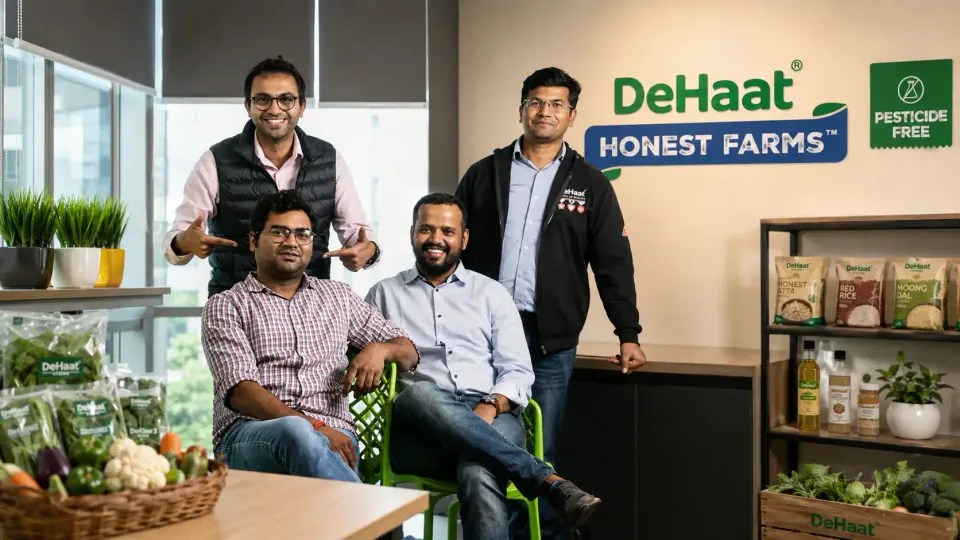
DeHaat Honest Farms has raised ₹35 crore in a pre-Series A round led by OTP Ventures, with participation from Sadev Capital and Maiuni Ventures. The round was reported on 17 August 2026.
The valuation, the dilution, the split between the three investors and the extent to which parent company DeHaat participated or was diluted have not been disclosed. Nor has any board change been stated.
The company said the proceeds will go towards geographic expansion, building category awareness for pesticide-free produce, and new product development.
Honest Farms is the consumer food brand launched by agritech company DeHaat. It sells pesticide-free staples, superfoods and everyday essentials, sourcing directly from DeHaat's farmer network. The company says it now offers more than 100 products, available in over 3,000 retail stores across more than 120 cities, alongside quick commerce and ecommerce platforms.
The business is led by Adarsh J Srivastava, a DeHaat co-founder and an alumnus of IIT (ISM) Dhanbad, who holds the chief executive role at Honest Farms. He was already described in that capacity in company communications earlier this year.
DeHaat itself was founded in Patna by Shashank Kumar, Amrendra Singh, Shyam Sundar Singh and Adarsh Srivastava, and provides agricultural inputs, advisory, financing access and market linkage to farmers through a franchise network of DeHaat Centres. It has raised around $221 million from investors including Sofina, Lightrock, Prosus Ventures, Peak XV Partners, Omnivore and FMO.
Honest Farms began as an internal project. DeHaat committed about ₹20 crore to it from mid-2022 and took it to market in 2024 with roughly 200 SKUs across pulses, rice and spices, working with about 5,000 farmers on pesticide-free cultivation. Monthly revenue was reported at around ₹3 crore at that point, growing 15% to 20% a month. The product range now cited, more than 100 items, is narrower than the launch count.
The farmer-network figure attached to this round, more than 13 million, is a company-stated reach number and is substantially larger than the roughly two million DeHaat reported in 2024. No revenue, order volume or profitability figure has been published for Honest Farms as a standalone business.
Why It Matters
Agritech in India has a structural margin problem. Aggregating produce from farmers and selling it to institutional buyers is a high-volume, low-margin trade, and DeHaat's own history shows it: turnover in the thousands of crores built on a business where most revenue passes through as the cost of the goods themselves. Scale arrives long before profit does.
A consumer brand is the standard escape route. The same grain that sells to a bulk buyer at a commodity price can carry a brand, a claim and a packet, and the gap between those two prices is margin the aggregator keeps. Honest Farms exists to capture that gap on produce DeHaat is already handling.
The specific claim it makes is pesticide-free, and the sourcing network is what makes that claim cheaper to substantiate than it would be for a brand buying on the open market. If the company already runs advisory services telling farmers what to apply to a crop, it can contract a subset of them to grow without chemicals and trace the output back. That traceability is the product, more than the rice is.
What the round funds is the expensive half. Pesticide-free staples cost more than ordinary staples, and a consumer has no way to verify the difference at the shelf, which means the brand has to be built through marketing rather than through the product speaking for itself. That is why category awareness is named alongside geographic expansion in the use of proceeds, and it is why the company appointed a creative and media agency earlier this year.
None of the economics are visible. Honest Farms has disclosed no revenue, no gross margin, no repeat purchase rate and no split between its retail, quick commerce and ecommerce channels. The last public revenue figure for the brand is around ₹3 crore a month, from 2024.
The Strategic Read
The most informative thing about this round is its structure. DeHaat has raised roughly $221 million and could have funded a ₹35 crore brand extension internally, as it did with the initial ₹20 crore. Instead the consumer business has taken outside capital at its own price, which means it is being built as a separate asset with a separate cap table rather than as a division.
That has consequences in both directions. It gives Honest Farms investors whose returns depend only on the brand, which tends to sharpen focus. It also means the parent has chosen dilution in the subsidiary over deployment of its own cash, and outside investors have chosen to price the brand rather than buy exposure to it through DeHaat. Neither party has explained the reasoning.
The market assumption being underwritten is that Indian consumers will pay a premium for verified pesticide-free staples. That is a real and growing preference in metro households, but staples are the most price-sensitive category in the basket, and organic and clean-label brands in India have repeatedly found that stated willingness to pay exceeds the actual kind.
Where Honest Farms has an advantage over a standalone clean-food brand is upstream. It does not have to find farmers, verify practices or build a supply chain, because the parent already has one. Where it has no advantage at all is downstream: on a shelf next to Tata Sampann or a private label, it competes on brand and price like anyone else, and 3,000 stores is a modest footprint in a category where distribution is measured in lakhs of outlets.
The number that will settle this is one nobody has published: what a packet of Honest Farms rice sells for against the equivalent unbranded grain, and how many households buy it twice.
For daily, sharp analysis of the biggest moves in the Indian business and startup ecosystem, follow StartupFox.