


The Story
Balwaan Krishi has raised ₹100 crore in a Series B round led by First Bridge India Growth Fund Private Equity, with other institutional investors participating.
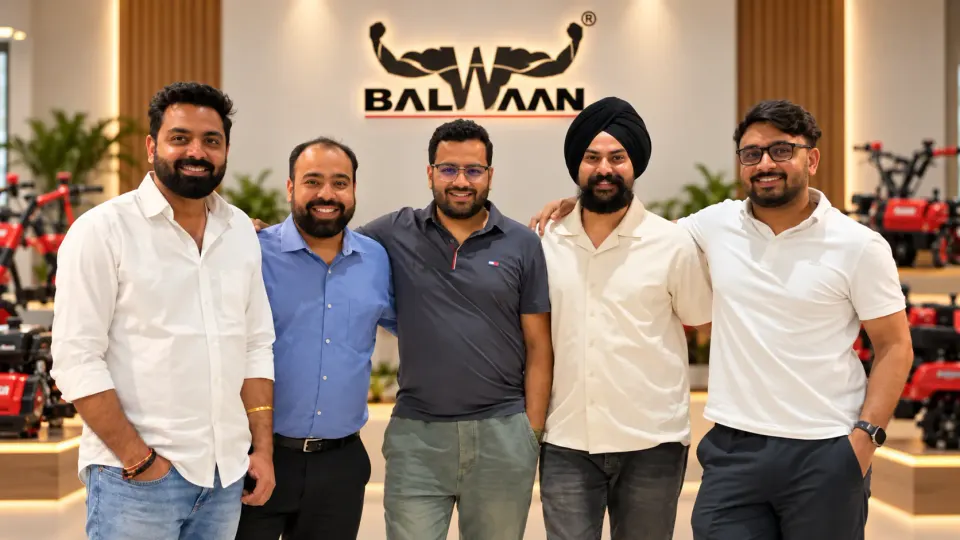
The Jaipur company makes small farm equipment for Indian conditions: brush cutters, power weeders, sprayers, water pumps, tillers, augers and chainsaws, priced between ₹10,000 and ₹1 lakh. Brothers Rohit and Shubham Bajaj founded it in 2016, operating through Modish TractorAurKisan Private Limited, and it says more than four lakh farmers use its equipment.
The money goes towards three things: expanding domestic manufacturing capacity, strengthening dealer and service networks in Southern India, and developing equipment with predictive maintenance and IoT capability, including power weeders and battery sprayers. A significant portion is earmarked for manufacturing in India, which the company says will reduce its dependence on imported machinery and components while giving it more control over product quality, supply chains and availability.
The company points to roughly 86 percent of Indian farmers being small and marginal, cultivating under two hectares each, as the segment its pricing is built around. It sells through a hybrid B2B and B2C model with more than 800 dealers across Northern India alongside e-commerce channels, and has partnered with platforms including BigHaat, Moglix and Tractor Junction. It operates a manufacturing hub in Jaipur with regional warehouses positioned against crop cycles, and was the first Indian company to launch ISI-marked agricultural power equipment.
The round follows a ₹40 crore Series A from JM Financial Private Equity in June 2024, which was also directed at product development and expansion into Southern India, and a $2 million pre-Series A led by Caspian's Leap for Agriculture Fund in May 2023.
Capital has been moving across agricultural machinery and supply chains. Electric tractor company Moonrider raised $6 million from Pi Ventures and Singularity AMC last year, Harvested Robotics took ₹5 crore from Arali Ventures with Anand Mahindra participating, and Tractor Junction raised $22.6 million in a Series A led by Astanor.
Why It Matters
India's farm mechanisation story is usually told through tractors, and tractors are the wrong lens for most of the people farming here.
About 86 percent of Indian farmers work under two hectares. On a plot that size a tractor is not merely expensive, it is often the wrong tool: too large to manoeuvre, too costly to justify against the yield, and idle for most of the year. The mechanisation those farmers actually need is smaller and cheaper. A brush cutter to clear a field that would otherwise take three days of hired labour. A power weeder. A battery sprayer that does in an hour what a knapsack does in a morning. Equipment between ₹10,000 and ₹1 lakh, which is roughly the range Balwaan sells in.
That gap has widened rather than closed, because the economics underneath it have shifted. Agricultural labour has become scarcer and more expensive across much of India as workers move to construction and services, and the cost of hiring hands for weeding or clearing has risen faster than crop prices. A farmer who once had cheap labour and no machine now has neither cheap labour nor an affordable alternative. That is the pressure this category sells into, and it is the reason a machine costing a season's hired labour is a straightforward purchase rather than an aspirational one.
The harder part of the business is not the product. It is that these buyers are dispersed across tens of thousands of villages, buy in bursts tied to crop cycles, and will not order a ₹15,000 machine online from a brand nobody in the district has heard of. Which is why the dealer count matters more than the product catalogue: 800 dealers across the North is the asset, and a farmer's decision usually comes down to whether the shop that sold it will fix it.
That also explains why the company has taken money from agriculture-focused and private equity investors rather than conventional venture funds. Building this business means adding dealers, holding stock near crop cycles and running service networks, which grows steadily and physically rather than exponentially. It is an unglamorous way to reach four lakh farmers, and it is the only one that works.
The Strategic Read
The line about reducing dependence on imported machinery and components is the most consequential thing in this announcement, and it is doing more work than it appears.
Small agricultural power equipment in India is overwhelmingly assembled from imported parts, principally Chinese engines, carburettors and gearboxes. A brush cutter sold under an Indian brand is frequently an imported engine in a locally made frame. That arrangement works while the rupee is stable and shipping is cheap, and it exposes the seller on three fronts when it is not: landed cost moves with the exchange rate, availability moves with somebody else's factory schedule, and quality is whatever the supplier shipped that quarter. For a company whose customer is buying a ₹15,000 machine on thin margins and judging it entirely on whether it still runs next season, the third is the one that decides the brand.
Moving that in-house is expensive and slow, which is why ₹100 crore is going into it rather than into marketing. It is also the only way a company at this price point builds anything durable, because a brand assembling the same imported parts as everyone else has no defence when a cheaper assembler appears.
The Southern India push is the other half, and it is a harder problem than the announcement suggests. Balwaan has more than 800 dealers, and they are in the North. Agricultural equipment does not travel well across that divide: crops differ, plot sizes differ, the machines farmers need differ, and dealer relationships are built over years by people who speak the language and know which villages buy in which season. The Series A in June 2024 was also earmarked for Southern expansion. That the Series B lists it again suggests the work is still substantially ahead of the company rather than behind it.
What is notable is the shape of the investors. A pre-Series A from an impact-linked agriculture fund, a Series A from JM Financial Private Equity, and now a Series B from a growth fund. This is not a venture capital cap table, and it should not be. A manufacturer selling physical machines through dealers to farmers grows at the rate it can build capacity and sign distributors, which is nothing like a software growth curve. Private equity money at ₹100 crore is priced against that reality, and its presence says the company has the kind of revenue and margin profile those funds underwrite.
What has not been disclosed is what that profile actually is. No revenue, margin or unit figures have been published with this round, and reported estimates for the business vary widely enough that none of them is worth repeating. For a company nine years old raising at this size, the numbers would settle a great deal.
The IoT and predictive maintenance line deserves the most scepticism. Connected features on a ₹15,000 brush cutter have to justify their cost to a farmer who is buying on price and durability, and predictive maintenance only matters if there is a service network to act on the prediction. That makes it dependent on the dealer expansion rather than separate from it, and the sequencing matters: service first, sensors after.
For daily, sharp analysis of the biggest moves in the Indian business and startup ecosystem, follow StartupFox.