

The Story
Amaani has raised $5 million in a Series A round led by BECO Capital, with Homegrown Ventures and Peak XV's Surge participating. It takes total funding to $8 million, after a $3 million seed round from Surge last year.
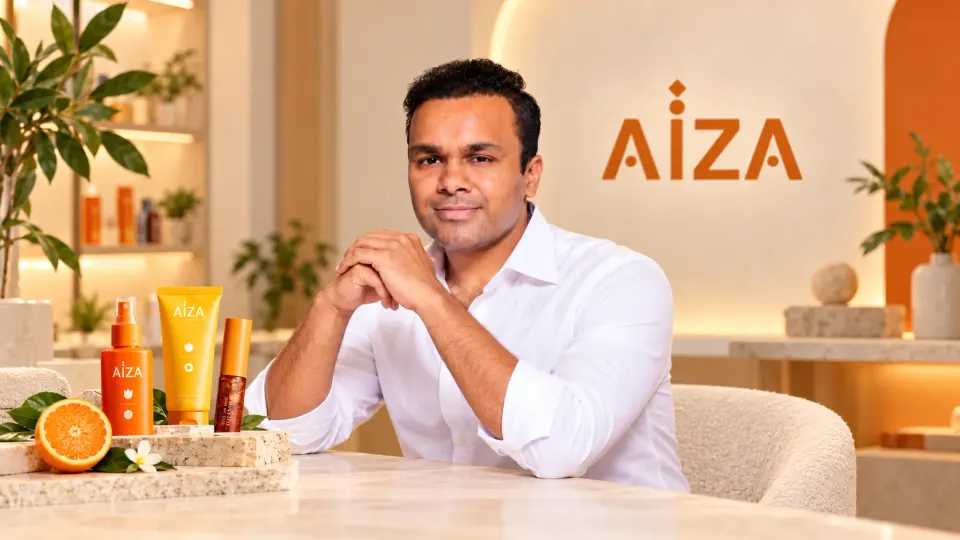
The Dubai company was founded in 2023 by Shubham Poddar and owns AÏZA, a skincare and haircare brand launched in December 2024. Its products draw on ingredients and beauty practices from the Arab world, including dates, black seed, frankincense, rose and bakhoor, with formulations developed in laboratories in Korea, Japan and Italy.
Hero products include the Sukkar Rush lip treatment, Scent Storm hair mist and Date Setter brow and lash serum. The range is vegan, cruelty-free and alcohol-free, and meets Clean at Sephora standards.
The company says AÏZA's net revenue grew more than ninefold year on year in the first half of 2026 as it moved from an online-first model into retail. It sells through its own website, Ounass and Ulta Beauty in the UAE, where it says it ranks among the top ten brands out of more than 300 global and regional names carried.
The capital funds expansion across the Gulf Cooperation Council, with Saudi Arabia the immediate priority. The brand is due to launch at Ulta Beauty stores in Jeddah and Riyadh by the end of September, with Kuwait and Qatar planned for the fourth quarter.
It competes with Huda Beauty and Kayali, both founded by Huda Kattan and built from Dubai, and with The Giving Movement.
Why It Matters
The ninefold growth figure needs its starting point attached.
AÏZA launched in December 2024. The first half of 2025, against which the first half of 2026 is being measured, covers the brand's first six months of existence. Growing nine times from a base that small is a different achievement from growing nine times from an established one, and the absolute revenue has not been disclosed.
What the figure does indicate reliably is direction, and the direction matches the distribution. A brand selling only through its own website grows at the speed of its advertising budget. A brand carried by Ounass and Ulta Beauty grows at the speed of footfall in stores it does not pay for. Multiplying revenue ninefold during exactly that transition is consistent with shelf space doing the work.
That distinction matters more than it might appear. Indian beauty brands attempting the same move have generally built their own stores, and the results this year have been instructive. Sugar Cosmetics shut 30 to 40 per cent of its newly opened outlets after per-store losses, and raised in September at roughly a quarter of its 2022 valuation.
AÏZA is not doing that. Ulta and Ounass carry the leases, the staff and the fit-outs. The risk shifts from fixed cost to competition for shelf space, which a brand can survive in a way it often cannot survive a store network.
The Strategic Read
The more interesting thing about Amaani is where it chose to build.
Shubham Poddar founded the company in Dubai in 2023, and its first institutional backer was Peak XV's Surge, the early-stage arm of what was Sequoia Capital India. An Indian founder, an India-anchored fund, and a business built entirely for Gulf consumers.
That reads as a rational allocation rather than an accident. Per-capita beauty spending in the GCC sits far above India's, price sensitivity is lower, and retail is concentrated in a handful of malls and platforms rather than spread across millions of small stores. A brand can reach a meaningful share of the addressable market in Saudi Arabia and the UAE through a few retail relationships. Doing the equivalent in India requires either enormous advertising spend or a distribution network that takes years to assemble.
The positioning follows the same logic. Dates, black seed, frankincense and bakhoor are not exotic ingredients in the Gulf. They are familiar ones, which is exactly why a brand built around them can claim a cultural authority an imported Korean or French label cannot. Huda Kattan proved the model works, twice.
The tension worth watching sits between that story and the supply chain behind it. The ingredients and the narrative are Arab. The formulation work happens in Korea, Japan and Italy. That is standard for modern beauty, where almost nobody manufactures their own product, but it means defensibility rests entirely on brand and distribution rather than on anything a competitor could not replicate using the same contract labs.
Which is why the Ulta shelf in Jeddah matters more than the ingredient list. In a category where the formulation can be copied, the durable asset is the retail relationship and the position held on it.
For daily, sharp analysis of the biggest moves in the Indian business and startup ecosystem, follow StartupFox.