
 Safebox
The Story
Safebox has raised $1.11 million, about ₹10.5 crore, in a seed round led by a family office, with angel investors participating including Sekhar Garisa, managing director at Claypond Capital, investing in a personal capacity. The lead investor has not been named.
The company builds what it calls wealth protection: a single record of a family's financial life, so information about what they own does not sit scattered across institutions, files and one person's memory. It is built on the RBI's Account Aggregator framework, which pulls in bank accounts held across multiple phone numbers, portfolios across multiple PANs, stocks, ETFs, EPF from multiple employers, NPS, insurance and liabilities through consent-based, read-only rails. Every holding is mapped to a nominee, so families can see which designations are current and which are years out of date, and a spouse or relative can be given access to locate what they need in an emergency.
The idea came from a near-fatal accident involving two of the founders. The question that followed, as they describe it, was administrative rather than dramatic: if they had not survived, would their families have even known what they owned. They went looking for a product that answered it and could not find one.
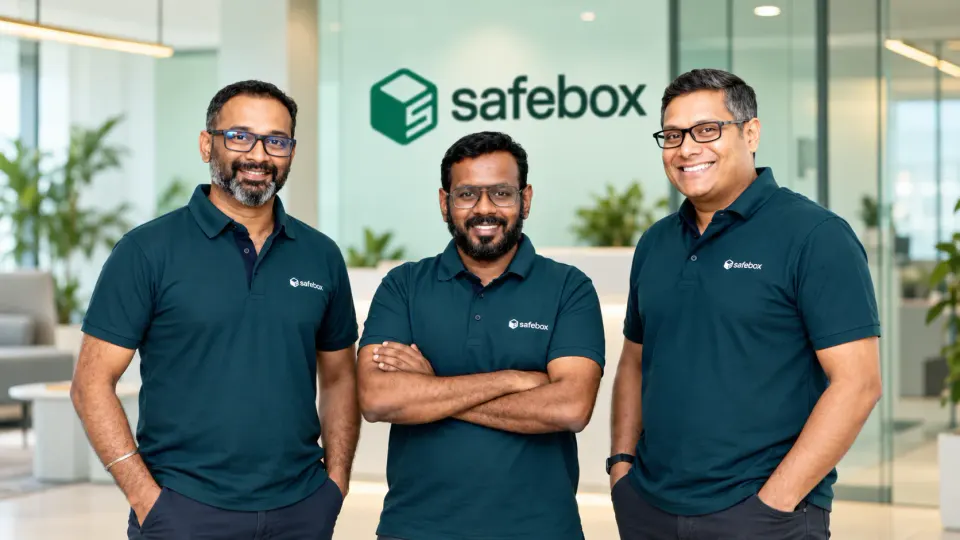
Vijay Veera, Vignesh Rengasamy and Rajesh Sankarappan founded the company. The three are childhood friends and serial entrepreneurs, and Safebox is their third venture together after earlier companies in India and the United States. Veera is chief executive, Rengasamy chief product and technology officer, and Sankarappan chief operating officer.
Safebox operates through BeyondCo Technologies Private Limited, registered with SEBI as an Investment Adviser. The company stresses that it is designed for visibility rather than transaction access: it can see what a family owns but cannot move, trade or touch it.
It launched publicly in June 2026 and says it has since recorded more than ₹6,000 crore of family assets across 55 categories, growing largely through word of mouth and family invites.
The money goes towards product and distribution. On product, that means more institutional integrations for automated data ingestion and AI-assisted capture for holdings that still have to be entered manually. On distribution, partner networks and corporate tie-ups to reach families through institutions they already trust. A share is allocated to security, covering encryption, access controls, independent audits and compliance certification.
The company points to ₹86,917 crore lying unclaimed in the RBI's Depositor Education and Awareness Fund, a figure that covers bank deposits alone.
Why It Matters
₹86,917 crore is sitting in the RBI's Depositor Education and Awareness Fund, which is where bank deposits go when nobody has touched them for a decade. That is bank deposits alone. It does not count mutual fund folios nobody redeemed, insurance policies nobody claimed, shares transferred to the Investor Education and Protection Fund, or provident fund accounts left behind at employers people stopped working for fifteen years ago.
The instinctive explanation is that families were careless. The more accurate one is that nobody ever had a list. An Indian household's wealth is unusually scattered by international standards: bank accounts opened against different phone numbers over the years, demat accounts under more than one PAN, EPF balances at four former employers, an insurance policy sold by a relative, gold in a locker, a plot bought in another state, a chit fund, a loan given to a cousin. Most of that exists in one person's head, and that person is usually the one who earned it.
When that person dies or becomes incapacitated, the family does not inherit a portfolio. It inherits an archaeology problem. Nominee details are frequently decades out of date, naming a parent who has since died or a spouse from before a second marriage. Documents live in a file nobody can find. And the institutions themselves have no obligation to come looking: a bank does not know its customer has died, and a mutual fund does not write to the family.
India has built extraordinary infrastructure for the other half of this. UPI, demat accounts, the whole apparatus of digital investing, and more than forty apps to help someone grow their money. Almost none of it helps a family keep track of what has already been accumulated, and the Account Aggregator framework, which went live in 2021 and lets a person share financial data across institutions with consent, is the piece that finally makes the record side buildable. Before it, a product like this meant screen-scraping or asking people to type everything in.
That is the shift the founders walked into. Their own version of the question was sharper than most: two of them survived a crash and realised that the honest answer to what their families would have found was, nobody quite knew.
The Strategic Read
The number that will get repeated is ₹6,000 crore of assets recorded, and it is worth being precise about what it is not.
A wealth manager with ₹6,000 crore under management earns a fee on it. A record-keeper with ₹6,000 crore under record earns nothing from the figure at all. It is a measure of trust and adoption rather than revenue, and it tells you families are willing to put their financial lives into the product, which for a three-month-old launch is the right thing to be measuring. But it should not be read as scale in the way an AUM number would be, and Safebox has not disclosed what it charges anyone.
The SEBI Investment Adviser registration is the clue to where that might go. A company that only kept records would not obviously need one. Holding an IA licence permits charging advisory fees, and a platform that can see every holding a family owns, including the ones scattered across forgotten employers and old PANs, is unusually well positioned to advise on them. Whether Safebox monetises through subscription, advice, or distribution partnerships is the open commercial question, and the licence suggests the second is at least available.
The harder product problem is staleness, and it is the one that has killed this category repeatedly elsewhere. A financial record is only worth anything if it is current. The Account Aggregator rails solve that for everything they cover, because the data refreshes itself. What they do not cover is a long list: physical gold, property, unlisted shares, private loans, jewellery, foreign assets, the locker key, the plot of land in another state. Those are exactly the holdings that go missing in Indian families, and they are also the ones that require somebody to sit down and type them in, then remember to update them. Safebox knows this, which is why AI-assisted capture is a stated priority. The company that makes manual entry genuinely effortless wins this category, and nobody has managed it yet.
Then there is the thing that is simultaneously the product's value and its largest risk. Safebox holds a map of what a family owns and where. That is not money, and the read-only rails mean nobody can move anything, but it is arguably a more attractive target than money: a structured list of households and their net worth. The company addresses this directly and has allocated part of the round to security, which is the correct response. It also means a single serious breach would not damage the product so much as end it, because the entire proposition is trust.
What is genuinely well-judged is the distribution plan. This is a product people should have and will not go looking for, in the same category as a will or term insurance. Reaching families through advisers, employers and institutions they already deal with is how those products get sold, and building partner networks rather than buying app installs is the right instinct for something nobody wakes up wanting.
For daily, sharp analysis of the biggest moves in the Indian business and startup ecosystem, follow StartupFox.