
 Airbound
The Story
Airbound, a Bengaluru-based aerospace startup, has raised $37 million in a Series A funding round led by Greenoaks, with participation from DoorDash, Lachy Groom, Lightspeed and Humba Ventures. The round was announced on 25 August 2026.
The company did not disclose a valuation, the equity diluted, or the split between primary and secondary capital. The round takes Airbound's total funding to nearly $50 million since 2023, including an $8.65 million seed round led by Lachy Groom in October 2025. The company said the capital will fund engineering, commercial-scale manufacturing and go-to-market efforts.
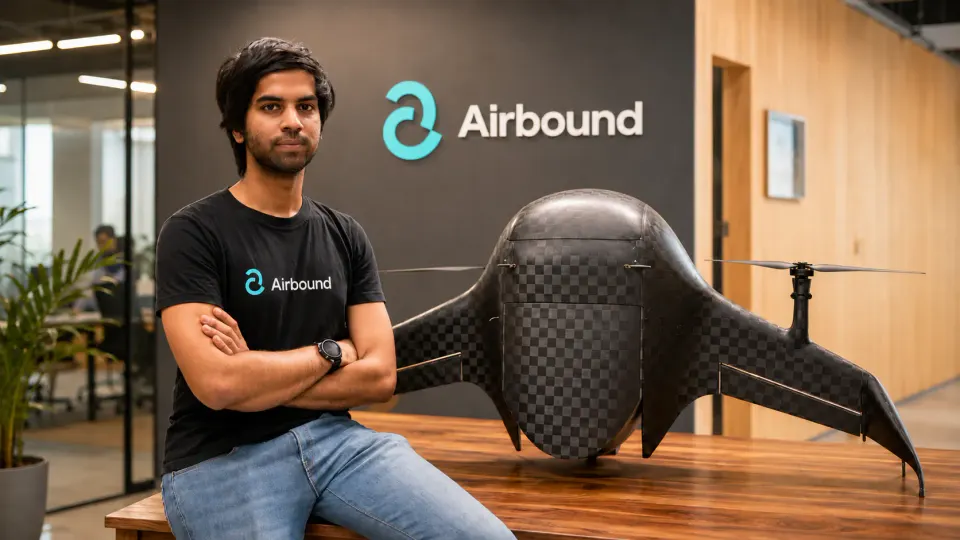
Founded in 2023 by Naman Pushp, Airbound develops lightweight autonomous aircraft designed to move goods at a lower cost than conventional aircraft. Its legal entity, Airbound Aerospace Private Limited, was incorporated in Bengaluru in October 2021. Pushp is the chief executive; company records also list Yashi Pushp as a co-founder, while an earlier co-founder, Muzavar Faraaz Baig, has since moved on.
The technical premise is specific. Conventional aircraft spend most of their energy carrying their own weight rather than their payload, which makes flight expensive for small loads. Airbound builds vertical-take-off tail-sitter drones engineered to weigh less than the cargo they carry: its current craft, called TRT, weighs about 1.5 kg and carries roughly 1 kg, and the company says a next-generation model will weigh about 2.99 kg and carry up to 4.9 kg. The stated aim is cost parity with trucking.
Airbound positions itself as an aircraft manufacturer rather than a delivery company, with Pushp likening the role to Boeing supplying airlines rather than operating flights. It designs and manufactures in a 43,000 sq ft facility in Bengaluru, keeping the airframe and core systems in-house.
The company said it has completed more than 13,000 autonomous flights across Bengaluru and Guntur, including over 1,000 with Narayana Health, flying diagnostic samples between facilities. It has also signed a commercial deployment agreement with the Andhra Pradesh government to connect Amaravati, Vijayawada and Guntur, with a stated goal of scaling to 10,000 daily flights across retail, ecommerce and healthcare. These figures are company-stated.
Why It Matters
Airbound is attacking a cost problem that has kept drone delivery stuck in pilots. The appeal of delivering by air is speed; the obstacle is money. A conventional drone spends most of its energy lifting its own airframe, motors and batteries, so carrying a small package costs far more per kilogram than a two-wheeler on the road. Until that inverts, drone delivery stays a demonstration rather than a business.
Airbound's answer is an aircraft engineered around payload rather than around the aircraft. Its tail-sitter drones take off vertically like a rotorcraft, then fly horizontally like a fixed-wing plane, and are designed to weigh less than the cargo they carry, a ratio the company says conventional designs cannot match. The current TRT model weighs about 1.5 kg to carry roughly 1 kg; a next-generation craft is designed to weigh about 2.99 kg and carry up to 4.9 kg. Lowering the weight the aircraft must lift to move a given load is the whole cost argument.
The business model follows from that engineering. Rather than run deliveries, Airbound wants to manufacture and sell the aircraft to logistics operators, the role Pushp compares to Boeing supplying airlines. That keeps the company out of the low-margin, operationally heavy delivery business and positions it to earn from many operators' networks at once, provided the aircraft is good enough that operators standardise on it. It builds in-house at a 43,000 sq ft Bengaluru facility, holding the airframe and core systems as the part it must own.
However, the reported flight count does not by itself prove the economics. More than 13,000 autonomous flights shows the aircraft works and is being flown, but the company has not disclosed per-flight cost, production capacity or how many craft it has built, and cost parity with trucking, the entire premise, remains a claim rather than a demonstrated unit economic.
The Strategic Read
The market assumption changing behind this round is that drone delivery has been solving the wrong problem. Most of the sector has focused on autonomy software and route networks while flying conventional multi-rotor drones that burn most of their energy lifting themselves. Airbound's bet is that the constraint is physical, not digital, and that redesigning the aircraft to weigh less than its cargo is what finally makes the economics work. If that premise holds, it is a more durable advantage than a logistics network, because it is an engineering property competitors cannot copy by raising a bigger round.
The "Boeing, not the airline" positioning is the strategically interesting choice and the one that carries the most risk. By selling aircraft to logistics operators rather than running deliveries itself, Airbound aims for a capital-lighter model that rides on others' Swiggy- or Amazon-scale demand rather than building its own. That multiplies the potential market, but it also means the company has to win over sophisticated operator-customers on hard performance and unit-cost data, not consumer marketing, and it has disclosed neither its production capacity nor its per-flight cost. The vision is coherent; the evidence that the aircraft hits cost parity with trucking is, so far, the founder's assertion.
The traction is real but narrow. More than 13,000 autonomous flights is a genuine operating record for a three-year-old hardware company, but the flagship Narayana Health deployment runs a single drone on one 2.5-mile route. The gap between one aircraft flying diagnostic samples and the 10,000 daily flights promised in Andhra Pradesh is enormous, and it is a gap of manufacturing scale, airspace management and reliability all at once. A government deployment framework is a strong signal of intent, not booked revenue, and the history of Indian drone-delivery pilots is that scaling from demonstration to network is where most stall.
The binding constraint is regulation, which the founder names directly: beyond-visual-line-of-sight approvals. Every ambition here, the AP network, the 10,000 flights, the eventual passenger vision of a 300 km hop in 20 minutes, depends on BVLOS certification that India is still building the framework for. Airbound can control its physics and its factory; it cannot control the pace of the regulator, and that is the largest execution risk. A well-funded aircraft company can still be grounded by an approval timeline, and $37 million buys the runway to build the fleet, not the certainty that it will be cleared to fly it at scale.
For daily, sharp analysis of the biggest moves in the Indian business and startup ecosystem, follow StartupFox.