


The Story
Vingo has raised ₹10 crore, about $1 million, in a seed round led by India Quotient. Inuka Capital and Credgenics founder Rishabh Goel also participated. The round was announced on 5 August 2026.
The valuation, the dilution and the split between investors have not been disclosed.
The company said the proceeds will go towards its product, trust and payment infrastructure, studying user behaviour and marketing across key user groups.
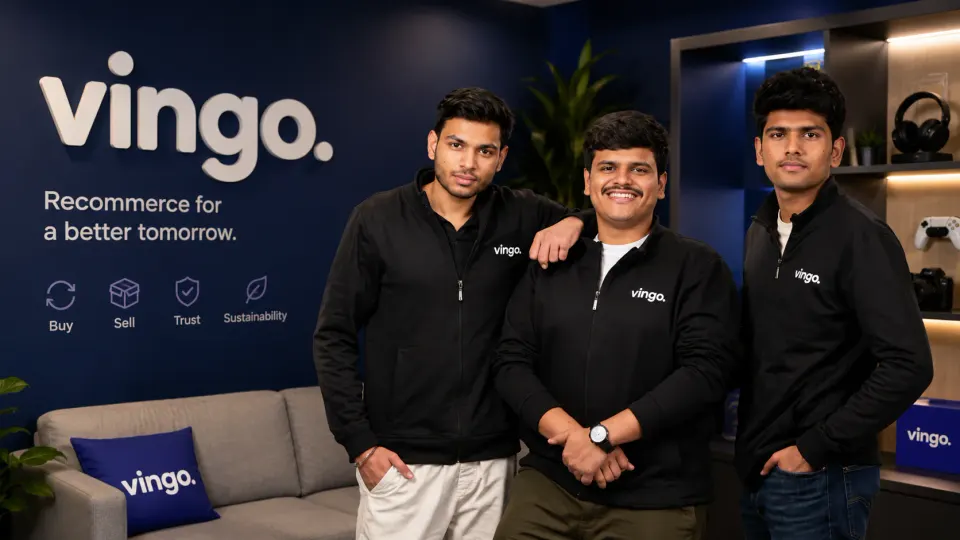
Vingo was founded in March 2026 by Parth Sarthi, Krish Vashistha and Saransh Goyal, making it five months old at the raise. Sarthi is chief executive and a BITS alumnus; Vashistha is chief product officer and Goyal chief business officer, both from IIT Delhi. The three previously spent two years building Genme, a venture they wound down earlier this year before starting Vingo.
The platform lets users buy and sell pre-owned products directly, combining identity verification, community-based discovery, escrow-backed payments and bidding. Categories include smartphones, cameras, gaming consoles, musical instruments, fashion and sports equipment. The company says it operates in Bengaluru and is available on Android and iOS, though its own website still describes the product as coming soon.
The announcement cites market research projecting India's recommerce market growing from $5.91 billion in 2026 to $8.61 billion by 2030. That is a third-party forecast for the whole category, not a statement about Vingo's addressable market or its position in it.
No user numbers, listing volumes, transaction counts or revenue have been published.
Why It Matters
Second-hand trade in India already works. It happens in WhatsApp groups, housing society chats and Facebook communities, and it works because everyone in the group is identifiable to everyone else. The seller lives in the same building. That is the trust mechanism, and it is why those groups have survived every attempt to move the activity onto a platform.
The cost of that arrangement is reach. A camera listed in one housing society reaches a few hundred people, most of whom do not want a camera. Vingo's proposition is to keep the trust and widen the pool, which is what identity verification, escrow and bidding are collectively for. Money is held until the transaction completes, so a stranger becomes as safe to deal with as a neighbour.
Where the money comes from is not stated. C2C marketplaces monetise through listing fees, transaction commission, promoted placement or payment margin, and each choice changes the product. Vingo has disclosed none of them, which at five months old is unsurprising but leaves the business model entirely unspecified.
The harder constraint is liquidity. A marketplace with verified identities and no inventory is not useful, and every category has to reach critical density independently: cameras do not help someone selling a guitar. Operating in one city concentrates that problem sensibly, and ₹10 crore is roughly the right size to find out whether one category in one city can be made to work. Nothing published so far shows whether it has.
The Strategic Read
The assumption being underwritten is that C2C resale in India is unsolved rather than unwanted. The demand is demonstrably there, transacted daily in WhatsApp groups and housing society chats, and the founders have said publicly that this is where they did their research. What has not existed is a product that carries the trust those groups supply socially.
That is a real gap and a well-defended one. OLX and Quikr occupied this category for over a decade and neither built escrow or verified identity at scale, which suggests the problem is harder than it looks rather than that nobody thought of it. Escrow on used goods means adjudicating disputes over condition, and adjudication is expensive per transaction on items worth a few thousand rupees.
The wider recommerce market is also not really the comparison. Most of that $5.91 billion figure is refurbished electronics sold by businesses, where a company takes ownership, certifies the device and offers a warranty. Vingo is doing the harder, thinner version: staying out of the transaction while guaranteeing it.
What India Quotient is buying at this size is the team rather than the traction. The three founders spent two years on Genme, shut it, and turned immediately to this. A seed cheque five months after founding, into a single city, with no metrics disclosed, is priced on the assumption that people who have already failed once at building something will build this faster.
The number that will settle it is liquidity per category, and nobody has published it. A marketplace works when a seller in Koramangala can list a camera and find a buyer within days. Until Vingo shows that in one category in one city, the platform is a set of trust features looking for a market that already routes around it.
For daily, sharp analysis of the biggest moves in the Indian business and startup ecosystem, follow StartupFox.