



The Story
Valar Atomics has raised $1 billion in equity in a round led by Sequoia Capital, alongside a $200 million line of credit from Erebor and other banks. Founder and chief executive Isaiah Taylor announced the round on 3 August 2026, and Sequoia partner Shaun Maguire joins the board.
The company did not disclose a valuation. Bloomberg reported the transaction values Valar at $6 billion including the money invested. Neither the dilution, the split between primary capital and any secondary purchase, nor the terms of the credit facility have been made public.
One further ambiguity sits in the headline number. When the round was first reported in July, part of the $1 billion was described as having been raised earlier at a lower valuation. Valar was reported in March 2026 to have raised about $450 million, $340 million in equity and $110 million in debt, at a $2 billion valuation. Whether that capital sits inside this $1 billion or beside it has not been clarified, and the difference is roughly a third of the total.
Other participants include Apandion Capital, Atreides Management, Conviction, Dream Ventures, HOF Capital, Point72 Ventures, Riot Ventures, Snowpoint Ventures and Valor Equity Partners.
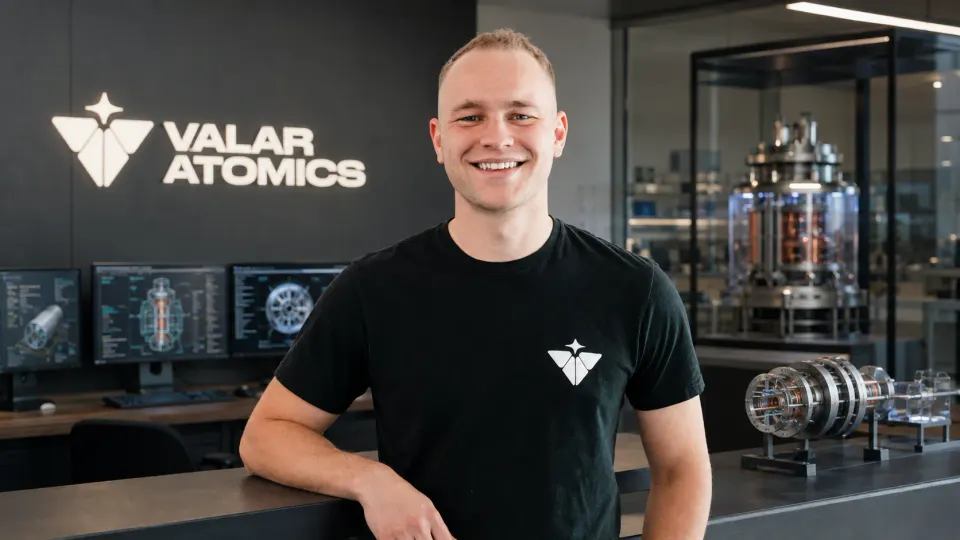
Valar was founded in 2023 by Taylor, who left school at sixteen and started two companies before this one. It builds small modular reactors using TRISO fuel, helium coolant and graphite moderators. In June 2026 its Ward 250 reactor achieved a zero-power fuelled criticality demonstration at the Utah San Rafael Energy Lab, the second reactor to do so under the Department of Energy's Reactor Pilot Program and the first DOE-authorised reactor built and operated outside the national laboratory system. In November 2025 its NOVA core reached zero-power criticality at Los Alamos.
The company also announced a development agreement with Nvidia in June for a waterless 30MW AI facility, and says it demonstrated Ward 250 powering an Nvidia Blackwell system.
Why It Matters
Conventional nuclear construction is a project business. Each plant is bespoke, built on site over a decade, financed against a schedule that historically slips. The cost of the first unit is close to the cost of the fifth, because almost nothing is repeated. That is the economics Valar is trying to escape.
Its argument is that a small reactor is a manufactured product. Build the same unit repeatedly in a factory, and the learning curve that drives down cost in aircraft and semiconductors applies to reactors too. Taylor's framing is that one reactor can be built as a project but a fleet has to be manufactured, and the company describes each build as shortening the cycle: two years for the NOVA core, seven months to take Ward 250 critical.
The cost structure follows from that ambition rather than from current operations. Valar is developing TRISO fuel fabrication in-house at its Utah facility rather than buying it in, which most reactor developers do not attempt. Fuel supply is the constraint that has stalled other advanced reactor programmes, so bringing it inside is defensible, but it means funding a second manufacturing problem before the first has been solved.
What none of this establishes is a business. Valar has disclosed no revenue, no signed power purchase agreements and no order book. The Nvidia arrangement is a development agreement for a 30MW facility, not a supply contract with stated value. The demonstration cited in June powered a single Nvidia system, which validates that the reactor produces usable electricity, not that it produces it at a competitive cost. Every figure in the investment case is currently a projection.
The Strategic Read
The market assumption being underwritten is that demand for data centre electricity arrives faster than grids can be expanded, and that the gap gets filled by generation built next to the load rather than delivered across transmission lines nobody has permitted yet. Nuclear is the only dispatchable, land-efficient option in that description, which is why capital is moving into reactors at a speed the sector has not seen in decades.
Valar's specific bet is narrower and more interesting than the sector thesis. Its competitive position rests substantially on having found a route around the regulator. The DOE Reactor Pilot Program, created by executive order in May 2025, authorises test reactors outside the national laboratory system on a timeline the Nuclear Regulatory Commission does not offer. Valar used it, went critical in June, and simultaneously remains a plaintiff in litigation arguing the NRC wrongly applies full commercial licensing to small test reactors. The Philippines subsidiary is the same strategy pursued geographically.
That is a real advantage and a fragile one. It depends on an executive order, a DOE programme and a political posture toward nuclear licensing, none of which are contractual and all of which can be reversed by a subsequent administration. A moat built on regulatory permission is not the same category of asset as a moat built on manufacturing cost.
The valuation is where the discipline breaks down. Tripling from a reported $2 billion to a reported $6 billion in roughly five months prices a company that has demonstrated physics, not commerce. Criticality proves a chain reaction is self-sustaining. It does not prove a reactor can run at power for years, that fuel can be fabricated at volume, that a fleet can be manufactured to cost, or that anyone will buy the electricity at a price that clears. No revenue figure, order book or signed power purchase agreement has been disclosed.
Neither valuation mark came from the company. Both were reported. For a business whose entire investment case is a claim about the future, that is a thin basis on which $6 billion has been set.
For daily, sharp analysis of the biggest moves in the Indian business and startup ecosystem, follow StartupFox.