


The Story
Ecosys has raised ₹5 crore in a pre-Series A round led by GVFL Prarambh Fund, with participation from Proteus Partners, which is backed by the operator-investors Puru Gupta and Sreejith Moolayil. It takes the company's total funding to ₹7.94 crore, meaning this single round is larger than everything it raised in its first nine years combined.
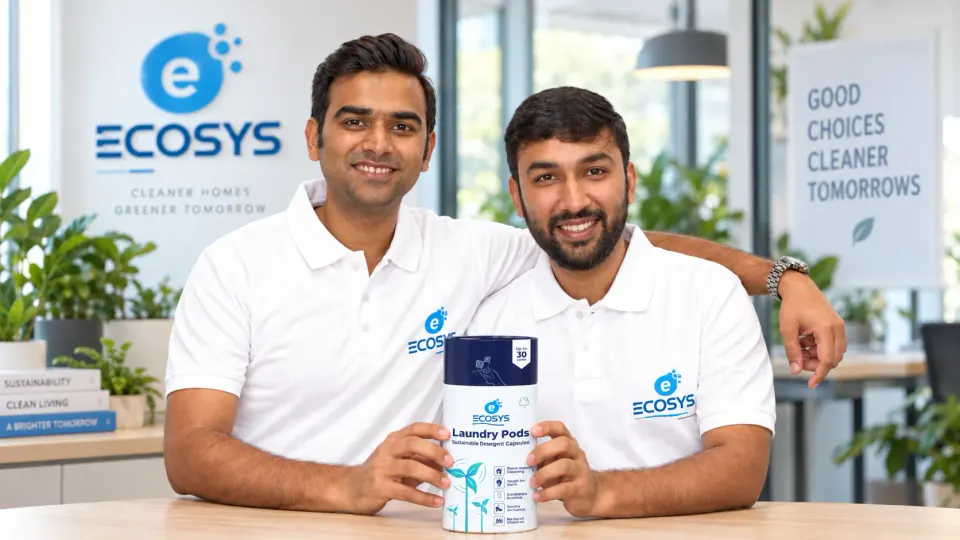
Sumit Goyal and Chirag Dangi founded the Mumbai company in 2017. It makes water-soluble laundry and home cleaning pods built around 10-ml polyvinyl alcohol capsules that dissolve in water, which the company positions as a way to cut the single-use plastic that conventional bottled cleaners generate.
Its range covers laundry detergent pods, glass cleaners, floor cleaners, bathroom cleaners and kitchen and utensil sprays. The formulations are described as non-toxic, biodegradable and safe around children and pets, and the products are designed so customers refill spray bottles they already own rather than buying new plastic ones.
The money goes towards brand building, reaching more consumers through digital channels and developing new formats across laundry and home cleaning. Ecosys positions itself as a premium, convenience-led brand and sells through quick commerce and e-commerce.
India's household cleaners market is growing at close to 14 percent a year, according to market research cited by the company, more than double the global rate.
The segment has drawn steady capital. Koparo raised ₹14.5 crore in an extended pre-Series A last year and Cleevo took $1 million in seed funding. Beco, which sells plant-based home and personal care products, raised $10 million from Tanglin Venture Partners, and Scrubsy raised ₹27 crore from V3 Ventures in August.
Why It Matters
Indian households buy cleaning products the way they buy salt: on price, out of habit, from a shelf where the same four or five names have sat for decades. It is one of the least romantic categories in consumer goods and one of the hardest to break into, because nobody is looking for a better floor cleaner.
What has changed is the shelf itself. Quick commerce has rearranged how these products reach people, and it rewards different things than a kirana store does. A dark store has finite space and a picker who has to find, lift and pack each item within minutes. Products that are small, light and do not leak are cheaper to hold and cheaper to move, and a category of five-litre plastic bottles of mostly water is close to the worst possible fit for that model.
That is the opening a pod format is walking through. A 10-ml capsule replaces a bottle, which means the same wash travels as a fraction of the weight and occupies a fraction of the shelf. The environmental framing is what gets marketed, but the economics work independently of it: you stop paying to transport water across the country.
The reuse element follows the same logic. Selling a concentrate that a customer dilutes in a spray bottle they already own removes the packaging from the transaction entirely. It also asks something of the customer, which is the part that has historically limited these formats. Refilling requires a small amount of effort in a category built entirely on requiring none, and the brands that have grown fastest in cleaning over the past century did so by removing steps rather than adding them.
Ecosys has been working on this since 2017, which is early for the Indian market and not necessarily an advantage. Being first in a category that takes a decade to mature means watching better-funded companies arrive with the same idea once the timing is right.
The Strategic Read
The number that frames this round is not ₹5 crore. It is ₹7.94 crore, which is everything Ecosys has raised since 2017.
Nine years and under eight crore is close to bootstrapped, and it puts the company in an awkward position within its own category. Beco has raised $10 million, roughly twelve times Ecosys's lifetime funding. Scrubsy took ₹27 crore in August. Koparo raised ₹14.5 crore last year. Ecosys was in this market before most of them and is the least capitalised company in it, which in a consumer category is a difficult place to be, because shelf presence, quick-commerce placement and brand recall are all bought rather than earned.
There are two readings of that, and the announcement does not distinguish between them. One is discipline: a company that grew on its own revenue for nine years and only took outside money when it could deploy it. The other is that the product took a long time to find its market while better-funded entrants arrived later and moved faster. The absence of any revenue figure, here or previously, leaves the question open.
The scientific question underneath the product is the more interesting one, and it applies to the whole category rather than to Ecosys alone.
The pod's environmental case rests on the film dissolving in water. Dissolving and degrading are not the same thing. Polyvinyl alcohol is a synthetic polymer, and whether it fully biodegrades under the conditions found in real wastewater treatment, or passes through and persists, has been contested in published research for several years. Studies have suggested a substantial share of PVA from detergent pods survives treatment; industry bodies dispute the methodology and point to evidence of biodegradation under appropriate conditions. It has not been settled, and it is not a trivial question for a brand whose entire positioning is the avoidance of plastic waste. India's wastewater treatment coverage is also considerably less complete than the systems most of that research assumes.
None of which makes the format wrong, and the strongest argument for it may not be ecological at all. Liquid detergent is mostly water, and shipping water across a country is expensive and absurd. A 10-ml capsule delivers the active ingredients without the liquid, which cuts freight, packaging and warehouse space per wash. On quick commerce, where every item is picked by hand and carried on a two-wheeler, small and light is a direct margin advantage rather than a virtue. That logic holds regardless of how the PVA debate resolves, and it is probably why the format keeps attracting capital.
The harder commercial reality is who else sells floor cleaner. Surf Excel, Ariel, Vim, Harpic and Lizol occupy the shelf, the habit and the price point, and Indian household cleaning is among the most price-sensitive categories there is. A premium eco-positioned brand is not competing with them; it is competing for a narrow urban segment willing to pay more, and ₹5 crore of brand spending buys a modest amount of that attention.
For daily, sharp analysis of the biggest moves in the Indian business and startup ecosystem, follow StartupFox.