
 Supply6
The Story
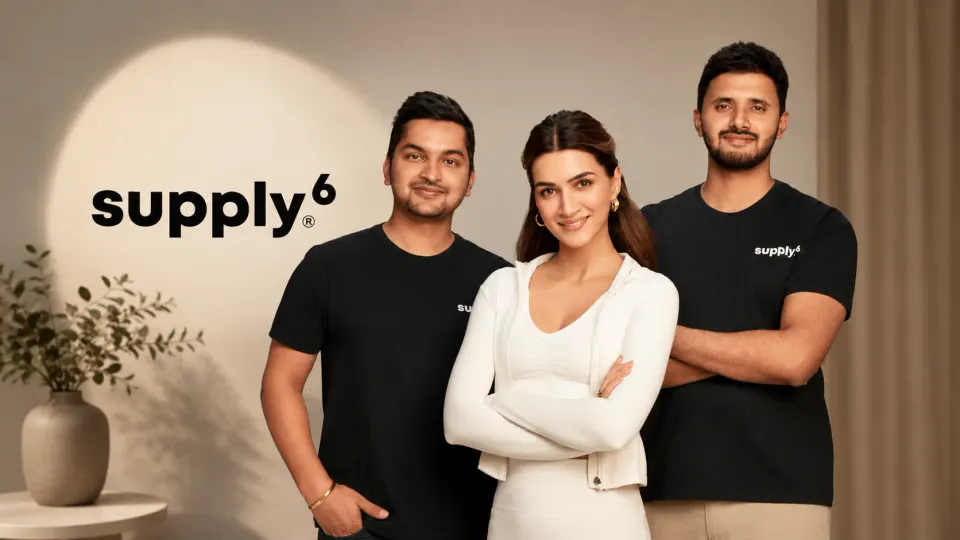
Bengaluru-based direct-to-consumer (D2C) nutrition startup Supply6 has raised ₹48 crore in a new funding round led by Unilever Ventures. The transaction also saw participation from existing backer Zeropearl VC and actor-entrepreneur Kriti Sanon.
Founded in 2019 by Vaibhav Bhandari and Rahul Saji Jacob, Supply6 focuses on foundational daily nutrition. The brand’s flagship product, Supply6 360, is an all-in-one powdered sachet combining more than 63 ingredients, including probiotics, adaptogens, and essential micronutrients. Rather than building a sprawling catalogue of highly specific supplements, the company currently generates roughly 80% of its total revenue from just two hero products.
The startup currently operates at an annualised revenue run rate (ARR) of ₹75 crore and projects it will cross the ₹100 crore milestone within the next three to four months. According to the company, the fresh capital will be deployed across product innovation, clinical research, supply chain expansion, and accelerating its go-to-market strategy across D2C, marketplaces, and quick-commerce channels.
This capital injection follows a $1.1 million (₹9.1 crore) seed round in September 2025, which was led by Zeropearl VC and featured prominent angel investors including Kunal Shah. The company also previously onboarded former international cricketer AB de Villiers as a brand ambassador and investor to drive its lifestyle positioning. The dual endorsement strategy aims to build credibility and reach across both fitness enthusiasts and mainstream wellness consumers.
Why It Matters
The ₹48 crore allocation matters because it proves that FMCG venture arms are actively targeting startups that have cracked the "habituation" code in the notoriously fragmented Indian nutraceutical market. Historically, the wellness sector has been crowded with brands offering dozens of confusing, overlapping SKUs. Consumers face decision fatigue when asked to buy separate protein, vitamin, and probiotic supplements, often leading to high drop-off rates after the first month.
Supply6 flipped this dynamic by combining these elements into a single, daily foundational product. By making nutrition a convenient, 30-second habit rather than a complex medical regimen, the startup transformed a discretionary health purchase into a daily utility. This simplicity directly translates to the bottom line; the company reports a robust 45% repeat purchase rate. When consumers build a product into their morning routine, the lifetime value (LTV) of that customer scales dramatically, justifying the initial cost to acquire them.
However, acquiring those customers initially remains brutally expensive. Supply6 currently reinvests an estimated 35% to 38% of its revenue directly into marketing and brand activations. In a hyper-competitive category battling heavyweights like Oziva, Plix, and Kapiva, maintaining visibility across Instagram, Amazon, and quick-commerce platforms like Zepto and Blinkit burns immense cash. Partnering with Unilever Ventures provides the startup with the deep balance sheet necessary to sustain this customer acquisition cost (CAC) while simultaneously leveraging Unilever's global expertise in clinical formulation and omni-channel distribution.
The Strategic Read
The investment in Supply6 signals that the next phase of India’s D2C wellness boom will be defined by SKU concentration rather than SKU proliferation. The underlying business mechanism driving this ₹48 crore bet is the superior unit economics of the "hero product" model.
When a D2C brand drives 80% of its revenue from two core products, its entire supply chain becomes drastically more efficient. Inventory forecasting simplifies, raw material procurement achieves economies of scale faster, and marketing capital is concentrated on a single, clear message rather than fragmented across twenty different campaigns. This operational leverage is exactly what a legacy conglomerate like Unilever looks to acquire or back—a clean, scalable brand that has already proven its product-market fit and repeat behavior.
The competitive consequence of this funding places immediate pressure on legacy pharmaceutical brands and sprawling D2C nutraceutical competitors. If Supply6 can use Unilever's capital to dominate the digital shelf space on quick-commerce apps—where convenience-driven urban consumers increasingly buy their daily supplements—they can effectively block competitors from capturing the lucrative "morning routine" segment. Bringing in Kriti Sanon as an investor further amplifies this top-of-funnel consumer trust, blending celebrity influence with clinical positioning to reach a broader demographic.
Furthermore, the quick-commerce revolution has fundamentally altered D2C distribution economics. In the past, health brands relied on slow e-commerce deliveries or fighting for limited physical shelf space in pharmacies. Today, a consumer can see an Instagram ad, open a quick-commerce app, and have the supplement delivered in ten minutes. This frictionless procurement massively increases impulse trials, but it requires deep working capital to maintain inventory across hundreds of localized dark stores. The ₹48 crore gives Supply6 the working capital needed to ensure stock availability across these high-velocity platforms.
For daily, sharp analysis of the biggest moves in the Indian business and startup ecosystem, follow StartupFox.