
 Sherlocks.ai
The Story
Artificial intelligence-native incident management startup Sherlocks AI has raised ₹7.5 crore (approximately $0.9 million) in a pre-seed funding round. According to the company's recent announcements, the capital injection was led by SenseAI Ventures, with active participation from SaaS-focused accelerator Upekkha.
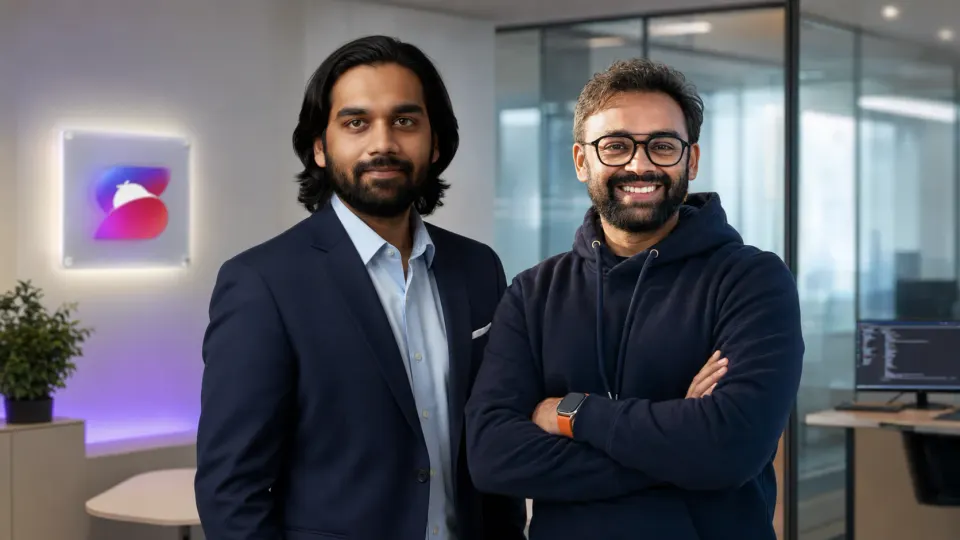
Founded in early 2025 by Gaurav Toshniwal and Akshat Jain, the startup aims to automate the highly manual processes involved in enterprise Site Reliability Engineering (SRE) and IT operations. Both founders bring deep technical expertise from the Indian consumer technology ecosystem; Toshniwal previously served as the Chief Technology Officer at Doubtnut after co-founding Aasaanjobs (which was subsequently acquired by OLX), while Jain led the search and machine learning divisions at Doubtnut.
Sherlocks AI develops software that helps enterprises investigate and manage production incidents across increasingly complex, microservices-based systems. The platform deploys autonomous AI agents that rapidly analyze incident data across a company's disparate infrastructure, including databases, Kubernetes environments, cloud networks, and CI/CD (Continuous Integration and Continuous Deployment) pipelines.
According to the startup, the fresh capital will be deployed primarily to strengthen its core product infrastructure and aggressively expand its go-to-market (GTM) efforts across North America. The company currently serves a mix of enterprise and mid-market clients, including brands such as Fynd, Lokal, TradeIndia, Topmate, and Repos Energy.
Why It Matters
The ₹7.5 crore pre-seed allocation addresses a severe operational bottleneck in modern enterprise software: alert fatigue and incident fragmentation. Over the past decade, global enterprises have aggressively migrated from monolithic software architectures to highly distributed, cloud-native microservices. While this shift increased deployment speed, it drastically compounded operational complexity. Today, a single user-facing latency issue might trigger hundreds of simultaneous alerts across diverse infrastructure dashboards and internal communication channels.
Currently, when a production incident occurs, Site Reliability Engineers (SREs) must manually cross-reference these fragmented alerts. They have to pull logs, check recent code commits, review cluster health, and search historical documentation to figure out exactly what broke. This manual diagnostic process is the primary reason why critical system outages still average over three hours to resolve.
Sherlocks AI matters because it attacks the diagnostic layer of the problem using agentic artificial intelligence. Instead of merely presenting an engineer with another dashboard of flashing alerts, the platform acts as an autonomous digital investigator. When an alert fires, Sherlocks automatically collects the surrounding context, correlates it with recent code deployments and historical incident patterns, and investigates whether the alert is a false positive or a critical failure.
The Strategic Read
The funding of Sherlocks AI signals that enterprise venture capital is moving aggressively past basic generative AI tools toward vertical, agentic workflows. Investors are actively seeking platforms that can execute complex, multi-step actions within closed enterprise environments, rather than tools that merely generate code or summarize data. The underlying business mechanism driving Sherlocks AI’s value proposition is the cost-of-downtime arbitrage combined with workflow consolidation. Traditional observability giants excel at telling a company that an infrastructure component has failed. Sherlocks AI’s strategic positioning aims to tell the company why it failed and how to implement the fix, bridging the critical gap between passive monitoring and active remediation.
The primary leverage point for Sherlocks AI is integration density and the resulting proprietary data moat. By deeply embedding itself into a client's CI/CD pipelines, database logs, and engineering communications, the software builds a highly specific "Awareness Graph" of the enterprise's unique infrastructure. The longer the AI operates within a specific corporate environment, the better it becomes at recognizing that company’s distinct failure patterns. This deep contextual learning creates immense switching costs; once an enterprise relies on an AI agent that implicitly understands its historical codebase quirks, ripping and replacing the platform becomes operationally disruptive.
However, this strategic ambition faces severe competitive pressure and execution risks. The startup is directly attacking an IT operations market dominated by heavily capitalized incumbents. Legacy giants are actively acquiring AI startups and aggressively bundling autonomous incident management features into their existing enterprise contracts. A standalone pre-seed startup must prove its proprietary AI agents are exceptionally superior to justify an enterprise adding yet another vendor to its procurement list.
Furthermore, the strongest countercase to the rapid adoption of agentic SRE tools is the "black box" trust deficit inherent in enterprise infrastructure. While engineering teams are comfortable letting AI summarize alerts and diagnose faults, they are notoriously hesitant to grant autonomous agents full write-access to execute remediation scripts on live production databases. If an AI agent hallucinates a fix that inadvertently cascades into a wider network outage, enterprise trust will evaporate instantly. The critical watchpoint over the next 12 to 18 months will be the execution of Sherlocks AI's North American expansion strategy. Investors and ecosystem observers should monitor whether the startup can successfully transition from serving mid-market Indian clients to landing complex, highly regulated Fortune 500 accounts in the US, proving its autonomous agents can navigate stringent enterprise security and compliance standards.
For daily, sharp analysis of the biggest moves in the Indian business and startup ecosystem, follow StartupFox.