

The Story
Benne, a Mumbai-based dosa quick-service restaurant chain, has raised ₹35 crore (around $3.7 million) in a pre-Series A funding round led by Claypond Capital, the family office of Manipal Group chairman Ranjan Pai. The round was announced on 7 August 2026.
The company's board passed a resolution to issue 1,799 compulsorily convertible preference shares at ₹20,349 each. Claypond Capital invested ₹28.75 crore, with AL Trusts putting in ₹3.5 crore, Mukul Agrawal ₹1.75 crore, Madhukeshwar Desai ₹75 lakh and Cortado Advisory Services ₹25 lakh. Following the allotment, Claypond became the largest external shareholder with an 8.21 percent stake, ahead of Mukul Agrawal at 5 percent, Madhukeshwar Desai at 3.85 percent, AL Trust at 1 percent and Cortado at 0.07 percent.
Benne has not disclosed a valuation for the round. A post-money figure of around ₹364 crore ($38.3 million) is a third-party estimate derived from the share issue price, not a number the company has confirmed. The proceeds are earmarked for expanding operations and supporting growth, with no specific outlet targets, timeline or capital allocation disclosed.
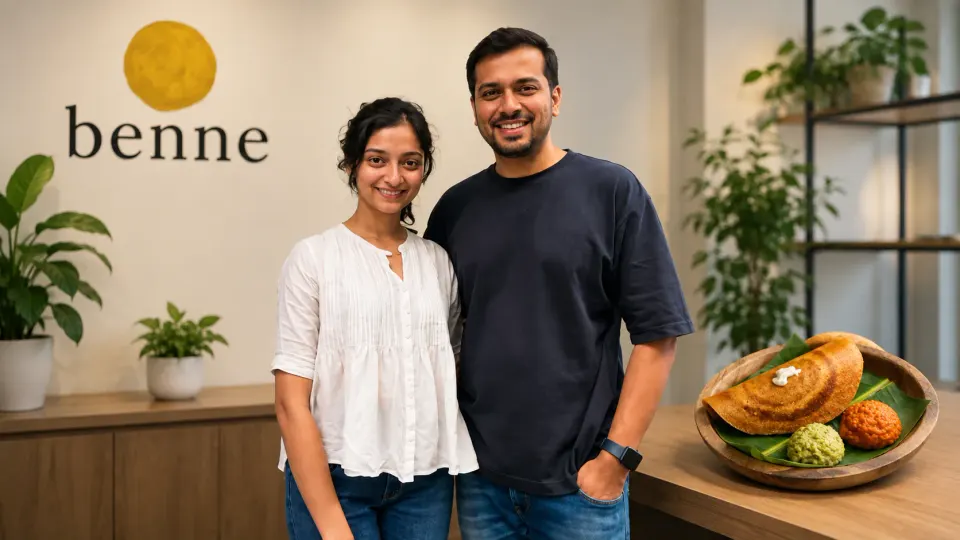
The raise is not Benne's first external capital. The company previously raised an undisclosed amount from early-stage venture firm Peercheque. Founded in 2024 by the husband-and-wife team of Akhil Iyer, a film producer, and Shriya Narayan, a psychologist, Benne runs a limited-menu format built around Bengaluru-style benne dosa, sold through dine-in, takeaway and delivery.
Why It Matters
Benne sells a single idea executed tightly: Bengaluru-style benne dosa, served fast from small outlets with a limited menu. It earns from food margins across dine-in, takeaway and delivery, and its format, compact spaces, self-service kiosks and a short SKU list, is built for high throughput rather than long dwell time. The economics depend on volume through a small footprint, not on table turns in a large restaurant.
The company was founded in 2024 by Akhil Iyer, a film producer, and Shriya Narayan, a psychologist, neither of whom came from hospitality. Benne's rise owed more to distribution than to advertising: social media, long visible queues and unpaid celebrity visits turned a 275-square-foot Bandra outlet into a recognised brand within months. The company reports monthly revenue of around ₹1 crore.
That figure is where the enthusiasm needs discipline. Roughly ₹1 crore a month annualises to about ₹12 crore of run-rate revenue, spread across only three outlets, and it is unaudited. Against the estimated ₹364 crore valuation, the round is priced at close to thirty times run-rate revenue, a multiple that assumes the format multiplies cleanly across many more locations. Virality and celebrity footfall have built awareness; they have not yet demonstrated that the unit economics repeat outside Bandra.
The Strategic Read
The market assumption changing behind this investment is that a single-dish, social-media-native café can be built into a multi-outlet chain without losing the authenticity and scarcity that made one Bandra location a destination. Claypond is underwriting the format, not the current footprint.
The reference point is The Rameshwaram Cafe, which proved that a South Indian QSR can scale to high volumes and attract serious capital. Benne is making a narrower bet: that a premium, story-led, compact format travels intact to new neighbourhoods and cities. Where value would be created is in the repeatability of the model, if the small-footprint, high-throughput outlet ports cleanly, margins compound with each opening. The difficulty is that the moat, brand nostalgia and operational tightness, is replicable, and better-funded rivals are already in the space.
Benne competes against The Rameshwaram Cafe and the Nikhil Kamath-backed Cafe Amudham, both operating in premium South Indian QSR with more capital behind them. In a category where the product itself is not defensible, distribution and consistency decide the winner, and a three-outlet chain has not yet shown either at scale.
The largest execution risk is the valuation itself. An estimated ₹364 crore on three outlets and roughly ₹12 crore of run-rate revenue leaves no room for a stumble; it prices in an expansion that has not happened. QSR chains most often break at exactly this point, when a beloved single location becomes a rollout and consistency, real estate, supply chain and the dilution of the original experience all arrive together. Whether Benne has built a repeatable operating system or one exceptional café is the question the next two years, not this round, will answer.
For daily, sharp analysis of the biggest moves in the Indian business and startup ecosystem, follow StartupFox.