

 E3 Electric.AI
The Story
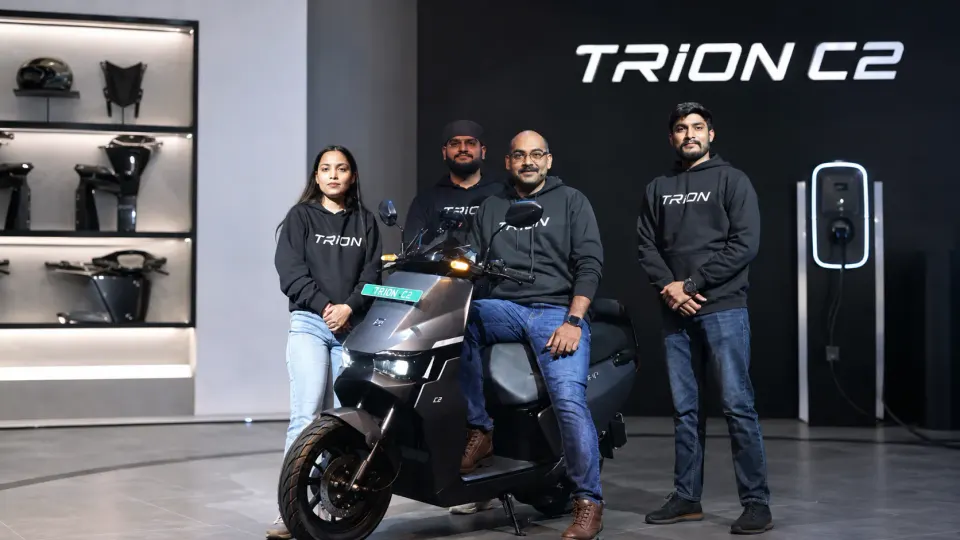
E3 Electric.AI, a Bengaluru-based electric mobility startup, has launched its first electric scooter, the E3 TRION, in three variants. The E3 TRION C1x is priced at ₹1,09,999 and the C2 at ₹1,19,999. The company did not disclose the price of the third variant, the C1, or specify whether the stated figures are ex-showroom or on-road. The launch was announced on 7 August 2026.
E3 has not disclosed booking or delivery timelines, warranty terms, production capacity, or the specific cities where the scooter will first be sold. The C1x carries an IDC-certified range of 165 km on a 3 kWh battery, a certification figure that typically overstates real-world range. The C2 is positioned as the performance variant, with a company-stated top speed of 82 km/h and acceleration from 0 to 40 km/h in six seconds in Sport mode. The C1 is the entry variant and features a removable battery.
The scooter runs on a 2.3 kWh portable VOLTPORT battery and a 3 kWh fixed battery, both using LFP chemistry, and is offered in six colours. E3 has built the vehicle around a proprietary IoT and cloud platform it calls the E3 COMMANDCENTER, which the company says monitors each vehicle, flags potential faults before they occur, and delivers software updates over the life of the scooter. It lists more than 100 connected features, including a 10-second AI diagnostic scan, predictive reports, a charger locator, remote battery monitoring, a dashcam, SOS assistance and geo-fencing.
The launch follows a ₹100 crore ($10.5 million) Series A round the company closed in July 2026, led by BluVenture Holdings and raised through a combination of equity and debt.
Why It Matters
E3 Electric.AI sells into India's mass-market electric two-wheeler segment, positioning the TRION as an alternative to the 110cc petrol scooters that still dominate Indian roads. Founded in 2024 by P. Sanjeev, a former head of TVS Motor's electric vehicle business, the company follows an asset-light model, designing the vehicle and its software in-house while keeping manufacturing capital off its own books.
Its pitch rests on a specific bet: that the next phase of India's EV shift will be won on software rather than on electrification alone. Where early adoption was driven by the switch from petrol to battery, E3 argues the differentiation now lies in intelligence, in predictive maintenance, connected diagnostics and safety systems layered on top of the powertrain. The COMMANDCENTER platform and a claimed portfolio of more than 18 patents are the assets it points to.
Whether that bet holds is unproven. Connected features and app-linked diagnostics already ship on scooters from Ather and Ola, so the capability is not unique to E3. In the mass 110cc-replacement segment, the factors that move a purchase are price, real-world range and the density of the service network, and software addresses none of them directly. The company's description of the TRION as creating a new category is a marketing claim rather than an established fact.
The Strategic Read
The market assumption behind E3's launch is that Indian family buyers will choose, and pay for, intelligence in a scooter priced around ₹1.1 lakh. That is a defensible premium position, but it places the TRION alongside established connected scooters rather than below them, and E3 enters without the brand recognition or dealer footprint its rivals spent years building.
Distribution and service are where the real contest sits. Ola, Ather, TVS, Bajaj and Hero's Vida already run retail and service networks across hundreds of cities, and the capital behind them dwarfs E3's round. Hero MotoCorp alone recently committed up to ₹1,000 crore to Ather. A ₹100 crore Series A, part of it debt, funds a first product and a limited rollout, not a national service network, and a connected scooter with no nearby service point is a harder sell than a simpler one a local mechanic can fix.
The asset-light approach cuts both ways. It spares E3 the capital drain of building plants, but it hands quality control and supply reliability to contract manufacturers, which is where several small electric two-wheeler makers have stumbled on after-sales and safety. The largest question the launch leaves open is not whether E3 can build an intelligent scooter, it has, but whether a company founded in 2024 can turn a technology platform into sales and dependable service across the roughly 90 cities it intends to reach, against incumbents that treat this exact segment as core. Until deliveries and service data exist, the category E3 says it is creating stays a claim.
For daily, sharp analysis of the biggest moves in the Indian business and startup ecosystem, follow StartupFox.