


The Story
Sarvam AI's board has passed a special resolution approving the issue of 20,244 Series B preference shares and seven equity shares at ₹3,44,570 each, raising ₹698 crore or about $74 million. The resolution was filed with the Registrar of Companies and reported on 3 August 2026.
NVIDIA Corporation leads the tranche with ₹238 crore, around $25 million. Glade Brook Capital follows at ₹190.3 crore, about $20 million. Gaja Capital is committing ₹95 crore and the pair of Sanjay Kalra and Jyotika Kapoor ₹50 crore. Indigo Ventures, along with angel investors and family offices including Vrijesh Agarwal, KJ Trust and AL Trust, make up the balance.
A board approval is not a completed raise. The allotment date, whether the money has been received, and whether this closes the round have not been confirmed. Sarvam has not announced the tranche itself, and no valuation has been disclosed for it. The issue price works out close to the $1.5 billion post-money figure the company published at its June first close, which would make this a flat extension rather than an up round.
Per the filing, NVIDIA will hold 1.66% and Glade Brook 1.33% after allotment. HCLTech's holding falls to 9.95% and the founders retain 38.44%. These figures come from a single publication's reading of the filing.
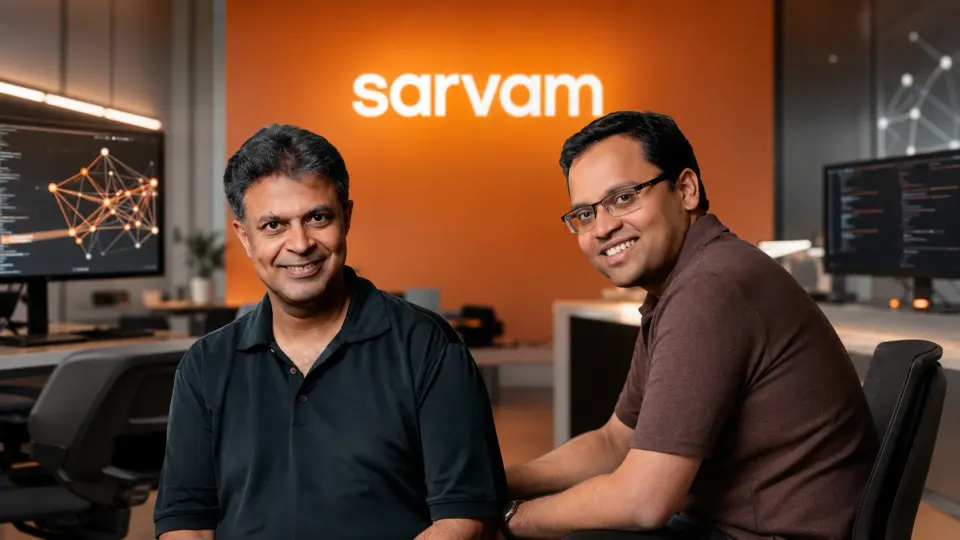
Sarvam was founded in 2023 by Vivek Raghavan and Pratyush Kumar and builds foundational models, inference infrastructure and enterprise products for Indian languages. Its recent releases include Sarvam 105B, Sarvam 30B and Sarvam Vision.
Why It Matters
This tranche exists because the Series B was never fully closed. Sarvam announced a $300 million round on 15 June 2026 and closed $234 million of it, with HCLTech putting in $150 million and Bessemer Venture Partners joining alongside existing backers Khosla Ventures and Peak XV Partners. Roughly $66 million was left for a second close. At $74 million, this approval covers that remainder and a little more.
The structure is standard for an Indian private company. Preference shares issued at a fixed price, approved by special resolution, filed with the RoC, then allotted. What the filing route means in practice is that the numbers become public before the company chooses to announce them, which is why stake percentages are visible here and were not in June.
NVIDIA leading is the substantive change to the cap table rather than the amount. Sarvam runs its training on NVIDIA hardware, and the chipmaker taking a direct position converts a supplier relationship into an ownership one.
What the approval does not establish is momentum. A flat issue price six weeks after the first close means the second tranche was raised on the same terms as the first, not on a re-rating. No revenue figure, contract value or model-adoption number has been disclosed alongside it, and Sarvam has not commented on the tranche at all.
The Strategic Read
The assumption being underwritten is that a country will pay for models it controls, and that controlling them requires a domestic company doing the training rather than a domestic deployment of somebody else's weights. Sarvam has built the strongest claim to that position in India, with government compute support that the Press Information Bureau put at ₹246.72 crore and deployments in banking, insurance and government systems.
NVIDIA's participation is the part worth reading carefully. Sarvam trains on a cluster of more than 4,000 NVIDIA H100 GPUs and describes its stack in NVIDIA's own terms. An equity stake in a large compute customer is a structure NVIDIA has used repeatedly with AI companies, and it means the lead investor's return does not depend solely on Sarvam's enterprise revenue. That is a reasonable position for NVIDIA and a weaker signal of independent price discovery than a lead cheque from a fund with no other exposure.
The gap that has not closed is revenue. Reporting earlier this year put Sarvam's annual revenue as of March 2025 at ₹29.1 crore, a figure the company has not confirmed or updated. Usage numbers are large and growing, with a conversational platform the company says handles over two million interactions a day, but interactions are not contracts and a sovereign mandate is not a purchase order. At $1.5 billion, the valuation prices a category position rather than a book of business.
The flat issue price is the honest detail in the filing. Six weeks after a first close that made the company a unicorn, the extension is going out at the same price. That is not a down round, and for an AI company raising in this market it is unremarkable. It is also not the mark-up that a hot second close would have produced.
For daily, sharp analysis of the biggest moves in the Indian business and startup ecosystem, follow StartupFox.