

The Story
QNu Labs has raised ₹200 crore, about $21 million, in a Series A1 round co-led by the National Quantum Mission and Speciale Invest, with Sony Innovation Fund, Gaja Capital and Artha Ventures participating. It takes total capital raised to ₹375 crore, which means this single round is larger than everything the company raised in its first ten years combined. Co-founder Sunil Gupta says roughly 80 percent of the money came from investors new to the company, several of them global.
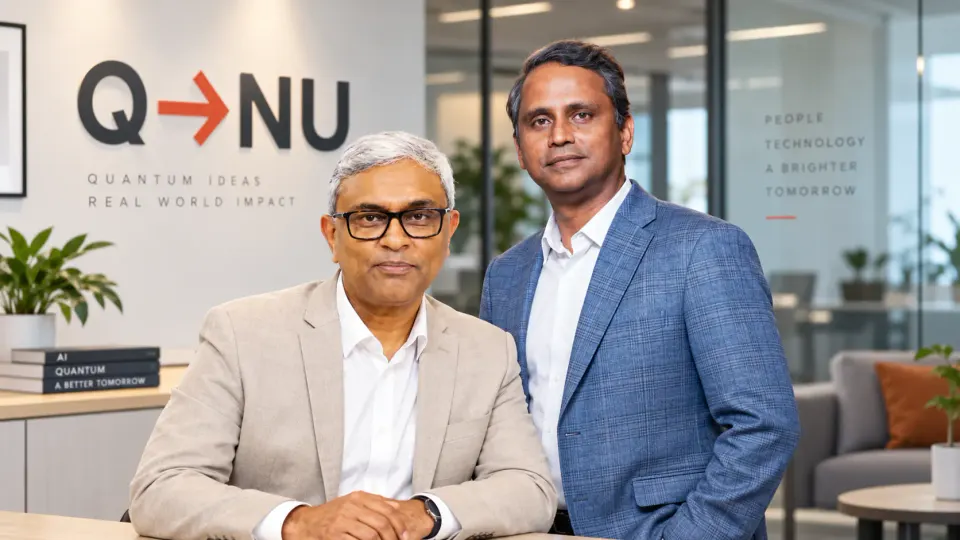
The Bengaluru company was founded in 2016 by Sunil Gupta, Srinivasa Rao Aluri, Mark Mathias and Anil Prabhakar, and incubated at IIT Madras. It sells quantum-safe cybersecurity products through its QShield platform, spanning quantum random number generation, quantum key distribution and post-quantum cryptography, and has deployed across government, critical infrastructure and financial services. It operates a US subsidiary in Massachusetts, set up in 2019.
Filed accounts show operating revenue of ₹40.5 crore in FY25, up 64 percent year on year. Headcount is around 180, up from roughly 118 in August last year. Gupta describes the company as moving out of a technology development phase and into what he calls a proof-of-scale business.
It previously raised ₹60 crore in a Series A led by the National Quantum Mission in April 2025, of which the mission itself put in ₹25 crore, and $6.5 million in a pre-Series A1 round led by Ashish Kacholia of Lucky Investments in December 2023.
The new money funds research and development, technology capability, and sales and go-to-market operations in India and abroad. QNu also plans to contribute to a project funded under the RDI programme to build the technology backbone for India's Quantum Secure and Sensing Networks, and to extend its stack into quantum sensing and AI.
The National Quantum Mission has set a 2029 timeline for India's migration to quantum-safe infrastructure, with sector implementation schedules published this year. Other Indian companies working across quantum technologies include QpiAI, Dimira Technologies, PRENISHQ, QuPrayog, Quanastra and Quan2D.
Why It Matters
The commercial case for quantum-safe cryptography rests on a peculiar kind of threat, and it is worth stating precisely because it explains why governments are setting deadlines for a machine that does not yet exist.
Encrypted data stolen today can be stored indefinitely and decrypted later, once a computer capable of breaking the encryption arrives. Anything with a long secrecy requirement, diplomatic cables, defence communications, health records, financial infrastructure, is therefore already exposed, regardless of whether the machine appears in 2032 or 2045. That is the entire argument, and it is why the migration cannot wait for the threat to materialise. India's National Quantum Mission has set 2029, with sector implementation schedules published this year.
QNu has been building toward exactly this for a decade, which is the part of its story that holds up best. Founded in 2016 and incubated at IIT Madras, with a professor among its four founders, it spent years selling into a market that did not have a deadline. Revenue of ₹40.5 crore, growing 64 percent, is small in absolute terms and substantial for a company in a category where most competitors are still selling research rather than product. Deployments across government, critical infrastructure and banking are references that take years to earn in security procurement, where nobody buys from a company they have not watched.
The investor logic follows from the timing. Speciale Invest first backed QNu five years ago and has waited; Sony Innovation Fund and Gaja Capital are arriving now that policy has converted a research field into a procurement schedule. Ten years of patient engineering meeting a government-mandated migration window is a reasonable moment to put twenty-one million dollars into a company, and it explains why the round is five times the size of anything QNu had raised before.
The Strategic Read
Two things deserve separating out, and the first is who is doing the buying.
The National Quantum Mission led QNu's Series A in April 2025 and co-leads this one. It is a Department of Science and Technology programme. It also runs the IIT Madras hub where QNu was incubated, and it is the body that set the 2029 quantum-safe migration deadline which creates the demand QNu exists to serve. QNu's next stated move is contributing to an RDI-funded project for India's Quantum Secure and Sensing Networks. So the same arm of government funds the company, sets the timetable that generates its market, and buys the output.
None of that is improper. Sovereign cryptography is precisely where a state should be acting, and no country outsources the security of its critical infrastructure to whoever wins on price. But it does mean commercial validation and state procurement cannot be cleanly separated here, and that ₹40.5 crore of revenue does not tell you how much of the demand is arm's-length. The genuinely encouraging counterpoint is Gupta's claim that 80 percent of this round came from new investors, several global, which is money with no stake in the Indian programme.
The second thing is that the three technologies QNu sells have very different futures, and the coverage flattens them into one.
Post-quantum cryptography is mathematics. NIST standardised its first algorithms in 2024, it runs on ordinary hardware, and it is a software upgrade. That is where the global migration is actually heading, because it is the only version an enterprise can deploy across a fleet without laying fibre. Quantum random number generation is real, sellable hardware today, improving the keys that any encryption depends on, and it is a modest but genuine market. Quantum key distribution is the contested one. It needs dedicated fibre and trusted intermediate nodes, it does not authenticate the parties involved, and Western security agencies including the US National Security Agency and the UK's National Cyber Security Centre have published guidance discouraging it for general use in favour of post-quantum cryptography.
Which makes one detail the most informative in the announcement: QNu's most sought-after product is its quantum-safe VPN. That sits on the software side. The market, in other words, is buying the same thing Western agencies recommend, not the quantum hardware that makes the company distinctive. If that continues, QNu's long-term position looks less like a quantum physics company and more like a cryptography software company with unusually strong government relationships and a hardware line for customers who specifically want it.
The date is the last thing, and it is the largest risk. Almost everything about this valuation rests on 2029 holding. Migration deadlines of this kind have slipped before, in India and elsewhere, because the migration is enormous and the threat is still theoretical. A two-year slip turns a procurement schedule back into a research budget, and a ₹200 crore round into a longer runway rather than a growth story. Ten years of building and one year of policy tailwind is the shape of this company. The tailwind is the part it does not control.
For daily, sharp analysis of the biggest moves in the Indian business and startup ecosystem, follow StartupFox.