

The Story
Qiroko, a Bengaluru-based fashion accessories brand, has raised ₹1.5 crore in a pre-seed round led by ISV Capital, with angel investors also participating. It is the company's first outside funding.
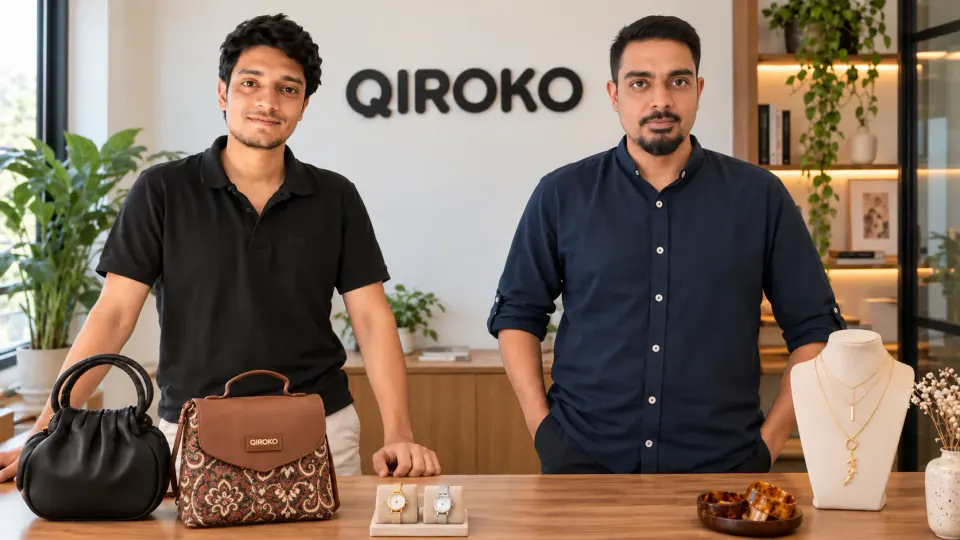
Founded in 2025 by Shivam Vasisht and Ashwin Krithik, Qiroko sells everyday jewellery and accessories for women and men, in styles ranging from ethnic to Western. Its listings include oxidised choker necklace sets, multi-piece nose stud sets, stainless steel ring combos and magnetic non-piercing studs for men, most of them selling for a few hundred rupees. It sells through its own website, through Amazon, Flipkart and Myntra, and on the quick-commerce app Blinkit.
The company says it reached an annualised revenue run rate of ₹6 crore within its first year without outside funding, with strong unit economics. Its website says it has served more than 70,000 customers in more than 250 cities, with an average rating of 4.6 out of 5 across more than 4,700 reviews.
The money will go into new products, expansion into watches and bags, which it has begun listing, and wider distribution across its website, marketplaces and quick-commerce platforms. Qiroko also plans to grow its team and build in-house brand and content capabilities.
Why It Matters
Most fashion jewellery in India is still sold the old way: unbranded pieces from street markets, local shops and wholesale hubs, bought on price and look alone. Online, a layer of brands has grown above that, from fast-fashion labels to demi-fine names working in silver and plated metals. Earlier this month Zinara raised ₹3.6 crore to put lab-grown diamonds on gold-plated silver, near the top of that range. Qiroko works the opposite end, where a set of 19 nose studs sells on Flipkart for a little over ₹300 and a men's stainless steel ring combo goes for under ₹300 on Amazon.
At those prices, the business is about volume. A ₹6 crore run rate means roughly ₹50 lakh of sales a month, which at the price points on Qiroko's marketplace listings works out to well over 10,000 orders a month. Getting there in a year without outside money suggests the founders have become good at the things that decide marketplace selling at this level: picking designs that sell, sourcing them cheaply enough to leave a margin after commissions, shipping and returns, and ranking well when shoppers search for a category rather than a brand.
Quick commerce adds a newer channel that suits accessories unusually well. Jewellery has no sizes, weighs little, is rarely returned for fit, and is often bought at the last minute, for an outfit, an occasion or a gift. That makes it one of the easier fashion categories for apps like Blinkit to stock, and watches and bags follow much the same logic.
The Strategic Read
The weakness of growing on marketplaces is that shoppers stay loyal to the search result, not the brand. Someone looking for an oxidised choker on Amazon sees dozens of near-identical listings, and the cheapest well-rated one usually wins. Designs at this price are easy to copy, and a rival can undercut a bestseller within weeks. A brand that depends mainly on marketplaces is always exposed to a ranking change or a price war it did not start.
That is why the most telling part of Qiroko's plan is the line about in-house brand and content. The company is trying to turn marketplace volume into a name shoppers look for, which would push more sales through its own website, where it keeps more of each order and owns the customer relationship. Its tagline, "More to love, less to pay," makes value the identity, and that works only if quality holds as volume grows.
Watches and bags are logical next categories, since they reach the same shoppers through the same channels. They also bring different suppliers, higher expectations of durability and, for bags especially, more returns. Expanding too quickly could turn a focused jewellery brand into a general catalogue, which is what the marketplaces already are.
The round is small next to the business. ₹1.5 crore is about three months of sales at Qiroko's current run rate, and close to ISV Capital's median cheque of around $150,000. ISV Capital grew out of Indian Silicon Valley, the startup podcast Jivraj Singh Sachar started in 2020, into an angel syndicate whose backers include founders of Mamaearth and Groww. For a bootstrapped brand that already sells, the money matters less than the network: help with hiring, brand-building and the institutional round that would come next.
For daily, sharp analysis of the biggest moves in the Indian business and startup ecosystem, follow StartupFox.