


The Story
Mitti Labs has raised $9.5 million in a Series A round led by Aramco Ventures, the venture arm of Saudi Aramco. The round was announced on 5 August 2026.
Existing backer Lightspeed India participated, alongside Godrej Industries Group, Cisco Foundation, Francis Family Fund and Volta Circle. The investment is Aramco Ventures' first in an Indian startup.
The valuation, the dilution and the split between investors have not been disclosed. No valuation was published for the company's earlier round either.
The capital will fund geographical expansion within India, greenfield projects in the Philippines and Indonesia, and further development of the company's GeoAI platform.
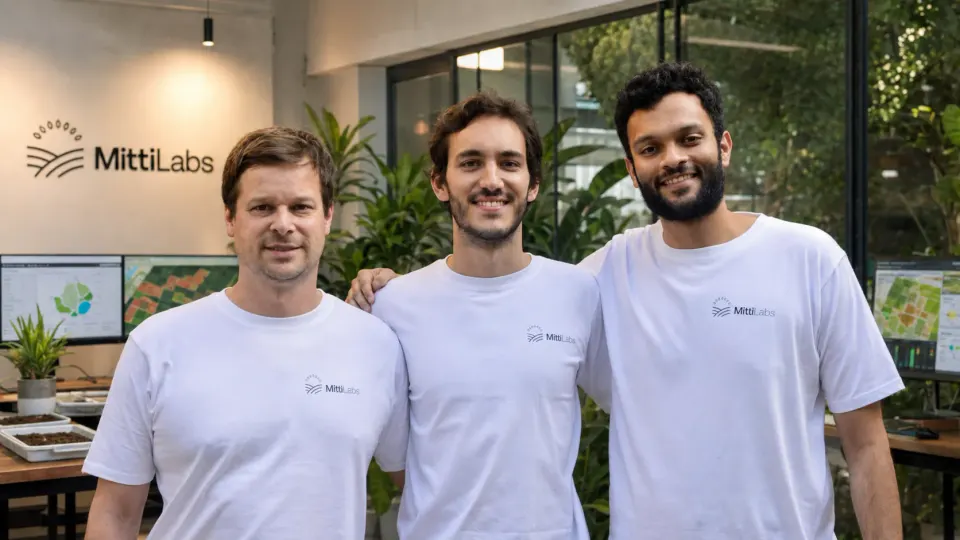
Mitti Labs was founded in 2023 by Xavier Laguarta Soler, Devdut Dalal and Nathan Torbick, and operates from New York and Bengaluru. Laguarta is chief executive and Torbick chief technology officer. The company raised $3 million in a seed round in July 2024 led by Lightspeed Venture Partners with Voyager Ventures and Overview, taking total funding to $12.5 million.
Its platform combines high-resolution synthetic aperture radar data with field-collected ground truth and physical models to build digital twins of rice fields at the level of individual plots. That measurement supports Alternate Wetting and Drying, an irrigation practice in which fields are periodically allowed to dry rather than remaining flooded.
The company says the practice cuts water use by about 40% and methane emissions by more than 50% without affecting yields, that its programmes have saved 500 billion litres of water to date, and that it runs the largest AWD rice programme globally. It reports 150 employees. Separately, its monitoring coverage has been recorded at 10 million hectares, roughly a quarter of India's rice-growing area, and it received a NASA SBIR Phase I grant of $150,000 in 2024.
Revenue comes from carbon credits and from the GeoAI platform. Named customers include Cool Effect, Ebro Foods and Syngenta.
The operating figures and performance claims come from the company. No revenue, credit volumes, contract values or pricing have been published.
Why It Matters
Flooded rice fields are among the largest agricultural sources of methane. Standing water starves the soil of oxygen, and the bacteria that thrive in those conditions release methane for as long as the field stays submerged. Letting the field dry periodically breaks that cycle, and the agronomy has been understood for years.
The obstacle has never been the technique. It has been proof. Carbon credits require verification that a specific field was managed a specific way over a season, and rice is grown by tens of millions of smallholders on plots too small and too numerous for anyone to inspect. Optical satellites cannot help much either, because the growing season is the monsoon and the fields sit under cloud.
Synthetic aperture radar is the answer to that specific problem. It penetrates cloud and distinguishes standing water from drained soil, which turns an unverifiable claim into a measurable one. Layering ground truth and physical models on top produces what the company calls a digital twin of a field, and that artefact is what a credit buyer is actually paying for.
The business that results has two revenue lines with different characteristics. Credits are the higher-value, more volatile one, exposed to voluntary carbon market pricing and to periodic collapses in buyer confidence. Data sales to companies like Syngenta and Ebro Foods are steadier, because those buyers want water-resilience visibility across their supply chains whether or not they are offsetting anything.
What has not been disclosed is the size of either line. Mitti Labs has published no revenue, no credit issuance volume, no price per tonne and no contract values. A $9.5 million Series A three years after founding, on a business with 150 employees and field operations across multiple states, implies the field model is expensive to run relative to what it currently earns.
The Strategic Read
The assumption being underwritten is that measurement, not persuasion, is the constraint on agricultural emissions reduction. Everyone in the field already knows AWD works agronomically; it has been researched for decades. What has never existed is a way to prove, cheaply and at continental scale, that a particular smallholder actually drained a particular field on particular dates.
Aramco's involvement clarifies what is being bought. An oil company's venture arm is not making an agricultural bet. Methane is the emission where reduction is fastest and cheapest per tonne, and a fifth of Asia's cultivated land is rice. For a hydrocarbon producer under pressure on emissions, a supply of verified methane credits at scale is a strategically useful asset independent of whether Mitti Labs becomes a large software company.
That points at the structural tension in the business. Carbon credit revenue depends on voluntary market prices, which have been volatile and periodically discredited, particularly where verification was weak. Mitti's answer is that its verification is the rigorous kind, and its Gold Standard issuance supports that. But a company whose credibility rests on rigorous measurement is selling into a market whose price is set partly by less rigorous supply.
The platform revenue is the hedge, and probably the better business. Syngenta and Ebro Foods are not buying credits; they are buying visibility into water resilience across their own supply chains, which is a procurement requirement rather than a discretionary offset purchase. That revenue does not move with carbon prices.
The expansion into the Philippines and Indonesia is where execution risk concentrates. The satellite layer travels easily; the field operations do not. Mitti's model requires people on the ground persuading smallholders to change an irrigation habit, and the 150-person organisation that built that in India has to be rebuilt in each new country before a single credit is issued.
For daily, sharp analysis of the biggest moves in the Indian business and startup ecosystem, follow StartupFox.