



The Story
Bengaluru-based cyber resilience startup Mitigata has raised $15 million (approximately ₹141 crore) in a Series B funding round led by Bessemer Venture Partners. The transaction also saw continued participation from existing investors Nexus Venture Partners, Titan Capital, and WEH Ventures, who previously backed the company's $5.9 million Series A round in August of last year.
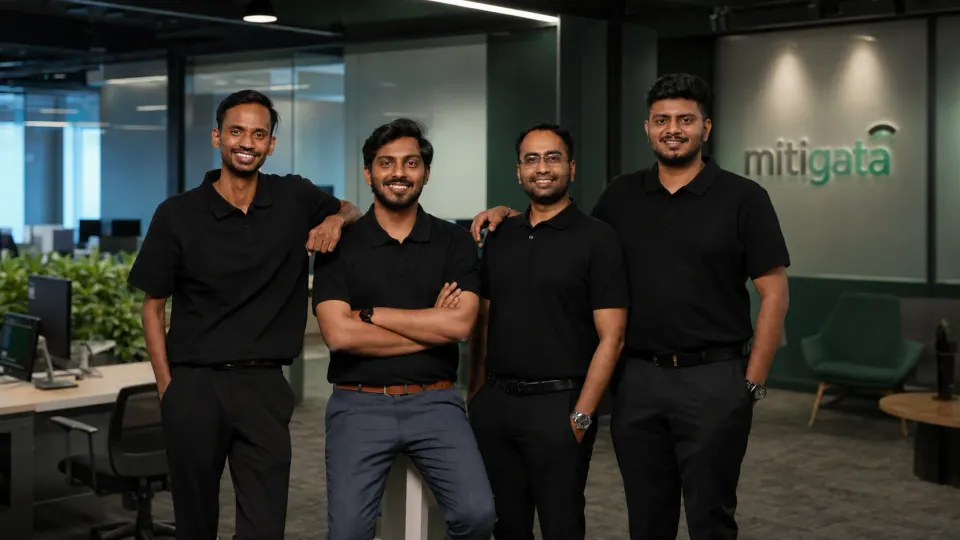
Founded in 2023 by Mohit Anand, Sarthak Dubey, Mayank Morya, and Akshit Kaushik, Mitigata operates a full-stack cyber resilience platform. The company combines AI-powered security operations, incident response, compliance management, and cyber insurance into a single ecosystem. Notably, the startup operates as an IRDAI-regulated insurance broker focused exclusively on cyber insurance.
According to the company, the fresh capital will be deployed to expand its workforce—with plans to add roughly 100 employees across engineering and product divisions over the next year—and to accelerate research and development. Mitigata intends to upgrade its Security Operations Centres (SOC) in Bengaluru and Delhi, deploying an AI stack that founders claim will allow analysts to process ten times the volume of security alerts.
Furthermore, the funding will support Mitigata's international expansion into the Middle East, North Africa, and Southeast Asia, diversifying its revenue base, which is currently 95% concentrated in India. The company currently serves more than 800 enterprises across the BFSI, healthcare, and e-commerce sectors, reporting a 12x year-on-year growth rate after triaging over one million security incidents in the past twelve months.
Why It Matters
The $15 million Series B allocation matters because it addresses a fundamental shift in how enterprises manage digital threats: the transition from pure cybersecurity to financial cyber resilience. With India's cybersecurity market projected to reach $6.5 billion by 2026, the frequency of AI-driven malicious attacks has surged, making network breaches an inevitable reality rather than a preventable anomaly.
Traditionally, the enterprise response to cyber threats has been highly fragmented. A company purchases threat detection software from one vendor, hires a separate consultancy for regulatory compliance, and procures a cyber insurance policy through a traditional broker. This fragmentation creates severe operational blind spots. When a breach occurs, the delay between detecting the incident, containing the threat, and coordinating the insurance claim often results in catastrophic financial losses.
The Strategic Read
The massive scale-up of Mitigata signals that venture capital increasingly views the integration of active cybersecurity software with financial insurance as the most defensible moat in the modern risk management sector.
The underlying business mechanism driving this $15 million raise is real-time risk underwriting arbitrage. Legacy insurance companies struggle to profitably underwrite cyber policies because they rely on static, historical questionnaires to assess a company's digital posture. A company's security can degrade the day after a policy is issued. Mitigata’s strategic advantage is its proprietary AI engines, such as Gordon AI for threat detection and RELIQ for continuous risk assessment. Because Mitigata continuously monitors its clients' networks through its SOC, it has real-time visibility into their actual security posture. This allows the platform to proactively defend against claims-triggering events, theoretically lowering the loss ratio and allowing for more accurately priced insurance coverage.
The competitive consequence of this unified model is immense customer lock-in. If an enterprise uses Mitigata’s software to detect threats, automate compliance, and actively manage its cyber insurance claims, the operational friction of switching to a traditional security vendor becomes prohibitively high. Mitigata essentially captures multiple line items in an enterprise's budget—IT security, compliance software, and corporate insurance premiums—funnelling them into a single, high-retention platform.
For daily, sharp analysis of the biggest moves in the Indian business and startup ecosystem, follow StartupFox.