


The Story
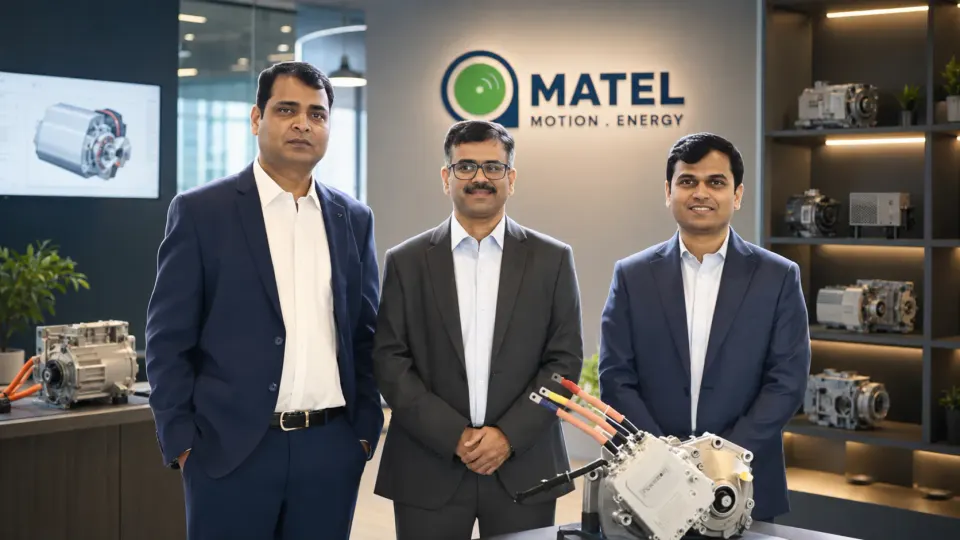
Matel Motion & Energy Solutions has raised ₹130 crore, around $15 million, in a Series B round led by UC Impower. Catamaran came in as a new investor and existing backer Transition VC participated. The round was announced on 3 August 2026.
The valuation, the dilution and whether any part of the round is a secondary purchase from existing shareholders have not been disclosed. Nor have the individual cheque sizes, board changes or the terms attached to the instrument. The company has not said how much of the ₹130 crore is drawn down immediately.
Matel said the capital will fund manufacturing capacity, research and development, product development, hiring across engineering and production, and international expansion.
The Pune company was set up in 2017 and designs and manufactures motors, motor controllers and integrated powertrains for electric vehicles and industrial use. It sells into two-wheeler, three-wheeler, four-wheeler, bus and off-road vehicle applications, and began mass production of powertrains in April 2024 after validation by EV manufacturers. It has developed a magnet-free motor and sells IE5 industrial motors, with an IE6 motor stated to be in development.
Sunil Patel, chief executive, previously led the Chetak EV development programme at Bajaj Auto's research division. Co-founder Netaji C Patro has held research roles at Maruti Suzuki and Bajaj Auto.
Reporting from the May 2024 Series A named a third co-founder, Mahesh Toraskar, who was quoted as founder at that time. Company records now list only Patel and Patro on the board, and databases describe Toraskar as a former co-founder. No departure has been announced, and the current announcement does not mention him.
The round has so far been reported by a single publication.
Why It Matters
Matel sells components into vehicles it does not build, which fixes the shape of the business. Every design win requires the customer to validate and certify the motor against its own platform, a process measured in quarters. That is expensive to win and hard to lose, because switching a validated powertrain means repeating the exercise. Mass production only began in April 2024, once that validation cleared.
The cost structure is a manufacturer's, not a platform's. Winding motors requires tooling, test rigs, copper and magnet inventory and a plant running at usable utilisation. Revenue arrives against purchase orders that the customer can slow at will, so working capital sits between the two. This is why the money is going into capacity and hiring rather than distribution.
The number that matters is the gap between ambition and result. At the Series A in May 2024, the company said it was targeting annual sales exceeding ₹100 crore by the following year and planned to lift monthly output from 5,000 units to 20,000 by FY26. Registry-sourced reporting puts FY25 revenue at ₹50.6 crore.
That is roughly half the stated target, and the company has not published the FY26 figure, current capacity utilisation, gross margin or profitability. Nor has it disclosed the split between EV and industrial revenue, or how much of the order book sits with its largest customer. A ₹130 crore round into a business at this revenue base is funding capacity ahead of demonstrated demand.
The Strategic Read
The assumption being underwritten is that India's EV supply chain localises at the component level, and that the motor and its controller are worth owning together rather than separately. Vehicle assemblers can import cells and buy motors from anyone. A supplier that designs the motor, the controller and the software as one unit claims efficiency that a bolted-together system cannot match, and that claim is what buys design-in.
Two things distinguish Matel from a generic components vendor. The first is the industrial side. Motors for pumps, cooling and factory equipment are a slower market than EVs but a steadier one, and IE5 efficiency ratings sell into it on payback arithmetic rather than on subsidy timing. The second is the magnet-free work. Most traction motors depend on permanent magnets containing rare earth elements, a supply concentrated in a handful of countries, and a motor that performs without them takes a geopolitical input out of the bill of materials. Matel has published no performance or cost data for that technology, so it remains a stated capability.
The structural risk is the customer. EV component suppliers sell to a small set of manufacturers, and those manufacturers have a persistent incentive to bring the motor in-house once volumes justify a line of their own. Bajaj, Ola and TVS all have internal powertrain programmes. A supplier whose founders came out of Bajaj knows this better than most, which may be why the industrial and international lines exist at all.
Catamaran's arrival is the signal worth reading. The family office states a focus on providing growth capital to Indian manufacturing, and that is a longer-horizon posture than a fund raising its next vehicle in three years. It also means the ₹130 crore has to convert into installed capacity and orders rather than into a marked-up valuation, on a base that did roughly ₹50 crore last year.
For daily, sharp analysis of the biggest moves in the Indian business and startup ecosystem, follow StartupFox.