
 Anthropic
The Story
Karnataka will constitute two dedicated working groups to identify priority use cases for artificial intelligence across governance, education and innovation. One will sit with the Centre for e-Governance, the other with the state Home Department. Minister for Home Affairs Priyank Kharge announced the decision in a post on X on 25 July 2026, after visiting Anthropic's Bengaluru office.
Kharge said the Anthropic team showed applications covering AI-enabled citizen services, multilingual experiences and responsible deployment. The discussions covered how existing government datasets could be used to improve public service delivery. They also covered expanding AI skilling through Claude certifications for students, professionals and enterprises, and access for Karnataka startups and developers to Anthropic's tools. Anthropic's AI for Science and Claude for Education programmes were raised as possible areas of collaboration.
No agreement was signed. Karnataka and Anthropic have not disclosed the membership of either working group, when they will be constituted, what they are expected to produce, whether any procurement will follow, on what commercial terms Anthropic's models would be used, or where inference on government data would run. No financial figure attaches to the announcement because there is no contract to attach one to.
A working group is not a purchase. It is a deliberative body that produces recommendations, and the recommendations bind nobody. The announcement sits one stage before a memorandum of understanding, which itself sits several stages before a tender.
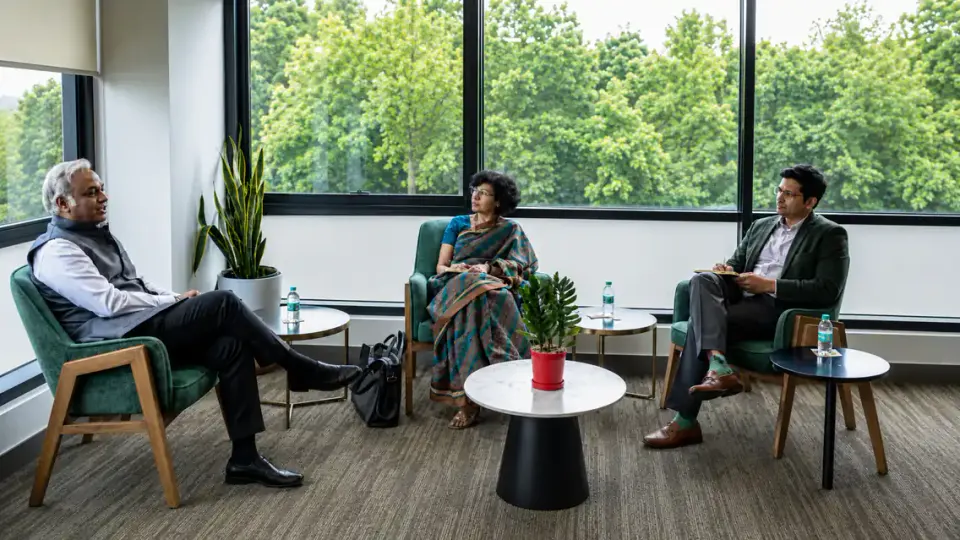
The visit follows a meeting on 11 July 2026 between Kharge, Anthropic India managing director Irina Ghose and Karnataka Innovation and Technology Society managing director Avinash Menon Rajendran. That discussion covered skilling, centres of excellence and incubators, and was described at the time as exploratory with no formal agreement in place. Anthropic opened its Bengaluru office in February 2026, its second in Asia-Pacific after Tokyo.
Why It Matters
Anthropic is not selling Karnataka software. At this stage it is buying position.
The company earns on paid usage, through enterprise seats and API consumption. Government workloads are among the largest and slowest-moving demand pools in any market. A state that standardises on one model family for citizen services generates volume that does not churn quarterly. That revenue, if it arrives, arrives after a procurement cycle that has not started.
The nearer-term mechanism is the skilling line. Claude certifications cost Anthropic engineering time and credits, and produce a pool of developers whose default tool is Claude. In a state that supplies engineers to the rest of the country, that pool is the distribution channel. Microsoft ran the same play with Azure certifications for a decade, and Anthropic's India managing director spent 24 years at Microsoft before joining in January 2026.
The cost side is real and immediate. Localisation for Indic languages, solutions engineers embedded with state departments, and free or discounted credits during pilots all sit on Anthropic's books before any invoice is raised. The company has not said what it is spending in Karnataka, and no figure has been reported.
A demonstration is not a deployment. The multilingual citizen-service applications shown to the minister establish that the models produce Indian-language output in a controlled setting. They do not establish accuracy on the material a state department actually holds — land records, police case files, welfare eligibility applications, revenue court orders — where an error has a named victim and an appeal process.
The Strategic Read
The market assumption changing behind this engagement is that the scarce input in Indian public-sector AI is data access, not model quality.
Earlier e-governance programmes digitised paper. Forms moved online, the underlying process stayed the same, and the work was delivered by system integrators building bespoke software against a written specification. The vendor relationship was with Infosys or TCS, and a model layer did not exist. What Karnataka is testing now is a direct relationship with the model provider, with the integrator layer shrunk or removed.
Value in that arrangement accrues to whoever sits closest to the data. A model embedded in the pipeline that reads state datasets becomes expensive to remove. The switching cost is re-validating outputs and retraining the staff who depend on them, on a system citizens cannot be asked to wait for. That is the position Anthropic is playing for, and the working groups are the mechanism by which it would be reached.
Anthropic says its focus in India is responsible deployment and multilingual access. The evidence that would support the claim is not a demonstration but a published evaluation on Indian-language administrative text, error rates broken out by task, and a statement of where government data is processed and how long it is retained. None of that has been produced, and Karnataka has not asked for it in public.
The moat is thin. Nothing announced is exclusive. OpenAI and Google are courting the same state governments, and Sarvam AI is doing it with a sovereign-model pitch that plays well in exactly this room. A state can run parallel pilots on parallel models at no cost to itself, which is what makes the consultation stage cheap for Karnataka and expensive for the vendors.
The largest execution risk is that nothing is built. Working groups in Indian state IT departments have a long record of producing reports and no procurement. The second risk is data governance. The announcement covers using existing government datasets without saying which datasets, under what consent basis, or where inference runs. Those questions decide whether a pilot becomes a system, and neither party has answered them.
For daily, sharp analysis of the biggest moves in the Indian business and startup ecosystem, follow StartupFox.