
 NVIDIA
The Story
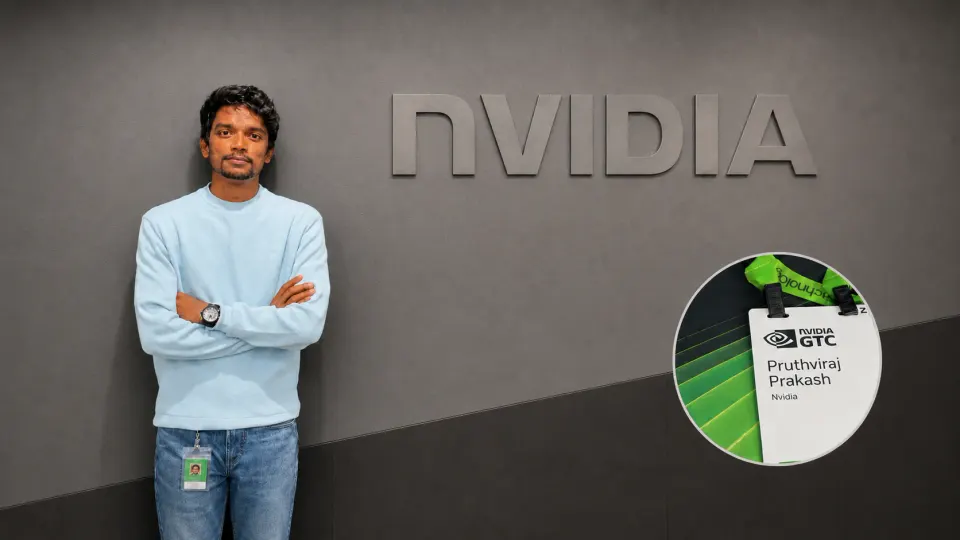
Pruthviraj P, an engineer from Chitradurga district in Karnataka, has joined NVIDIA as a Software Development Engineer working on deep learning, based in California. Reports circulating since early July 2026 place his annual compensation at approximately ₹2.6 crore. Mint reported that he joined the company's deep learning division in August 2025, which places the hire roughly eleven months before the coverage of it.
The compensation figure has not been confirmed by NVIDIA, by Pruthviraj, or by any named source. His own LinkedIn announcement, quoted at length by every outlet carrying the story, does not mention pay. No outlet has identified where the number originated.
The split between base salary, restricted stock and bonus has not been disclosed. Neither has the level at which he was hired, nor the vesting schedule attached to any equity component. One widely shared post converts the figure to roughly $275,000. At prevailing exchange rates ₹2.6 crore is closer to $295,000, and the sources do not agree on the dollar equivalent.
Details of his background also vary between accounts. Reports state he completed an electronics engineering degree at PES University, Bengaluru, in 2020, and later moved to the United States for a master's degree. Several describe the American institution only as a tier-3 university. His LinkedIn profile lists Clarkson University. Coverage places him at NVIDIA's Santa Clara headquarters, while his profile lists the San Francisco Bay Area.
The spelling of his name is inconsistent across outlets, appearing as both Pruthviraj and Prithviraj.
One outlet described the package as record-breaking. No comparative data supporting that characterisation has been published.
Why It Matters
United States technology compensation is public in aggregate and private in the particular. Levels.fyi, Blind and similar sites publish self-reported bands by company and level. That makes it straightforward to construct a plausible number for any given role without speaking to anyone. A software engineering position at NVIDIA in Santa Clara falls in a range where $275,000 to $300,000 in total compensation is unremarkable. Producing the figure requires no source. It requires a job title and a lookup table.
That is the likely mechanism here. The number arrives in rupees, in a round figure, attached to a story that already had momentum on LinkedIn. The aggregation economy runs on exactly this material: one verifiable human detail, one unverifiable financial detail, and a headline built on the second.
The distinction matters because total compensation at NVIDIA is weighted toward equity. Restricted stock granted at hire vests over several years and is valued at the grant date, not at today's price. A package described as ₹2.6 crore could mean the value at grant, the value now, or first-year cash and stock combined. Those are three different numbers and they are not close to each other.
Nobody carrying the story has said which one it is, because nobody carrying the story knows.
The Strategic Read
The assumption being underwritten by this story is that an individual salary figure is a useful signal about opportunity. It is not, and the gap between the two is where the reporting fails.
What the story documents is real and reasonably well evidenced. A student from a district town in Karnataka took an electronics degree at a private Bengaluru university, funded a master's in the United States, and was hired into deep learning work at the company supplying most of the world's AI training hardware. That path exists. It is narrower than the coverage suggests, but it is not fictional.
What the coverage adds is a number that converts the story into a target. A reader treating ₹2.6 crore as the expected outcome of that path is reading a survivorship statistic as a forecast. The relevant denominator is absent from every version of the story: how many Indian engineers attempt the same route, how many complete the master's, how many convert to a US offer, how many convert at that level. Without it the figure carries no information about probability.
For NVIDIA the episode is free recruiting. The company confirmed nothing and had no need to. Compensation leaks of this kind work as employer branding at zero cost, and the message reaching Indian engineering students is that the ceiling sits higher than they assumed.
The durable question is what happens when the figure is wrong. Pruthviraj is a private individual who posted about a job, not about a salary. He now has a compensation number attached to his name across dozens of outlets, none of which appear to have asked him. If it is inflated, he carries the correction. If it is accurate, his pay has been published without his consent.
Neither outcome was his to choose, and no outlet carrying the number has explained where it came from.
For daily, sharp analysis of the biggest moves in the Indian business and startup ecosystem, follow StartupFox.