



The Story
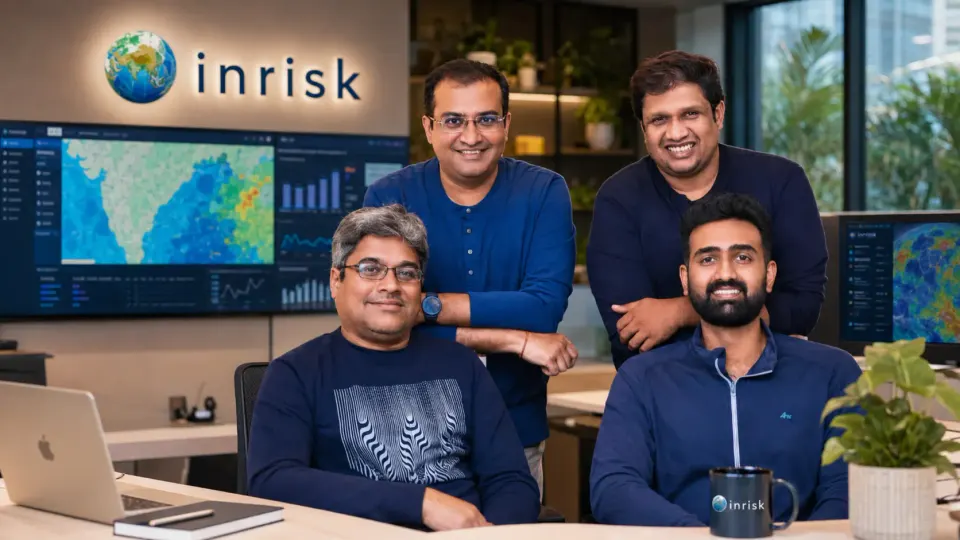
InRisk Labs has raised $27 million, about ₹259 crore, in a Series A round co-led by Bessemer Venture Partners and Northpoint Capital. The round was announced on 5 August 2026.
It comes alongside a regulatory approval. The company's subsidiary, EarthRe Insurance IFSC Limited, has received a licence from the International Financial Services Centres Authority to operate as a reinsurer. InRisk says EarthRe is the first incorporated reinsurer licensed at the International Financial Services Centre at GIFT City, a claim the company has made rather than one independently established.
The valuation, the dilution and the split between the co-leads have not been disclosed. Nor was a valuation attached to the company's only earlier round, a seed led by Bessemer in January 2025 whose size has never been made public.
The capital will go towards underwriting, actuarial, catastrophe modelling and AI capabilities, expansion into natural catastrophe and climate risk alongside non-life lines including marine cargo and motor, development of parametric and structured reinsurance products, and meeting the regulatory capital requirements for EarthRe's operations.
That last item is the substantive one. EarthRe was incorporated in Gujarat in 2025 and registry filings put its authorised and paid-up capital at ₹15 lakh as of July 2026. A reinsurer capitalised at that level has not yet taken on meaningful risk, which is what a portion of this round is intended to change.
The company describes the licence as marking its transition from a technology-led insurtech platform to an integrated reinsurance group with licensed risk-bearing capacity. InRisk Labs will continue building technology, data and risk intelligence infrastructure while EarthRe underwrites through its own regulated balance sheet.
EarthRe will focus on non-life reinsurance across natural catastrophe, climate risk, property, crop and specialty lines, offering treaty, facultative, structured and parametric products aimed at India and other Global South markets.
Founded in 2024 and based in Ahmedabad, InRisk Labs was set up by Malay Kumar Poddar, its managing director, and Aavrit Singhal, its chief product officer, who previously worked at Agriculture Insurance Company of India and the UNDP. Siddesh Ramasubramanian is chief executive of the parent company. Poddar heads EarthRe, whose board also includes RS ShivaKhumar.
Bessemer partner Vishal Gupta said the firm had backed the company at seed and doubled down. Sameer Brij Verma, founder and chief investment officer of Northpoint Capital, said EarthRe combines a licensed balance sheet with an AI-native risk platform.
No premium volumes, revenue or loss ratios have been published.
Why It Matters
Traditional insurance pays after someone inspects the damage. A surveyor visits the farm, assesses the crop, files a report, and months later a claim settles. For a smallholder whose income has already failed, the delay is the problem, and the assessment cost often exceeds what the policy is worth.
Parametric cover removes the assessment. Rainfall below a threshold triggers payment automatically, measured by a source both sides accept. That makes small policies economic to write and fast to settle, and it is why the model has taken hold in agriculture and climate risk rather than in motor or property.
The catch has always been who carries the risk. A parametric platform designs the product, prices it and monitors the trigger, then places the actual exposure with an insurer or reinsurer willing to underwrite it. The technology company earns a fee; the balance sheet earns the underwriting margin, and the balance sheet decides what gets written at all.
The IFSCA licence is InRisk stepping across that line. EarthRe can now write the risk itself, which turns a fee-based software business into one whose earnings depend on whether its pricing is right. That is a materially different company, with a different cost structure: regulatory capital must be held against exposure, and part of this round is explicitly earmarked for exactly that rather than for building product.
What none of the disclosure covers is scale. InRisk has published no premium written, no revenue, no capital base for EarthRe and no loss ratios from the parametric products it has designed to date. A reinsurance business is judged on the relationship between premiums earned and claims paid over a full cycle, and this one has not yet reported a single figure on either side of that equation.
The Strategic Read
The market assumption being underwritten is that India's reinsurance capacity should sit in India. Almost all catastrophe reinsurance for Indian risk has historically been placed with global reinsurers who price Indian monsoon, flood and cyclone exposure from models built elsewhere, on data thinner than what now exists. Poddar's framing, that capacity must be built by India for India, is the pitch and it has policy tailwinds behind it.
GIFT City is the mechanism. An IFSC licence lets a reinsurer operate in a foreign-currency, tax-advantaged jurisdiction inside India, which is how a startup can hold a reinsurance balance sheet without the capital requirements of a domestic carrier. Being early through that door is a genuine advantage, though it is an advantage of timing rather than technology, and other applicants will follow.
Where the technology claim has to be tested is loss experience. Better satellite and exposure data should mean sharper pricing than an incumbent working from sparse historical records, and if that holds, the company earns a spread on risk that others misprice. If it does not, the same balance sheet absorbs the error. There is no version of this business where the modelling is merely a feature.
The structural risk is correlation. Catastrophe reinsurance concentrated on Indian climate risk means a single bad monsoon or cyclone season hits the entire book simultaneously, which is exactly the exposure global reinsurers manage by spreading across continents. A young balance sheet writing concentrated Indian nat-cat has no such diversification, and $27 million of equity is thin against a severe event.
Scale is the open question, and the registry gives one measure of it. EarthRe's paid-up capital stood at ₹15 lakh in July 2026, so whatever underwriting capacity it ends up with is being created now rather than demonstrated. Premium volumes, retained capital and retrocession arrangements are all undisclosed, and those three numbers determine whether this becomes a reinsurer or a well-funded intermediary.
For daily, sharp analysis of the biggest moves in the Indian business and startup ecosystem, follow StartupFox.