


The Story
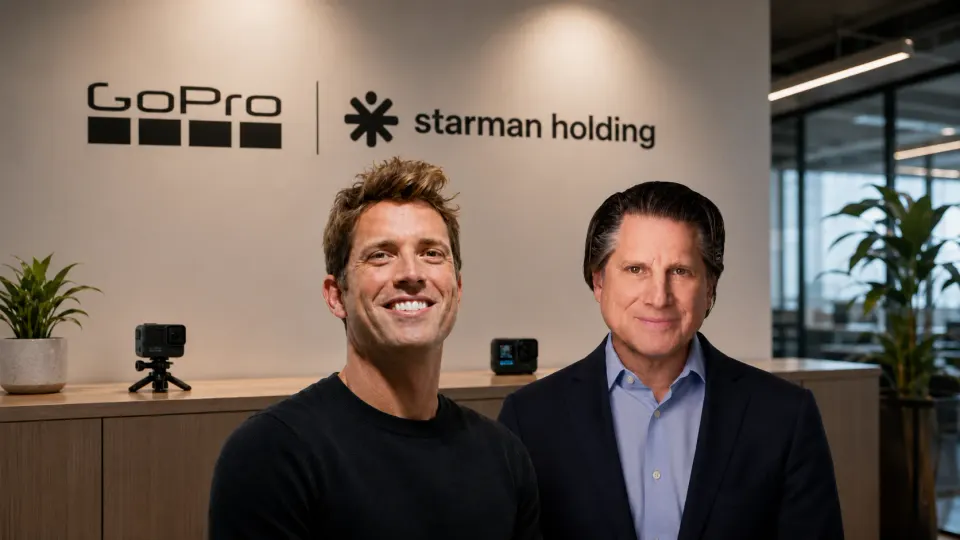
GoPro has agreed to a $285 million merger with Starman Optical, a privately held optical-photonics company, ending a sale process that ran most of the year. Shareholders receive $1.14 a share in cash, subject to adjustment for net working capital at closing, and retain roughly 10 percent of the combined company. GoPro's outstanding debt of about $92 million will be repaid in full. The company stays listed on Nasdaq. The deal is expected to close by the end of 2026, pending regulatory clearance and a shareholder vote.
Starman Optical was incorporated in Delaware on 31 August, the day before the merger was announced. It sits inside Starman Holding, a group run by Charles Tebele whose consumer brands include Incase, Incipio, Griffin and Survivor, and which also spans distribution, medical products developed with Northwell Health, semiconductors and affordable housing. Its photonics arm, Starman New Photonics, grew out of a 2024 joint venture and is renovating a 100,000 square foot facility in Warren, New Jersey, backed by a $150 million investment and state incentives approved in June, with 250 jobs promised.
The stated plan is to attach that transceiver business to GoPro's imaging patents and point the result at AI data centres, government, defence, robotics and aerospace. Optical transceivers convert electrical signals into light and back again, carrying data between processors inside data centres.
GoPro reached a $4 billion valuation on its first trading day in 2014 and has since lost roughly 96 percent of it. Full-year revenue fell 19 percent to $652 million in 2025 on consumer sell-through of about 2 million cameras, squeezed by DJI and Insta360. In March, its memory component costs rose by between 80 and 115 percent. It cut 145 of 631 staff in April, drew a going-concern warning from its auditor in June, and took a $20 million lifeline from founder Nick Woodman in July. Its shares traded as high as $1.58 after the announcement, above the cash on offer.
Why It Matters
Read the structure rather than the headline and this is a reverse merger wearing an acquisition's clothes.
Starman gets a Nasdaq listing without an IPO or a SPAC, a 24-year patent estate in optics, a globally recognised consumer brand, and engineers who know how to manufacture small precision optical assemblies at volume. That last asset is real but thin: after April's cuts GoPro is down to roughly 486 people, less than a third of its 2022 peak. GoPro, for its part, gets its debt erased, and its shareholders get most of what remains of their value in cash. Both sides needed this, which is usually when deals move quickly.
The policy tailwind is real and worth naming. Tebele has pointed to the Department of Defense moving to prohibit procurement of optical transceivers from certain foreign producers. If that holds, a domestic transceiver manufacturer is handed a protected market, and New Jersey has already written the first award under its new manufacturing programme to help build the factory. That is a thesis, not just a press release.
GoPro's imaging assets do have a plausible second life as well. Compact, rugged, thermally constrained camera modules with a proven supply chain and a deep patent portfolio are close to what defence, robotics and aerospace buyers are looking for. GoPro said as much in April when it started exploring those markets on its own. Woodman simply ran out of runway before he could get there alone.
The clearest signal came from the market itself. Pushing the stock to $1.58 against a $1.14 offer says investors are not valuing the cash. They are valuing the ten percent stub, and the story attached to it.
Advanced optics and imaging are essential to AI, national security, and the broader economy. — Charles Tebele, CEO, Starman Holding
The Strategic Read
The gap between the story and the assets is the thing to watch.
GoPro's optical expertise is lens design and small-module manufacturing. Optical transceivers are silicon photonics. These are different disciplines with different fabrication processes, different physics and largely different engineers. The announcement language moves smoothly from world-class optical expertise to advanced transceiver capabilities as though one feeds the other. Very little about designing a rugged action-camera lens helps you build a high-speed transceiver, and nothing disclosed so far explains the bridge.
What Starman brings is thinner than it sounds, too. The transceiver designs are licensed rather than developed in-house. The Warren facility is a building under renovation, with production described as starting at small scale this year. The entity signing the merger agreement is days old. This is a group with real money and real political backing that has not yet manufactured anything at volume in the United States.
So GoPro shareholders are handed a cheque and a minority position in a business whose centre of gravity has moved somewhere they did not choose. Anyone holding the stock because they believed in the camera roadmap now owns a tenth of an optics manufacturer that also sells cameras. The consumer business will be supported, which is not the same as being invested in.
There is a pattern here worth naming. Distressed consumer hardware companies are discovering that the AI infrastructure story is available to anyone with a balance sheet problem and a plausible adjacency; Allbirds rebranded itself Smartbird on much the same logic. Markets reward the announcement immediately. The manufacturing takes years and often does not arrive. GoPro is the most credible version of this trade so far, because it genuinely owns optics IP and genuinely has hardware that defence buyers want.
The honest reading is that this rescues GoPro rather than transforms it. The debt disappears, the delisting risk disappears, and a promised New Jersey factory acquires a listed vehicle and a recognised brand. Whether any of it produces a transceiver business depends on execution nobody can yet assess, at a company that did not exist last week.
For daily, sharp analysis of the biggest moves in the Indian business and startup ecosystem, follow StartupFox.