
 Tech Mahindra
The Story
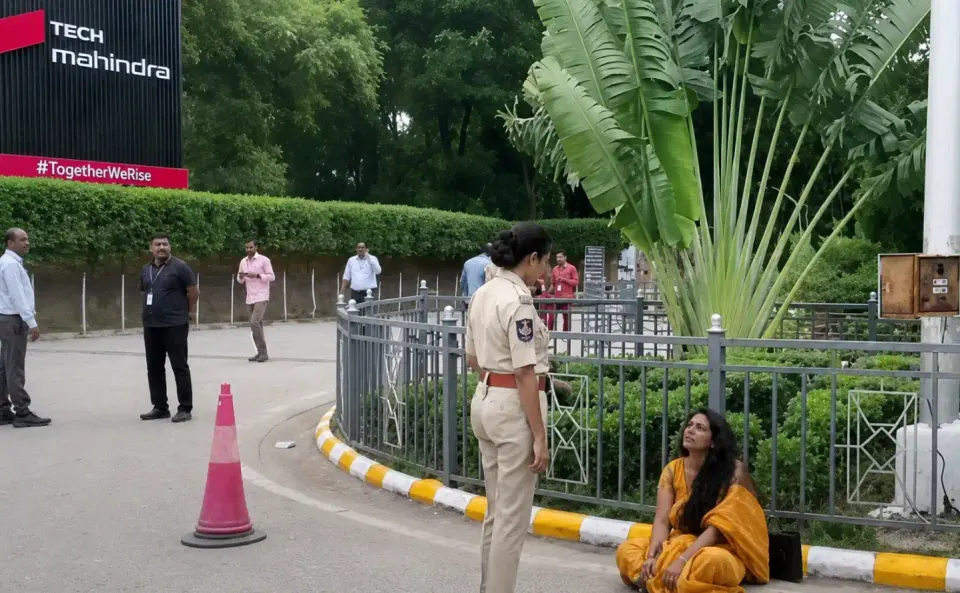
A former Tech Mahindra software engineer staged a protest outside one of the company's Hyderabad offices on 23 July 2026, alleging that she was terminated after taking leave to care for her 11-year-old daughter, who had fallen ill. The engineer, identified in coverage only by her first name, Bhavana, says she had been with the company for about four months.
According to her account, she fell ill during training, fainted at work and was hospitalised. She says she took 13 days of medical leave in June and received a warning letter while still unwell. When her daughter fell ill more recently, she says she was told to log in and wait for approval from a regional manager, left anyway, and was then directed by email to report to work by 21 July. She says she was dismissed without being given an opportunity to explain the absence.
None of this has been independently established. Tech Mahindra has not issued an on-record statement. Police have confirmed receiving a complaint and said a preliminary inquiry is underway, but no first information report has been registered, a point the engineer herself has made. Published accounts differ on where the protest took place, how long she had been employed and how much leave she took. Each of them rests on her description of events rather than on any document, filing or company response.
Why It Matters
The dispute turns on a classification question that most Indian IT employees never think about until they need it. Section 2(s) of the Industrial Disputes Act 1947 defines a workman as anyone doing manual, unskilled, skilled, technical, operational, clerical or supervisory work for hire. A Division Bench of the Karnataka High Court, in Commissioner of Income Tax v. Texas Instruments India, held that a software engineer falls within that definition so long as the role is not supervisory. Probationers are covered. Salary does not exclude a person either, a point the Delhi High Court reinforced in December 2024 when it held that airline pilots earning several lakh a month remain workmen.
That matters because Section 2A treats the dismissal of an individual workman as an industrial dispute in itself, with no union required. The forum is a labour court or industrial tribunal, and the remedy usually sought is reinstatement with back wages.
The protection that would matter most here is the one she is least likely to have. Section 25F requires one month's written notice and retrenchment compensation, but only for a workman with at least one year of continuous service. At about four months, she falls below that threshold. What remains is a challenge to the procedure followed, not a statutory right to notice.
The Strategic Read
The assumption being tested here is that formal labour protection exists for Indian IT workers in a form they can actually use.
It exists on paper. The Texas Instruments ruling settled the classification question in the employee's favour, and it did so in circumstances worth naming. The case arose because IT companies were claiming income tax concessions under Section 80JJ-AA for creating employment of workmen, while separately arguing in labour disputes that their engineers were not workmen at all. The tax position and the employment position could not both be true.
What does not exist is a route that resolves anything quickly. Union density in Indian IT is close to zero. Labour court proceedings run for years. A conciliation officer can call both parties in but cannot compel an outcome. For someone four months into a job, none of that is a remedy in any practical sense.
Which is why the police station and the protest video are being used instead. A police complaint has almost no purchase on a private employment dispute unless a criminal offence is alleged, and officers seeking a report from a company is not the beginning of a case. But it produces a response within the week, and the formal channel does not.
The likely ending is no ending. These stories surface, circulate for a few days and stop, because the machinery that would produce a finding takes longer than public attention lasts. Whether this one reaches a labour court at all is the only thing worth waiting to find out.
For daily, sharp analysis of the biggest moves in the Indian business and startup ecosystem, follow StartupFox.