
 Echovane
The Story
Echovane, a San Francisco-based startup that automates market research using AI agents, has raised $1 million in its first external funding round. The round was co-led by Titan Capital and Neon Fund, and was announced on 10 August 2026.
The company said the capital will expand its AI-agent infrastructure, its multimodal research capabilities, and the global participant network it uses to run studies. Echovane has not disclosed the valuation at which the round was raised or the equity given up. The company was bootstrapped until this round, which is a small one by the standards of enterprise software.
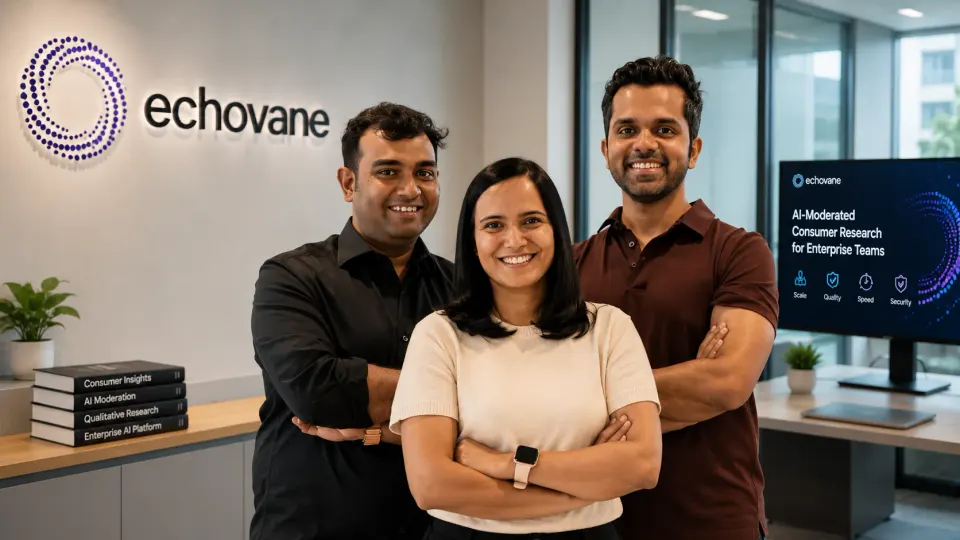
Echovane was founded in 2025 by Smriti Gupta, Vipul Nair and Himadri Roy, graduates of the Indian Institutes of Technology who previously held product and engineering roles at Amazon, Stripe, Gojek and Razorpay. Gupta is chief executive, Nair chief technology officer and Roy chief operating officer. The three set out to build an AI moderator for consumer interviews, then widened the product after concluding that the interview was only a fraction of the work; recruiting participants, coordinating fieldwork, analysing evidence and turning it into something a business could act on consumed far more of a research team's time.
Echovane now positions itself as a done-for-you service: a client submits a business question, and the company's AI agents design the study, recruit and verify participants, run interviews, observations and surveys across voice, video and text, analyse the qualitative and quantitative data together, and deliver the result as dashboards, datasets and video reels. The company says its systems are already used by enterprises including Procter & Gamble, Coca-Cola, Haleon, Kantar and Trustly, claims that have not been independently verified.
Why It Matters
Echovane is built on a real inefficiency. A large consumer or retail company runs hundreds of studies a year, and the ambitious ones combine qualitative and quantitative methods, niche participant criteria, observation and longitudinal fieldwork across several countries, all tied to a launch or a media deadline. Running that traditionally means assembling a supply chain of recruiters, panels, moderators, translators, analysts and production teams, where every stage waits on the one before it. Researchers end up managing vendors rather than interpreting findings.
Echovane's pitch is to own the whole chain rather than sell a tool into it. This is the important distinction: most AI research products give a team faster software and leave the coordination to the customer, whereas Echovane takes the brief and returns the finished answer, combining the accountability of an agency with the cost and speed of automation. That framing, research as a done-for-you outcome rather than a self-serve product, is what the investors are backing, and it is a genuinely different position in a crowded category.
The economics of that choice are the open question. Owning delivery means Echovane carries the messy, human parts of research, recruiting real people, verifying they are who they claim, ensuring quality across languages and markets, which do not obviously compress the way software does. The company frames its participant network and agent infrastructure as assets that improve with each study, but a done-for-you model can just as easily behave like a tech-enabled agency, where each new study needs incremental human effort. Which of the two Echovane actually is will show up in its margins, and those are not disclosed.
The Strategic Read
The market assumption changing behind this round is that enterprises will hand an entire research study to an AI-run service and trust the answer enough to make decisions on it. Global market-research spending runs near $97 billion this year and is projected past $116 billion by 2030, so even a modest slice is a large prize, and the buyers, CPG and retail giants, are exactly the ones drowning in the coordination Echovane wants to remove.
Where Echovane could build an advantage is trust and traceability. In research, a fast answer is worthless if the buyer cannot rely on it, and the company's emphasis that every insight traces back to a verified source and a real participant is aimed squarely at that concern. If it can prove the outputs hold up, and that its participant network reliably reaches hard-to-find respondents across markets, the accumulated context for each client becomes a switching cost, because a system that already understands a brand's past studies is hard to replace.
The risks are equally clear. The category is loud, with incumbents like Qualtrics and the large research agencies moving to bolt AI onto their own workflows, and a wave of AI-native rivals pitching similar automation. Quality and fraud are chronic problems in online research, and taking full ownership of delivery means Echovane inherits them rather than passing them to a vendor. And $1 million is a pre-seed-scale cheque against an enterprise ambition; it funds proof, not scale, and the enterprise logos the company cites are described as users rather than disclosed as paying, contracted accounts.
The honest read is that this is a small first round into an experienced team with a sharp thesis and unproven economics. The clients, the speed claims and the compounding-infrastructure framing are the company's own, and the metric that will decide whether Echovane is software or a modern agency, gross margin as it scales, is not yet visible. The next round, and the disclosures that come with it, will show which one it is.
For daily, sharp analysis of the biggest moves in the Indian business and startup ecosystem, follow StartupFox.