



The Story
DocPharma has raised $2 million in a pre-Series A round led by Equentis. Existing backer 100Unicorns took part, along with Vinners and a group of angel investors. Tracxn records roughly $500,000 raised previously, which puts the company's total funding near $2.5 million.
The Bengaluru company is a backend supply chain for other people's healthcare businesses. It runs licensed dark stores, a SaaS layer called DocPharma One covering warehouse management, inventory intelligence and order routing, and prescription-compliant fulfilment. More than 30 health and wellness platforms use it — e-pharmacies, insurers, corporate wellness providers, hospitals, D2C nutraceutical brands and pet care businesses — to deliver medicines without building fulfilment of their own.
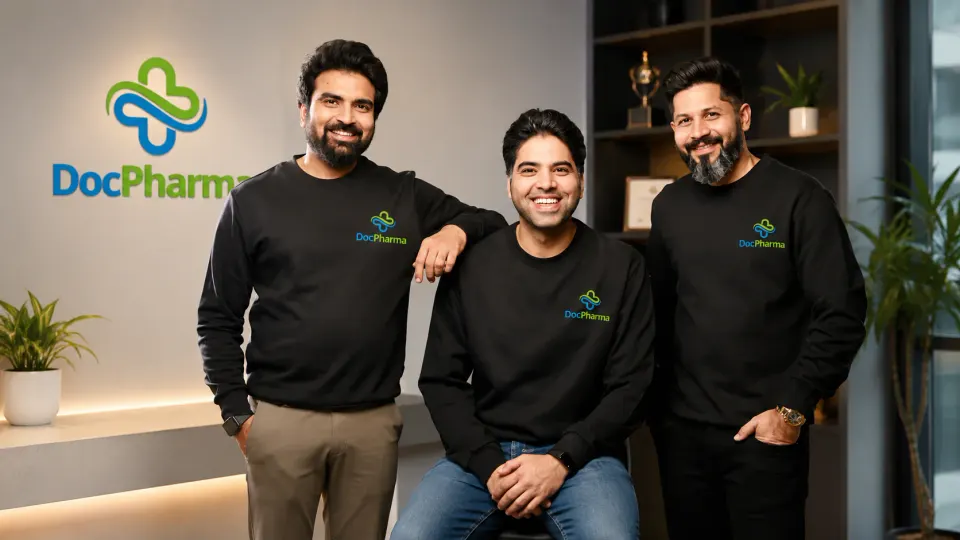
Shashank Rai and Saquib Ali started it in early 2023, out of something they had been doing since the first COVID lockdown: arranging medicine deliveries by WhatsApp for a 1,500-flat housing society, tying up with local pharmacies and handling the logistics themselves. That informal operation was running at about ₹5 lakh a month. Sagar Chauhan joined as a third co-founder in 2025. Rai is chief executive, Ali chief business officer, Chauhan chief product and technology officer.
DocPharma says it operates in more than 12 cities, has fulfilled over 800,000 orders at a fulfilment rate above 95 percent, and has affected more than 500,000 lives. Delivery runs on a hybrid of owned dark stores and partner pharmacies, with a rule engine picking the nearest compliant fulfilment point for each order.
The money goes towards 100 more licensed dark stores and expansion past 50 cities. For scale, the Bengaluru pharmacy-first quick commerce company Plazza raised $15 million in July from Accel, Elevation Capital and Nexus Venture Partners.
Why It Matters
The positioning is the interesting part. DocPharma is not trying to win medicine delivery. It is trying to be the thing everyone who wants to win it has to rent.
That is a defensible place to stand in this market, because the hard part of online pharmacy in India is not the app. It is the licence. Every point that dispenses prescription medicine needs registered physical premises, a state drug licence and a registered pharmacist on site. A wellness brand with a good product and an insurer with a captive customer base both want to deliver medicine in thirty minutes, and neither wants to become a licensed pharmacy operator across eleven states in order to do it.
So DocPharma sells the slow, regulated, unglamorous layer. Thirty-plus platforms spanning categories with nothing else in common — insurers, hospitals, pet care — suggests the pitch lands.
The founding story supports it. Rai and Ali did not start from a market map. They started delivering medicines by WhatsApp inside their own housing society during lockdown, found ₹5 lakh a month of demand across 1,500 flats, and worked backwards to what was actually broken. Companies built that way usually know which parts of the problem are real and which are slideware.
Equentis leading is the mild surprise. It is a SEBI-registered equity advisory firm that sells stock research to retail investors under the Research & Ranking brand, and it launched a ₹500 crore angel fund in December 2024. This is that fund's cheque, not the advisory business, but it is still an unusual name at the top of a healthcare infrastructure round.
Healthcare supply isn't the same as e-commerce or quick commerce. — Saquib Ali, co-founder and CBO, DocPharma
The Strategic Read
The arithmetic is the first problem.
Two million dollars is about ₹17.7 crore. The stated plan is 100 new licensed dark stores plus expansion from 12 cities to more than 50. That is roughly ₹17 lakh per store before a rupee goes to inventory, pharmacist salaries, city launch costs, technology or working capital. A compliant fulfilment centre needs leased premises, a registered pharmacist on payroll, storage that satisfies drug rules and stock to dispense. Seventeen lakh does not buy that. Either the new stores are mostly conversions of existing partner pharmacies rather than new facilities, or the number is a direction of travel rather than a funded plan. DocPharma's own website already describes a network of more than 150 dark stores and partnered pharmacies, which points firmly to the first reading. It is a materially different claim from the one the announcement implies.
Scale is the second. Eight hundred thousand orders since early 2023 works out to roughly 730 a day across the whole network and more than 30 clients. That is a working pilot, not infrastructure. Plazza raised seven times as much in July to attack the front end, and it is front-end companies that generate the volume a backend needs.
Then the regulatory position, which is both the moat and the exposure. India still has no notified e-pharmacy rules. The 2018 draft was never brought into force, the government confirmed in July 2025 that no final regulation exists, and the Delhi High Court's 2023 direction to frame a policy within eight weeks has not produced one. Online pharmacies operate under the offline Drugs and Cosmetics rules, with a 2018 Delhi High Court order against unlicensed online sale technically still standing.
DocPharma's response is to over-comply: real licences, real pharmacists, real premises. That is the correct reading of the law as it stands, and it is precisely why its expansion is slower and costlier than a marketplace's. It also means the company is accumulating a compliance asset whose worth depends on rules nobody has written yet. If the eventual framework favours licensed-inventory models, DocPharma is early. If it favours marketplaces, or narrows the category, those licences are cost rather than moat.
For daily, sharp analysis of the biggest moves in the Indian business and startup ecosystem, follow StartupFox.