

 Discovered Materials
The Story
Discovered Materials, a San Francisco-based deep-tech startup, has raised $9 million (₹85 crore) in a seed funding round led by Lightspeed India Partners. The round included participation from Y Combinator and Peak XV Partners, and angel investors including Paul Graham, Gokul Rajaram and Thariq Shihipar. The round was announced on 10 August 2026.
The company said the capital will be used to expand its team and laboratory and to scale its AI research agents. Discovered Materials has not disclosed the valuation at which the round was raised or the equity it gave up. The startup emerged from Y Combinator's Spring 2026 batch and was founded the same year, and it employs a small team; the seed is its first institutional round.
Discovered Materials was founded by Akash Ramdas and Advaith Sridhar, who met more than a decade ago at IIT Madras. Ramdas holds a PhD in materials science from Stanford, where his work on nanoscale interconnects fed into the roadmaps of Intel and TSMC; Sridhar, the chief executive, studied AI at Carnegie Mellon and built autonomous agents at Persona AI and Luma Labs.
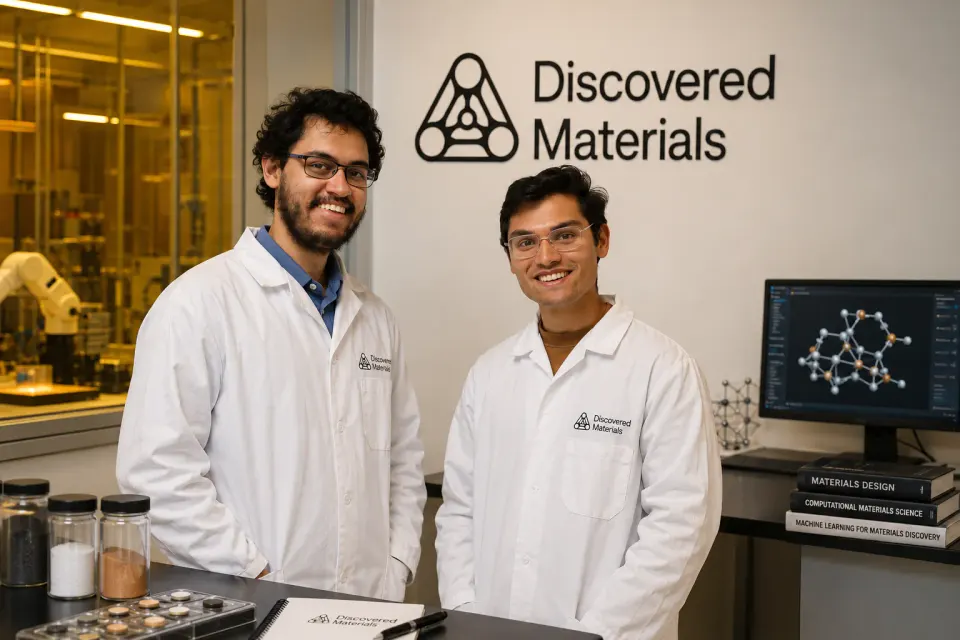
The company is targeting thermal dissipation in AI chips, which can generate heat fluxes above 140 watts per square centimetre, and is developing thermally conductive dielectric materials for 3D chip packaging. It runs cloud-based autonomous agents, built on frontier AI models in a custom harness, to generate thousands of candidate materials, then validates them through physics simulations trained in-house. Alongside the raise, it released the Material Discovery Bench, a benchmark for how frontier AI systems perform on real-world semiconductor materials problems, and said it plans to patent promising candidates and license the resulting technologies to chipmakers.
Why It Matters
Discovered Materials is built on a specific bottleneck: AI chips are running into a heat wall, and the materials that would let them run cooler take too long to find. A modern GPU sheds heat at fluxes higher than a spacecraft on re-entry, and that heat drives much of the power and water a data centre consumes. Better thermal materials would ease that, but discovering one and getting it into production has historically taken more than a decade of lab work.
The company's answer is to attack the slow part with software. Its agents, running on frontier models in a custom harness, propose thousands of candidate materials a day, far more than a researcher making a few educated guesses at a bench, and physics models the team trained in-house filter those candidates by stability, dielectric constant and thermal performance before anything reaches a lab. The intended business is not selling software but owning intellectual property: patent the promising materials or the processes to make chips from them, then license to chipmakers. Revenue, in this model, arrives only once a licensed material is designed into a product.
That is the caveat the funding cannot paper over. Discovered Materials is months old, pre-revenue and employs a handful of people, and its headline claim, that it produced thermal materials in three months matching products that took years to develop, is the company's own and has not been independently verified. Generating candidates quickly is the part AI makes easy; the hard, expensive, multi-year work is validating a material in a fab and persuading a conservative chipmaker to adopt it. Even Lightspeed's partner expects the prediction step to commoditise as models improve, which places the burden of the moat on the lab and the founders, not the agents.
The Strategic Read
The market assumption changing behind this seed is that AI can compress materials discovery from a decade to months, and that whoever industrialises that compression for semiconductors captures a share of every chip that depends on the result. It is a large prize, and the investor list, Lightspeed leading with Y Combinator, Peak XV and Paul Graham alongside, signals conviction in the founders more than in any shipped result, which is appropriate for a company this young.
Where durable value would sit is not the AI that proposes materials but the apparatus around it. If the generation step commoditises as models improve, the defensible assets become Ramdas's domain expertise, the in-house physics models that separate real candidates from plausible ones, and the lab that can validate them. The Material Discovery Bench is a shrewd move in that light: by publishing the benchmark for agentic materials discovery, Discovered Materials positions itself as the party defining how the field is measured, which is a form of influence that outlasts any single model generation.
The competition is heavier than the company's size suggests. Microsoft's MatterGen, Google DeepMind's GNoME and a cluster of well-funded materials-AI startups are chasing the same idea with far deeper resources, and the incumbents in electronic materials are large chemical companies with their own labs. Discovered Materials' wedge, a narrow focus on thermal materials for chip packaging where one founder has prior production credibility, is sensible precisely because it avoids competing across all of materials science at once.
The largest risk is the one the sector has never cleared: the gap between an AI-discovered candidate and a material a fab will actually run. No AI-discovered material has yet made a real commercial impact, qualification cycles at chipmakers take years, and licensing into that supply chain is slow and conservative. The seed buys time to turn hundreds of computational candidates into one that survives the lab and the fab. Whether the company can cross that valley, rather than merely generate more entries into it, is what the next few years, not this round, will decide.
For daily, sharp analysis of the biggest moves in the Indian business and startup ecosystem, follow StartupFox.