
 Cüraa
CüraaThe Story
Cüraa, a New Delhi-based kitchen and lifestyle brand, has raised ₹40 crore in a Series A funding round led by 3one4 Capital. The round was announced on 26 August 2026.
Existing investors Kae Capital, Lumikai and Better Capital also participated. ValueBridge Capital, a Merisis company, advised on the transaction. Cüraa and its backers did not disclose the company's valuation or the equity diluted.
The company said it will use the fresh capital to expand its portfolio across pre-cook and cooking categories, strengthen warehousing and supply chain infrastructure, and scale its presence across its own D2C channel, marketplaces and quick commerce. It also plans to hire senior executives across key functions.
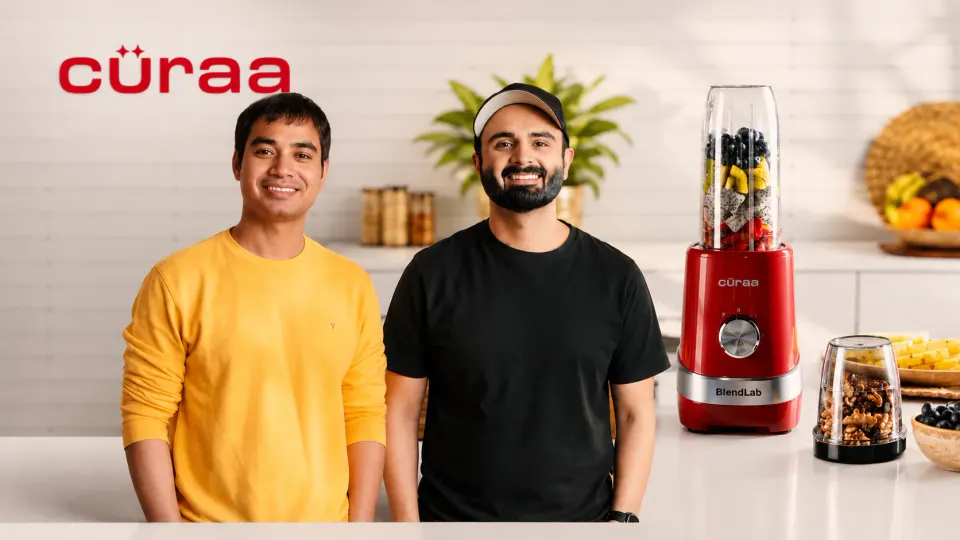
Founded in 2024 by chef and content creator Sanjyot Keer and entrepreneur Neeraj Kumawat, Cüraa makes kitchen appliances and tools designed for Indian cooking, from a blender-mixer-grinder to kettles and spice storage. Kumawat is the co-founder and chief executive, while Keer, who also runs the food content platform Your Food Lab, is a co-founder. Content creator and investor Raj Shamani is associated with the company as a strategic adviser, supporting consumer reach and brand strategy.
Cüraa follows what it describes as an India-first manufacturing model, with most value addition taking place domestically and some components sourced overseas to manage costs. It sells through its website, Amazon, Zepto and Swiggy Instamart, with Amazon accounting for the largest share of sales.
The company said it has served more than three lakh households since its launch in September 2024, that its monthly net revenue has grown 25 times since launch, and that it is adding around 25,000 to 30,000 customers a month. These figures are company-stated.
Why It Matters
Cüraa is built on the premise that Indian kitchens are underserved by appliances designed for how Indians actually cook. Mass-market brands offer generic mixers and kettles; Cüraa's pitch is products tuned to specific Indian use cases, tougher grinding for spices and batters, formats suited to Indian recipes, sold with the credibility of a chef who has spent a decade showing millions of people how to cook. The founding insight is Sanjyot Keer's: having watched how home cooks struggle, build the products they wish existed.
The revenue model is direct consumer sales of appliances and tools, through Cüraa's own website and, more significantly, marketplaces and quick commerce, Amazon, Zepto and Swiggy Instamart, with Amazon the largest channel. This is a physical-product business, not content: Cüraa designs and sells hardware, and the content platform Keer runs is the demand engine that sends buyers to those listings. The creator audience is effectively the top of the funnel, which is what lets a two-year-old brand claim three lakh households.
The cost structure is that of a consumer-hardware company, and Cüraa has chosen to carry more of it than most. Its India-first manufacturing model keeps most value addition domestic, which supports both margin and the made-for-India story, but means the company owns more of the production, quality-control and inventory burden than a brand that simply rebadges an OEM's catalogue. The round's emphasis on warehousing and supply chain reflects where that money has to go.
However, the reported growth does not by itself prove the business is sound. Twenty-five-times revenue growth and three lakh households demonstrate that Keer's audience buys what he builds, but appliances live or die on durability, returns and service over years, and the company has disclosed neither its margins nor its repeat-purchase behaviour. Whether Cüraa is a lasting appliance brand or a successful creator launch is a question only time and the next set of numbers can answer.
The Strategic Read
The market assumption changing behind this round is that a creator's audience can be converted into a durable kitchen-appliance brand, in a category long dominated by decades-old names competing on distribution and price. Cüraa's entire go-to-market advantage is Sanjyot Keer's reach: a decade of Your Food Lab content and millions of followers give it a warm audience and a credibility with home cooks that a conventional appliance startup would spend heavily to build. That is a real and unusual asset at launch.
It is also the round's central question, because audience is a customer-acquisition advantage, not automatically a product one. A blender or a kettle competes on reliability, after-sales service and unit cost against Stovekraft, Sumeet, Wonderchef and a wall of cheaper unbranded options on the same Amazon listings where Cüraa says most of its sales happen. A creator can drive the first purchase on trust; the second purchase, and the brand's reputation, rests on whether the appliance holds up. Selling primarily through Amazon also means the marketplace, not Cüraa, largely owns the customer relationship and takes a cut, which caps the margin advantage the creator halo might otherwise create.
The growth figures are striking and should be read for what they are. Twenty-five-times monthly net revenue growth and three lakh households in under two years show the audience-to-sales conversion is working, but 25x is measured from a standing start in September 2024, and the company has disclosed no absolute revenue, gross margin or return rate. Appliances are a returns- and service-heavy category, and an India-first manufacturing model, while good for margin and messaging, places quality-control risk on a young company's own supply chain rather than an established OEM's.
The competitive and structural risks converge on longevity. Creator-led consumer brands can scale revenue fast and stall just as fast if the founder's attention shifts or the novelty fades, and the ₹40 crore is aimed squarely at building the unglamorous infrastructure, warehousing, supply chain, senior hires, that turns a creator brand into an operating company. That is the right use of the money and the correct diagnosis of the risk: Cüraa has proven it can sell appliances to Keer's audience, and now has to prove it can run an appliance business once the audience is exhausted. Whether mass-premium pricing holds against incumbents with deeper service networks is the test the next round will judge.
For daily, sharp analysis of the biggest moves in the Indian business and startup ecosystem, follow StartupFox.