
 Bruno Milano
The Story
Bruno Milano, a Noida-based direct-to-consumer watch brand, has raised ₹7.5 crore in a funding round led by Sauce VC. The round was announced on 20 August 2026.
Titan Capital participated alongside angel investors, including Arjun Purkayastha, Unacademy co-founder Roman Saini and Kitty Agarwal. Bruno Milano and its backers did not disclose the company's valuation, the equity dilution, or whether the round was structured as equity or a convertible instrument.
The company said the fresh capital will be used to expand its market presence across India, accelerate the rollout of new watch collections and designs, and strengthen its availability across major ecommerce and quick commerce platforms.
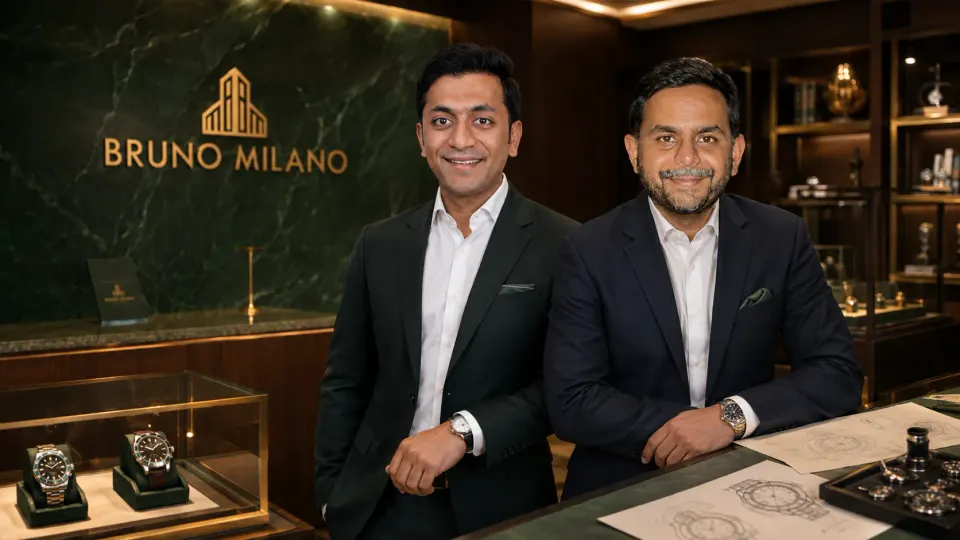
Founded in 2024 by Rachit Jain and Saurabh Agarwal, Bruno Milano sells affordable, contemporary timepieces generally priced between ₹2,000 and ₹5,000. Its portfolio includes hand-finished quartz and chronograph watches across collections such as Vittorio Chrono, Ambrosiana Chic and Duomo Heritage, and it also runs a customised corporate gifting line. The brand sells through its own website, ecommerce marketplaces and quick commerce channels.
The round appears to be Bruno Milano's first institutional funding. The company has not disclosed revenue, unit sales or other operating metrics, so the raise is not accompanied by traction figures that would indicate its scale.
Why It Matters
Bruno Milano is built on a simple proposition: that there is room for a homegrown fashion watch brand in the gap between cheap unbranded timepieces and the established mid-market names. Its watches sell for ₹2,000 to ₹5,000, aimed at a buyer who wants something that looks considered and contemporary without paying for a global label, and who increasingly shops for accessories on marketplaces and quick commerce rather than in stores.
The product line is designed to look more premium than its price. The brand offers hand-finished quartz and chronograph watches across named collections, Vittorio Chrono, Ambrosiana Chic and Duomo Heritage, with the Italian-styled branding doing deliberate work to signal aspiration. Alongside the consumer line, it runs a corporate gifting business, which is a useful volume channel for a watch brand because it moves inventory in bulk and smooths the seasonality of retail demand.
The part of the business that matters most sits behind the brand. Co-founder Saurabh Agarwal has spent over twenty years in watch manufacturing, and the company's roots run into an existing manufacturing operation rather than a purely outsourced supply chain. For a low-price watch brand, that vertical link is the difference between a defensible margin and a race to the bottom, because it lets the company control cost and quality on a product where every hundred rupees of landed cost matters.
However, the absence of any disclosed traction makes the model hard to assess. The company has not shared revenue, order volumes or repeat-purchase data, and at this price point the entire question is whether the brand can sell enough units at a thin enough cost to make the unit economics work. Manufacturing credibility lowers the cost side of that equation, but it does not by itself prove there is durable demand at the scale the round implies.
The Strategic Read
The market assumption changing behind this investment is that Indian consumers will buy fashion watches from a homegrown brand at the ₹2,000 to ₹5,000 price point, a band that sits above unbranded imports and below the Titan and Fossil mid-market. It is a crowded, low-differentiation stretch of the market, and the bet is that brand, design and distribution can carve out a defensible position in it.
The most durable advantage Bruno Milano has is not obvious from the funding line. Co-founder Saurabh Agarwal brings more than two decades in watch manufacturing and design, and the brand's supply chain traces back to an established manufacturing base rather than a contract order placed by a marketing-led startup. In a category where most D2C entrants source finished product from the same third parties, owning the manufacturing relationship is what protects margin and allows faster iteration on new collections. That is the same structural advantage the sneaker brand Zaydn leaned on in its seed round days earlier, and it is becoming the common thread in Indian D2C hardware: a family manufacturing business putting a brand and a website in front of capability it already had.
The economics of fashion watches at this price are unforgiving. A ₹2,000 to ₹5,000 watch carries thin absolute margin per unit, and selling through Amazon, Myntra and quick commerce means marketplace commissions, returns and fulfilment eat into that further. Quick commerce in particular, which the company is expanding into, is a demand channel more than a margin channel. A ₹7.5 crore round is small, and the absence of any disclosed revenue makes it impossible to say whether this is growth capital on top of a working business or early money to find out if one exists.
The competitive set shows both the appeal and the crowding. Rotoris raised a $3 million seed in December 2025 with Nikhil Kamath among its backers, Argos Watches took ₹6.5 crore in 2025, and heritage-oriented players like Jaipur Watch Company and Bangalore Watch Company occupy the premium and mechanical end. Bruno Milano is entering as one of several funded bets on Indian watch brands at once. The largest execution risk is differentiation: at this price and through these channels, a watch brand competes on marketing spend and shelf presence as much as on product, and ₹7.5 crore does not outlast a better-funded rival in an auction for the same customer.
For daily, sharp analysis of the biggest moves in the Indian business and startup ecosystem, follow StartupFox.