

The Story
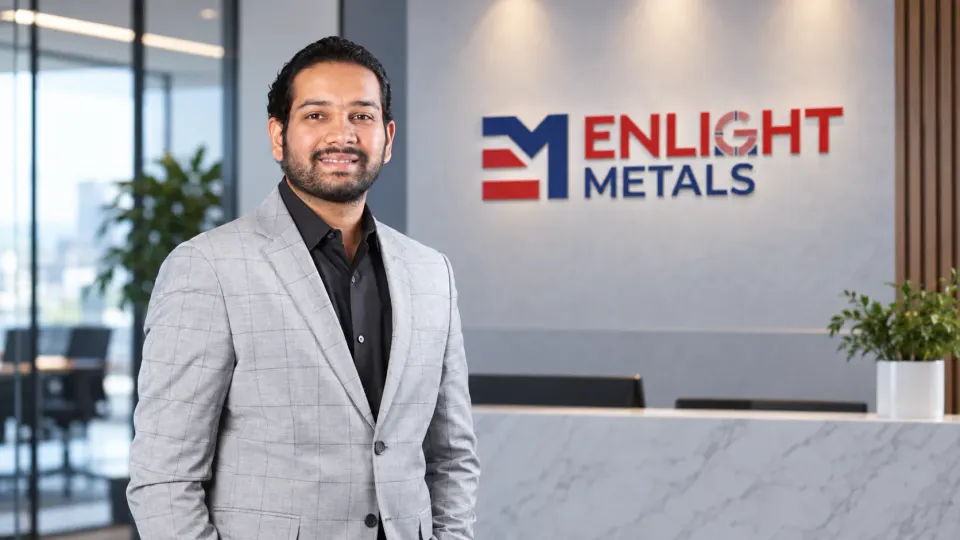
Enlight Metals has raised $1.5 million from Exar North Group, a United States investment firm headquartered in Princeton, New Jersey, at a valuation of $10 million. That implies roughly 15 percent dilution.
Brothers Dhananjay Goel and Vedant Goel founded the company in Pune in 2024, with Vedant as chief executive and a third brother, Taranjay Goel, running the technology side. It works in metal procurement, combining steel sourcing and distribution with software, and supplies more than 500 small and medium manufacturers across solar, wind, cable, railways, automotive, heavy engineering, warehousing, infrastructure and government projects. Its range covers HR and CR coils, GP sheets, MS pipes, structural steel, TMT bars and colour-coated sheets.
It runs facilities in Pune, Mumbai and Raipur, and plans to add Ahmedabad and Indore along with further dark stores, the stocking points it uses to hold inventory closer to buyers and support a 24-hour delivery promise on ready stock.
The money goes towards developing its agentic AI procurement platform, strengthening technology infrastructure, customer acquisition and geographic expansion.
Enlight says its platform has cut end-to-end transaction processing time by 75 percent, inventory costs by 30 percent and operational overhead by 60 percent, and reduced supplier matching from between five and seven hours to under three minutes.
Its Waste Free Steel initiative is the clearest customer-facing claim. It uses drawing-based procurement, matching supply to engineering requirements rather than standard mill sizes, which the company says can cut physical steel wastage by 8 to 10 percent on large infrastructure and EPC projects. Vedant Goel has described the inefficiency in steel procurement as structural rather than operational, and the company frames the shift as moving buyers from taking what is available to receiving what is required.
Enlight also runs an open marketplace at enlightmetals.com where buyers raise procurement tickets, track steel prices in real time and are connected to verified sellers anywhere in India, including regions Enlight does not serve itself. It charges nothing for this.
The company is targeting around ₹1,200 crore of revenue in the next financial year. It has not disclosed current revenue.
Why It Matters
A company valued at $10 million saying it will do ₹1,200 crore of revenue next year looks like a misprint. It is not, and understanding why explains most of what matters about this sector.
Metal distribution is a pass-through business. Enlight buys steel and sells it on, and the entire value of that steel lands on its books as revenue. The margin it keeps is thin, typically low single digits, because the product is a commodity and every buyer can price it against a published benchmark. So ₹1,200 crore of revenue might represent something in the region of ₹30 to ₹60 crore of gross profit before any costs at all. Set against a $10 million valuation, roughly ₹95 crore, the numbers stop fighting each other.
This is why revenue is close to a meaningless figure in Indian B2B commodity marketplaces, and why the largest of them report numbers that sound extraordinary. OfBusiness and Infra.Market book tens of thousands of crores, because they are moving raw materials and recognising the full value of the goods. A reader comparing that to a software company's revenue is comparing two entirely different things. The useful questions in this category are gross margin per tonne, inventory turns, and how much working capital is tied up to produce the turnover.
None of which Enlight has disclosed, and the omission is not unusual. Very few companies in this business publish margin, because the margin is thin and publishing it invites customers to negotiate against it.
What the ₹1,200 crore figure does tell you is the scale of ambition relative to where the company is now. It has three facilities, plans for two more, and has taken $1.5 million. Reaching that revenue requires moving a great deal of metal, and moving metal requires either owning it, which takes capital, or brokering it, which takes trust that buyers and mills will transact through you rather than around you. Both are achievable. Neither is achieved by a procurement interface alone.
The Strategic Read
The efficiency figures in the funding announcement are worth reading closely, because most of them describe the wrong side of the transaction.
Transaction processing time down 75 percent, operational overhead down 60 percent, supplier matching cut from several hours to three minutes. Every one of those is Enlight's own cost of doing business. A fabricator buying steel cares about the price per tonne and whether it arrives when promised, and faster internal matching only reaches him if it is passed on.
The claim that actually addresses him sits outside the funding release entirely. Waste Free Steel, the company's drawing-based procurement model, proposes to cut physical steel wastage by 8 to 10 percent by matching supply to engineering requirements rather than to standard mill lengths. That is a more valuable proposition than a price discount, and a more defensible one. Steel bought in standard sizes and cut to fit generates offcuts that are scrap, and on a large EPC project the accumulated waste is a real line item that no amount of negotiating rate per tonne recovers. A distributor competing on price is in a race every competitor can join. One competing on how much of the delivered tonnage ends up in the structure is selling something a commodity trader cannot match.
The open marketplace resolves a question the funding announcement leaves hanging. A business that stocks inventory in five cities looks asset-heavy, and one running an agentic procurement platform looks asset-light, and the two point in different directions. Enlight is doing both deliberately. It owns metal where it serves buyers directly and brokers free introductions to rival sellers where it does not, on the reasoning that a buyer routed to a competitor through Enlight's platform is still a buyer inside Enlight's network. That is a sensible answer to the geography problem in a business where physical proximity determines who can fulfil an order.
What remains difficult is scale, because in metal distribution scale is the moat. Buying power with mills, credit terms, the working capital to carry stock through a price cycle, and the balance sheet to extend payment terms to buyers who need them separate a large distributor from a small one, and none of them is a software advantage. OfBusiness, Moglix, Zetwerk and Infra.Market have spent years and very large sums accumulating that depth in this and adjacent categories. One and a half million dollars does not buy much steel, and holding inventory in five cities means carrying price risk on a commodity that moves.
Which is why the ₹1,200 crore target is best read as a statement about throughput rather than about the size of the business. Getting there on this balance sheet requires most of that metal to move through the platform rather than sit on it, and the margin Enlight keeps on each tonne, which it has not disclosed, is the number that decides whether the turnover is worth having.
For daily, sharp analysis of the biggest moves in the Indian business and startup ecosystem, follow StartupFox.