
 Bakingo
The Story
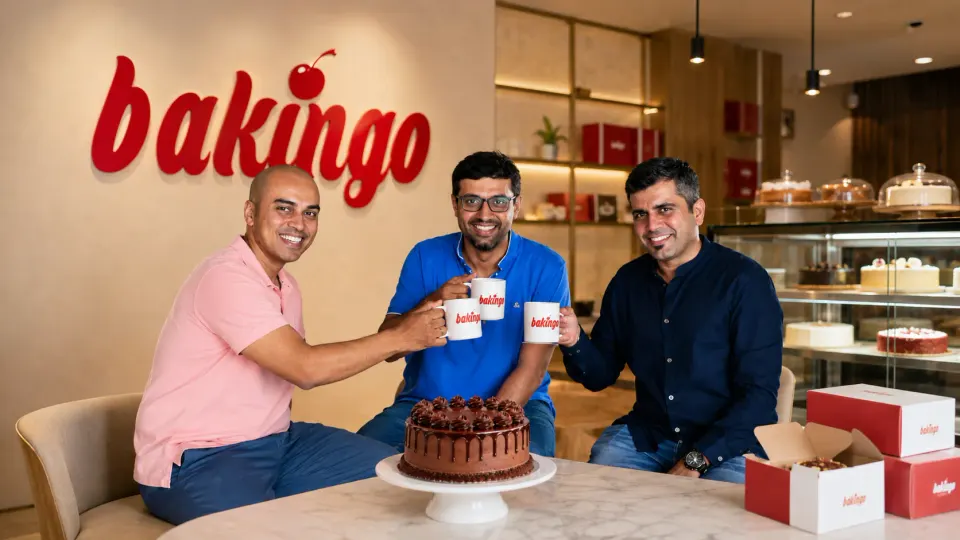
Bakingo, a Gurugram-based online bakery brand, has raised ₹100 crore (approximately $10.5 million) in a Series B round from its existing investor, private equity firm Faering Capital. The round was announced on 10 August 2026.
The board of FA Gifts Pvt Ltd, Bakingo's parent company, allotted 7,436 Series B preference shares at an issue price of ₹1,34,477 each, according to the company's filing with the Registrar of Companies. No new investor joined the round. Following the allotment, Faering Capital holds a 26.31 percent stake in the company. Bakingo has not disclosed the equity diluted by the founders, the split between primary and secondary capital, or a specific use for the proceeds beyond general business requirements and expansion.
By Entrackr's analysis of the filing, the round values Bakingo at ₹1,643 crore ($173 million), about 2.6 times the ₹627 crore at which it raised its previous round. That earlier round, a $16 million investment also from Faering Capital in November 2023, was Bakingo's first-ever external funding after seven years of bootstrapped operation, and was reported at the time to value the company at around ₹571 crore. The valuation figures are derived from regulatory filings rather than disclosed by the company.
The Series B is Bakingo's second round in under three years, and again comes entirely from the incumbent investor rather than a new lead. In FY25, the company reported revenue from operations of ₹300 crore with a net loss of ₹16.5 crore, on a standalone basis, according to its filings. Its FY26 accounts have not yet been filed.
Why It Matters
Bakingo sells cakes and desserts for occasions, and it makes them itself. Rather than list third-party bakeries, it runs its own network of more than 100 kitchens across over 30 cities, producing a catalogue of more than 400 cake designs, and delivers them through its own website, its sister gifting platform FlowerAura, and quick-commerce channels. The company earns on the margin between what it costs to bake and deliver a cake and what a customer pays for a branded product tied to a birthday, anniversary or festival.
The business grew out of FlowerAura, the gifting e-commerce company the same founders built before launching Bakingo in 2016, and that lineage is central to how it works. Gifting gave Bakingo a ready demand channel and an understanding of occasion-led buying, where customers order ahead and value reliability over the lowest price. Owning the kitchens lets it control quality and capture the full margin, unlike an aggregator, but it also means the company carries the fixed cost of that manufacturing footprint whether or not it is fully used.
That cost structure is visible in the numbers. Standalone revenue rose from ₹94.6 crore in FY23 to ₹159 crore in FY24 and ₹300 crore in FY25, strong growth, but the net loss widened over the same span, from ₹0.8 crore to ₹3.7 crore to ₹16.5 crore, as the company added kitchens and cities. Revenue is scaling, yet each expansion leg has so far cost more than it returned in the year it was taken, which is the tension the fresh capital has to resolve.
The Strategic Read
The market assumption changing behind this investment is that a branded, vertically integrated cake and gifting business can hold a national premium against both neighbourhood bakeries and the quick-commerce platforms now delivering cakes in minutes. Faering is doubling down on that thesis, having backed Bakingo since its first external round.
Where Bakingo's value sits is in the combination of owned production and captive demand. The kitchen network gives it control over quality and margin that a marketplace reselling third-party bakeries cannot match, and FlowerAura funnels gifting demand to it without paid acquisition. A cake bought for a birthday or anniversary is an occasion purchase where brand trust and reliable delivery matter more than price, which is the part of the market least exposed to discounting. That is a more defensible position than most D2C food brands hold.
The pressure is arriving from two directions at once. Theobroma, Monginis and a field of regional chains compete on brand and freshness, while Blinkit, Swiggy and Zomato have pushed hard into instant cake delivery, turning speed into the axis of competition and pressuring anyone whose model assumes a scheduled order. Bakingo's dark-kitchen footprint is an asset against the first group and a potential liability against the second if consumers shift decisively to instant delivery, because owned kitchens are fixed cost that must stay utilised.
The clearest signal to weigh is the shape of the round itself. A step-up led entirely by the existing investor, with no new institutional name, can mean efficient continuity or it can mean limited outside appetite at this valuation; the filing does not say which. Set against losses that have grown roughly twentyfold in two years as the kitchen network expanded, the pattern to watch is whether ₹100 crore buys a path to profitability at scale or funds another leg of expansion that widens losses first. FY26, still unfiled, is where that answer begins to show.
For daily, sharp analysis of the biggest moves in the Indian business and startup ecosystem, follow StartupFox.