
 Ather Energy
The Story
Ather Energy reported operating revenue of ₹1,217 crore for the quarter ended 30 June 2026, up 89% from ₹645 crore in the same quarter a year earlier. Loss before tax narrowed to ₹51.09 crore from ₹178.2 crore in Q1 FY26. The results were filed with the exchanges and announced on 3 August 2026.
Other income was ₹43 crore, taking total income to ₹1,259.65 crore against ₹672.91 crore a year earlier. Total expenses were ₹1,310.74 crore. Total comprehensive loss for the period was ₹51.09 crore.
The company delivered 88,655 vehicles in the quarter, against 83,418 in Q4 FY26. The sale of electric two-wheelers and related services was its only source of operating revenue, and no breakup between vehicle and non-vehicle income has been published for the quarter.
Several figures the company usually discloses were absent from the initial filing. EBITDA and EBITDA margin, adjusted gross margin, market share, cost of materials consumed and the AtherStack Pro attach rate have not been released, nor has any management commentary on the quarter. The board also approved the allotment of 3,67,875 equity shares and the grant of 80,223 employee stock options at the same meeting.
For context, Ather closed FY26 with operating revenue of ₹3,671.76 crore and a net loss of ₹517.17 crore, against ₹2,255.01 crore and ₹812.28 crore in FY25. Full-year volumes were 2,62,942 units and the company put its share of the Indian electric two-wheeler market at 18.6% for the year.
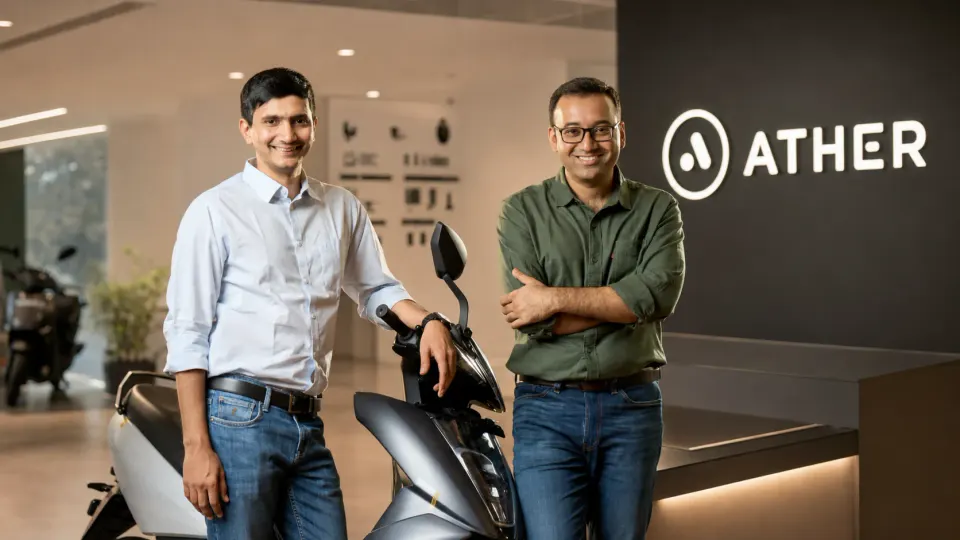
The Bengaluru company was founded in 2013 by Tarun Mehta and Swapnil Jain and listed on the NSE and BSE on 6 May 2025 at ₹328 a share.
Why It Matters
The loss reduction did not come from selling scooters at better prices. It came from spending almost nothing more to sell considerably more of them.
Total expenses in Q1 FY27 were ₹1,310.74 crore, against ₹1,314 crore in the March quarter. Revenue over the same two quarters rose from ₹1,174.66 crore to ₹1,217 crore. A manufacturer holding its cost base flat while adding revenue is the textbook definition of operating leverage, and it is what has taken the quarterly loss from ₹100.23 crore to ₹51.09 crore in three months.
Underneath that, realisation per vehicle went the other way. Divide revenue by deliveries and Q1 FY27 works out to roughly ₹1.37 lakh a vehicle, against about ₹1.41 lakh in Q4 FY26. Volumes grew 6% sequentially while revenue grew under 4%. Whether that reflects the Rizta taking a larger share of the mix, discounting, or a softer non-vehicle contribution cannot be determined, because the company has not published the breakup.
There is one more adjustment the headline hides. Other income of ₹43 crore is not revenue from selling anything. It is largely treasury return on the cash raised at listing. Strip it out and the loss on the business itself is about ₹94 crore rather than ₹51 crore. That figure is still an improvement on the ₹139 crore equivalent for the March quarter, but it is close to double the number in the headline.
The Strategic Read
The assumption being tested is that an electric two-wheeler manufacturer can reach profitability through volume alone, without owning the cell or commanding a price premium. Ather has done the volume part. Deliveries have gone from 46,078 in Q1 FY26 to 88,655 in Q1 FY27, and quarterly revenue has nearly doubled in a year while the loss has fallen to under a twentieth of quarterly revenue.
Capacity is now the constraint rather than the cushion. Against a stated annual capacity of around 400,000 units, FY26 volumes of 2,62,942 used roughly two thirds. This quarter annualises to about 355,000, close to 90%. That explains the company's stated plans for a larger facility, and it also means the next leg of volume growth requires capital spending before it produces revenue, at a point when the balance sheet is still absorbing losses.
Competition is arriving from the direction that matters. The established manufacturers, TVS and Bajaj, sell electric scooters through dealer networks built over decades and can price against internal combustion volumes in a way a single-category company cannot. Ola Electric's decline removed a discounting competitor and handed Ather share, but that was a one-off. Holding 18.6% against incumbents who are not going away is a different exercise from taking share from a company in retreat.
The input cost question sits underneath all of it. Rare earth magnets used in electric motors are supplied from a small number of countries and prices moved sharply during the quarter, a pressure flagged across the sector ahead of these results. Ather has not published cost of materials consumed or gross margin for the quarter, which is precisely the line where that pressure would show. Until those numbers arrive, a ₹51 crore loss on ₹1,217 crore of revenue is an encouraging headline resting on an incomplete disclosure.
For daily, sharp analysis of the biggest moves in the Indian business and startup ecosystem, follow StartupFox.