


The Story
Protein Pantry has raised ₹9 crore in a seed round led by Sharrp Ventures, with Peercheque, Consumer Collective by Atrium and Indian Silicon Valley Capital participating. Angel investors include Mamaearth co-founder Varun Alagh, Rishubh Satiya, Avnish Anand, Arush Chopra, Saurabh Munjal and Signal Ventures.
The money goes mainly into setting up and scaling the company's manufacturing unit, with further investment in research and development and supply chain.
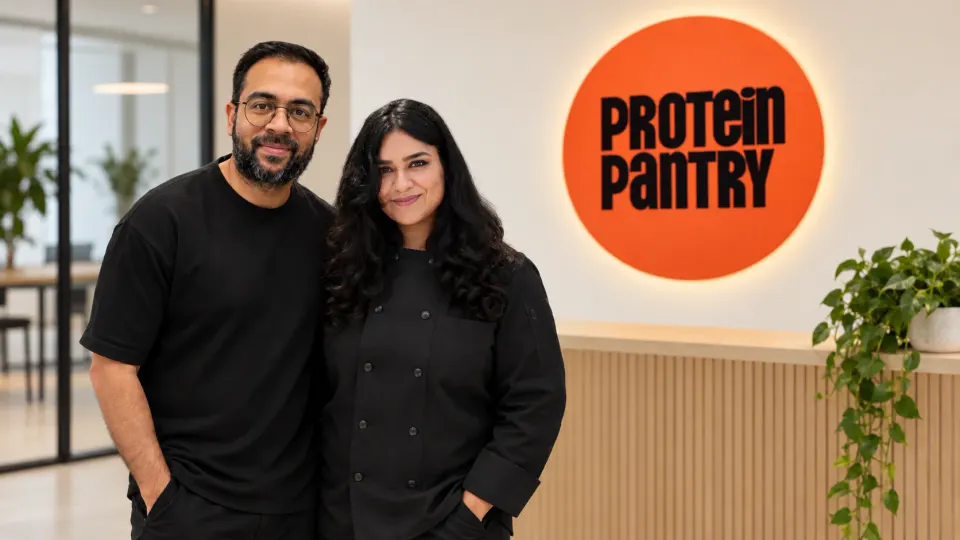
Disha Bhattacharya, a professional chef, and Prashanth Bhushan, a former brand manager, founded the Delhi company in November 2025. The two are a married couple and started it after questioning what went into the soya chaap they ate, following health problems in their family and repeated medical advice to increase their protein intake. They spent eight to nine months developing recipes and, after factories declined to make them, chose to manufacture in-house.
The brand makes high-protein, ready-to-cook frozen vegetarian food: soya chaap, kebabs, cutlets and falafels, baked rather than fried and made without refined flour, preservatives or palm oil. Products are formulated around a 1:10 protein-to-calorie ratio, and the company makes its marinades, sauces and chaap base at its own facility.
It sells direct-to-consumer in Delhi, Mumbai, Bengaluru and Jaipur, and on Blinkit, FirstClub and Flipkart Minutes in Delhi, Mumbai, Bengaluru and Hyderabad. It says it has served more than 30,000 households, reports a strong repeat rate without disclosing a figure, and plans to enter Pune, Kolkata, Lucknow, Chandigarh, Ludhiana and Chennai on quick commerce by the end of the year.
"We started Protein Pantry to move protein beyond the supplements aisle and into everyday Indian meals, with options that are vegetarian and have fewer calories," Bhattacharya said, adding that owning manufacturing end to end gives the company control over its recipes and macros and lets it hold pricing as commodity costs climb across the protein market.
The protein food segment has drawn capital this year. The Whole Truth raised about $51 million in a Series D in February, and Athena Protein took a pre-seed round from Campus Fund this month for high-protein food and cold-chain distribution.
Why It Matters
Soya chaap has a reputation it does not always earn.
For many vegetarian Indian households it is the protein dish: the thing ordered at a dhaba or grilled at home precisely because it is supposed to be the meat-equivalent on a vegetarian plate. In practice, a great deal of commercial chaap is bulked out with refined wheat flour, which is cheap, binds well and holds the familiar texture. The result can carry a fraction of the protein the name implies and a good deal more refined carbohydrate. In 2022 police in Faridabad raided a unit allegedly producing fake soya chaap and recovered 20,000 kg of refined flour against 200 kg of soy, a detail that stayed with the founders of this company.
That is the gap Protein Pantry was built into, and it is a sharper one than protein food in general. India's protein market has grown quickly, but most of it lives in supplements, bars and snacks, products eaten in addition to meals rather than as meals. Vegetarians, a large share of the country, have fewer everyday sources of protein to begin with, and the dishes they rely on are exactly the ones where the protein content is least reliable. A brand that makes a familiar dish honestly, and puts the number on the pack, is solving a problem people already have rather than creating a new eating habit.
The founding pair fits the problem unusually well. Bhattacharya is a professional chef, which matters because the hardest part of removing refined flour from chaap is keeping it tasting and handling like chaap. Bhushan came from brand management, which matters because a clean-label product still has to be sold against cheaper ones on the same shelf. They spent close to a year on the recipes before the company existed.
The baked rather than fried preparation, and the 1:10 protein-to-calorie target, extend the same logic. Reaching roughly ten grams of protein for every hundred calories means about forty percent of the energy in a product comes from protein, a standard most foods marketed as high-protein do not meet. It turns a vague health claim into a figure a customer can check against the label, which in this category is the most persuasive thing a brand can do.
The Strategic Read
The founders' decision to build a factory is the choice that shapes this company, and it cuts both ways.
It exists because they had no alternative. Contract manufacturers declined to make the recipes, which is not surprising: a co-packer's economics depend on standard formulations and long runs, and a product defined by leaving out the cheapest ingredient in the category, refined flour, is inconvenient to make. Owning the line solves that and gives the company something genuinely valuable in a claims-led category: every gram of protein on the label is under its control. When the product promise is a nutritional number, a brand that cannot audit its own production is one supplier substitution away from breaking it.
The cost is that a seed round is going into capital equipment rather than into finding out how big the market is. Nine crore spread across a manufacturing unit, R&D and supply chain is not a large amount of any of the three. Frozen food also carries a cost that ambient food does not: every step from the plant to the customer's freezer has to hold temperature, and cold chain is one of the more expensive logistics problems in Indian retail.
That is where quick commerce matters, and it is a double-edged channel. Blinkit, FirstClub and Flipkart Minutes already run freezers in their dark stores, so a frozen brand gets cold-chain last-mile delivery without building it. But freezer space in a dark store is small and fought over. Frozen is one of the categories where platforms are most selective about which brands they stock, because every slot costs more to run than a shelf does, and a brand that does not sell through quickly loses its space. Expanding to six more cities on quick commerce by the end of the year means winning that fight six more times.
The protein claim is worth checking against the company's own listings, and it largely holds. A 200g Tandoori Chaap pack lists 38g of protein and 338 calories, and a Beetroot Kebab 27g and 235 calories, both comfortably above ten grams per hundred calories. The Spinach Cheese Cutlet, at 25g of protein and 307 calories, comes in closer to eight, so the ratio is better read as the portfolio's target than as a guarantee on every product. That is a small gap, but in a category that sells on the numbers, consistency is what builds the trust the brand was founded on.
The larger question is the one the founders' quote gestures at: commodity costs. Soy protein prices move, and a brand that has promised no refined flour cannot quietly cheapen the recipe when inputs rise, which is the lever every other chaap maker uses. Holding price and formulation at the same time is harder than holding one or the other, and the answer depends on how well the factory runs at scale. That is what this round is actually buying.
For daily, sharp analysis of the biggest moves in the Indian business and startup ecosystem, follow StartupFox.