


The Story
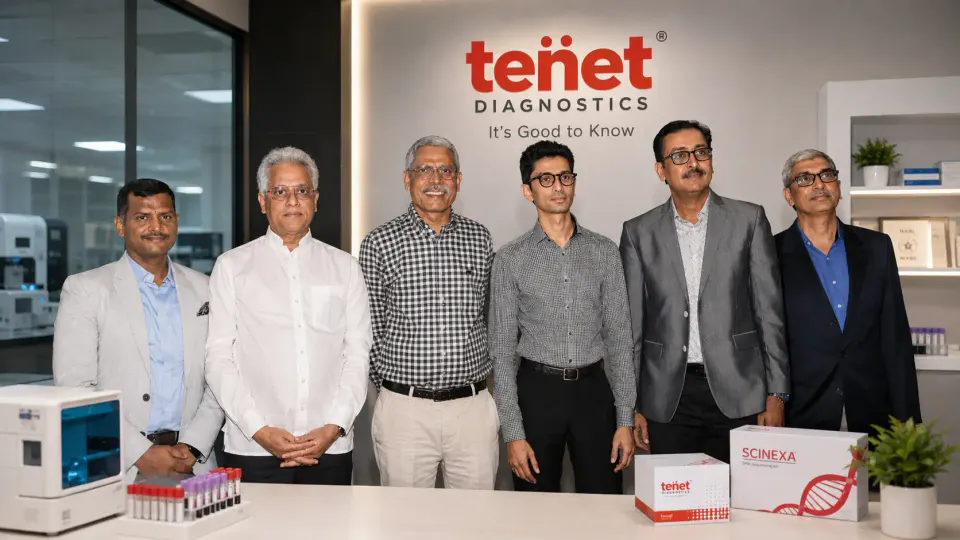
Tenet Diagnostics has raised approximately $30 million from Tata Capital Healthcare Fund III and Blue Earth Capital, a Switzerland-based impact investor. The investment was reported on 17 August 2026.
The equity stake acquired has not been disclosed, nor has the valuation, the split between the two investors, or whether any part of the transaction was secondary. No board changes have been stated.
The capital goes into Tenet Medcorp Private Limited, which trades as Tenet Diagnostics. Tata Capital Healthcare Fund III is the third vehicle in the healthcare-focused private equity series run by Tata Capital, and this is among its first investments since the fund's first close earlier this year. Talks between the two were first reported in March 2026, making this a five-month process from disclosure to close.
The company said the investment will help it accelerate its mission, deepen its footprint across India and bring reliable diagnostics to more communities.
Tenet was founded in 2018, opening its first centre at Banjara Hills in Hyderabad in June that year. It now operates a network of pathology and radiology centres headquartered in Telangana, with locations across Andhra Pradesh, Karnataka, Maharashtra, Bihar, Uttar Pradesh, Jharkhand and Odisha. Its services span imaging, laboratory testing, cardiology and neurology, including MRI, CT, PET-CT, ultrasound, mammography and preventive health packages.
The most recent financial figures in the public record are three years old. In September 2023 the company said it had registered 100% year-on-year turnover growth and expected to exceed ₹150 crore that year, operating 25 locations across eight states, alongside a stated ₹100 crore commitment to expansion in Karnataka. No revenue, profitability or current centre count has been published since.
Tenet also says it was the first radiology facility in India to receive NABL-I accreditation, that its laboratory menu runs to around 3,000 blood tests, and that it has research collaborations with Ohio State University, Siemens Healthineers and United Imaging. Those claims come from the company.
Leadership has not been restated with this round. Reporting from the 2018 launch named Devineni Suresh as chairman, with Devineni Sricharan as executive director and Dr T Vijender Reddy and Dr Sandeep Juvvadi among its directors. Company databases list a different set of names as founders, and the two accounts have not been reconciled publicly.
Why It Matters
Diagnostics is a capital business dressed as a services business. A pathology lab can be opened cheaply, but radiology cannot: an MRI machine costs several crore, a PET-CT more, and each needs a shielded room, a service contract and a radiologist to read the output. That is why the category consolidates and why growth capital rather than venture capital funds it.
The economics follow directly from that. Once the machine is installed, the cost of one additional scan is close to nothing, so profitability is a question of utilisation. A centre running its MRI eight hours a day earns roughly twice what an identical centre running it four hours does, on the same fixed cost. Everything a diagnostics chain does operationally is aimed at filling those hours: doctor referrals, corporate screening contracts, hospital lab management and preventive packages.
Tenet's position is that it runs both pathology and radiology under one roof. Pathology generates volume and repeat visits at low ticket sizes; radiology generates the margin. Selling both from the same location spreads the fixed cost of the premises and gives a referring doctor one place to send a patient for a full workup.
The geography is the interesting part of the strategy. Alongside Hyderabad and Bengaluru, Tenet has expanded into Bihar, Jharkhand, Odisha and Uttar Pradesh, where advanced imaging is thin and the national chains are lightly present. Being early into a district with a PET-CT is a durable advantage, because the second operator into that market faces the same equipment bill against a share of the demand.
What is not visible is whether any of it earns. The last public revenue figure is a 2023 projection, and the company has never published profitability, utilisation rates, or the split between its own centres and hospital lab management contracts.
The Strategic Read
The market assumption being underwritten is that Indian diagnostics still has room for a regional chain to become a national one, in a category where the listed players have struggled to convert scale into pricing power. Dr Lal PathLabs, Metropolis and Thyrocare all found that online-first entrants could undercut them on routine blood work, and recent years have been a price war in pathology.
Radiology is where that argument breaks down in Tenet's favour. Nobody undercuts an MRI over the internet. The scan requires the machine, the room and the radiologist, so the competitive floor is set by capital rather than by whoever is willing to lose money on a lipid profile. A chain weighted towards imaging is insulated from the fight that has damaged the pathology majors.
The investor composition is worth reading carefully, because it is less independent than it appears. Blue Earth Capital is a limited partner in Tata Capital Healthcare Fund rather than an unrelated firm, and the two have run this structure before: in early 2025 Blue Earth put $9 million into Apex Kidney Care, a TCHF portfolio company, in an arrangement the fund's managing partner described as facilitating a co-investment with its key limited partner. Two names on a term sheet here represent one investment decision, not two.
That matters for how the round is priced. TCHF has raised roughly $200 million across its first two funds, at ₹411 crore in 2012 and ₹955 crore in 2022, and $30 million is a substantial cheque against that history. Bringing an LP alongside is how a fund of that size writes it without concentrating the portfolio.
The risk sits in the expansion this funds. Utilisation is everything in imaging, and a new centre in a smaller district takes longer to fill than one in Hyderabad. Growth funded by equity into assets that ramp slowly is how diagnostics chains destroy returns, and it is the specific failure the category has repeated.
Three years of silence on the numbers is the other issue. A company that projected ₹150 crore in 2023 and has said nothing since is asking to be judged on a target rather than a result.
For daily, sharp analysis of the biggest moves in the Indian business and startup ecosystem, follow StartupFox.