
 Ringg AI
The Story
Ringg AI, a Bengaluru-based enterprise voice AI startup, has raised $10 million in an extended Series A funding round led by Peak XV Partners, with participation from existing investors Arkam Ventures and Capital 2b. The round was announced on 26 August 2026.
The extension follows the $5.5 million Series A the company raised in January 2026, taking the total size of the round to $15.5 million. Ringg did not disclose a valuation or the equity diluted. The company said the capital will be used to strengthen its AI platform, expand its voice, WhatsApp and browser agents, deepen investment in its proprietary AI models and context graph, and accelerate enterprise go-to-market efforts in India and international markets.
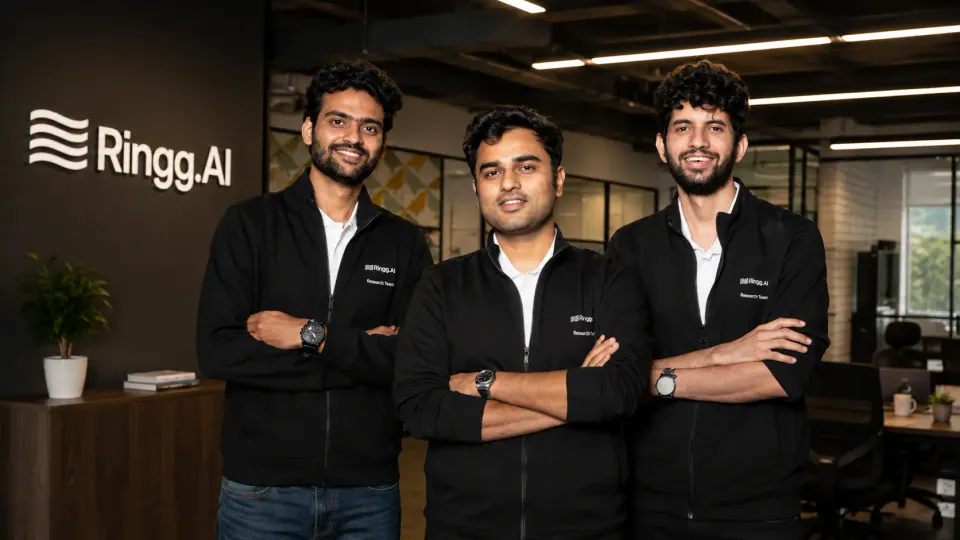
Founded in October 2023 by Siddharth Shankar Tripathi, Utkarsh Shukla and Kali Charan Vemuru, Ringg builds AI agents that automate customer conversations for businesses. Tripathi, the chief executive, was previously at Groww and Flipkart; Shukla was at Blinkit and Atlan, and Vemuru at Flipkart. The company is also backed by Kunal Shah and Groww Founder Fund.
Ringg began as a text-to-speech company called DesiVocal, but shifted to enterprise voice AI after finding the cost of developing its own speech models difficult to sustain. Its first customer was the fintech Cred, and it now counts Flipkart, Practo, Groww, PolicyBazaar and Shell among its clients.
The company said it processes around 20 million call attempts a month, with voice calls accounting for more than 70% of its business. Its agents are used for outbound calling, lead qualification and loan collection, and are deployed across 1,200 Practo clinics for appointment booking and post-visit follow-ups. These figures are company-stated. The startup is now expanding into chat, WhatsApp and browser-based support, and into more complex workflows such as healthcare appointment booking, ecommerce cart recovery, and fintech onboarding and KYC.
Why It Matters
Ringg is built to automate the conversations businesses have with their customers at scale. Enterprises run enormous volumes of routine interactions, chasing leads, collecting payments, booking appointments, answering the same questions, and each one traditionally needs a person on a phone. Ringg's proposition is that AI voice agents can handle those conversations end to end, in multiple languages, at a fraction of the cost of a human call centre.
The revenue mechanism is enterprise software sold on usage and outcomes. Ringg's agents make and take calls, and increasingly handle WhatsApp and browser-based tasks, and the company earns as those agents do work its customers would otherwise pay people to do. Its expansion from pure voice, still more than 70% of the business, into chat and browser workflows is an attempt to become an agent platform that completes tasks rather than a service that only makes calls.
The cost structure is the crux, and it is what reshaped the company once already. Building and running proprietary speech models is expensive, which is precisely why the founders abandoned their original text-to-speech business, DesiVocal, and moved up the stack. Now they have chosen to own the model layer again, betting that the volume they process, and the control it gives over latency, cost and data residency, justifies the expense this time. That is a heavier cost base than rivals who simply resell third-party AI, in exchange for a potential quality and margin edge.
However, the reported 20 million monthly call attempts does not by itself establish a durable business. Call volume shows adoption, but the founder has openly acknowledged that the simplest use cases are a price war, and the company has not disclosed revenue, retention or gross margin. Whether Ringg makes money depends on moving customers to the complex, sticky workflows it is now targeting, and that transition is still underway.
The Strategic Read
The market assumption changing behind this round is that enterprise voice AI is shifting from a demo-driven novelty to an outcomes business, and that the winners will be the ones who move up from cheap, interchangeable tasks to workflows customers cannot easily replace. Ringg's own founder has been unusually candid about why: the high-volume, low-complexity work it started with, outbound calls, lead qualification, collections, is not sticky and becomes a price war. That admission, rather than the funding, is the most revealing thing about this round.
The strategy that follows is a deliberate climb up the value chain. Appointment booking for clinics, cart recovery for ecommerce, KYC and onboarding for fintechs are harder to build and harder to switch away from, because they touch regulated data and core business processes rather than just dialling numbers. The 1,200-clinic Practo deployment is the template: an agent embedded in a workflow, doing bookings and follow-ups, is far stickier than a bulk outbound campaign. If Ringg can make that transition, it earns durable revenue; if it cannot, it stays in the price-war segment it is trying to leave.
The defensibility question is whether owning the models matters. Ringg builds its own speech recognition and generation rather than reselling third-party APIs, and operates as an orchestration layer routing tasks to different models. In a category where many competitors wrap the same underlying providers, an in-house stack could be a real cost and latency advantage, the company claims industry-leading response times, but it is also expensive to sustain, which is the exact problem that killed its first business as DesiVocal. The bet is that at 20 million monthly call attempts, the volume now justifies the model investment that did not pencil out before.
The competition is intense and well-funded on every side. Bengaluru alone has more than a dozen voice AI startups, Sarvam and Gnani among them, the category drew over $250 million in the region this year, and global players are pushing multilingual agents into the same enterprises. Ringg's edge is its enterprise traction and the workflow depth it is building; its risk is that voice AI is moving so fast that today's latency or model advantage compresses quickly, and that large customers eventually bring the capability in-house. A $10 million extension funds the climb into complex workflows, but the window to become indispensable, before the technology commoditises, is the real constraint.
For daily, sharp analysis of the biggest moves in the Indian business and startup ecosystem, follow StartupFox.