
The Story
The Government of Kerala has executed a definitive push into deep-tech infrastructure, earmarking dedicated capital for youth entrepreneurship and indigenous artificial intelligence development. Presenting the revised 2026-27 State Budget in the Legislative Assembly on Friday, Chief Minister and Finance Minister V D Satheesan allocated ₹50 crore to a new Generation Z (Gen-Z) startup initiative, alongside a ₹10 crore fund dedicated to building a Malayalam AI ecosystem.
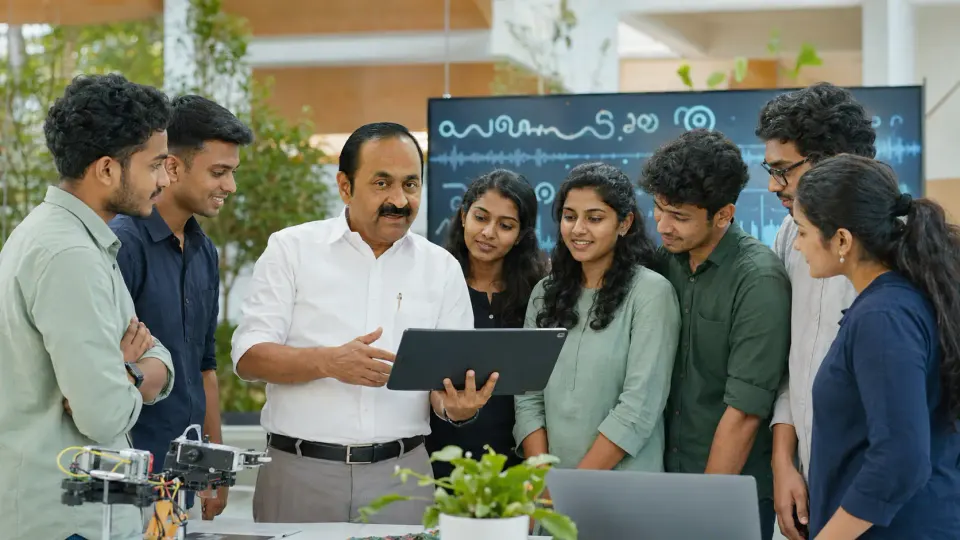
The ₹50 crore Gen-Z allocation aims to integrate the state's digitally native youth into local innovation hubs, research centres, and smart industries. According to the government, the fund will focus heavily on accelerating emerging technologies, including artificial intelligence, robotics, data science, the Internet of Things (IoT), and virtual reality.
Simultaneously, the ₹10 crore Malayalam AI Initiative will finance the creation of an open-source Malayalam language dataset. The state plans to provide this public dataset free of charge to researchers and startups, subsidizing the development of indigenous AI models that innovators can take to the commercial market. The move follows Kerala’s recent establishment of a dedicated Artificial Intelligence portfolio aimed at consolidating tech policies and ethical AI development under a single umbrella.
Why It Matters
The targeted tech allocations matter because they represent a direct policy response to Kerala's most persistent economic challenge: the mass migration of its intellectual capital. Despite boasting some of the highest literacy and education indices in the country, the state has historically struggled to retain its young, skilled workforce. Traditional state-sponsored MSME subsidies and agricultural support programs hold little appeal for digital natives, who routinely migrate to Bengaluru, Chennai, or the Middle East in search of deep-tech venture opportunities.
By explicitly carving out a ₹50 crore fund for "Gen-Z" startups operating in AI and robotics, the government acknowledges that reversing the brain drain requires funding high-risk, high-reward modern enterprises rather than legacy industries. The concurrent upgrade of the Kozhikode Cyber Park is a deliberate attempt to build a robust tech corridor in northern Kerala, ensuring that returning or retained talent has the physical infrastructure necessary to scale operations without relocating to the saturated southern hubs.
More importantly, the ₹10 crore Malayalam AI Initiative signals an understanding of how foundational technology is evolving. The current generative AI landscape is heavily dominated by Western models trained primarily on English language data. When these global models attempt to process regional Indian languages, they often suffer from high token costs, cultural inaccuracies, and severe hallucinations. For local startups trying to build vernacular ed-tech platforms, rural healthcare triage bots, or regional e-commerce customer service agents, the lack of a reliable, machine-readable Malayalam text corpus is a crippling barrier to entry.
The Strategic Read
This budget suggests that state governments are beginning to recognize that controlling localized data is just as critical to regional economic sovereignty as building physical highways or ports. The Indian technology landscape is rapidly realizing that whoever owns the vernacular AI datasets controls the next wave of internet penetration.
The underlying economic mechanism here is the socialization of research and development costs. Building a high-quality, diverse, and ethically sourced dataset for a complex regional language like Malayalam is an incredibly capital-intensive endeavor. Most early-stage startups cannot afford to scrape, clean, and formally annotate millions of vernacular data points. By establishing the Malayalam AI Initiative and making the resulting dataset free for all, the Kerala government structurally lowers the customer acquisition and R&D costs for indigenous tech companies.
The primary leverage point is cultural context. Global technology giants can brute-force regional language translation, but nuanced, context-aware Malayalam—crucial for sensitive deployments in local governance, legal tech, or healthcare—requires native data. If Kerala’s open dataset becomes the definitive standard for the language, any global or domestic enterprise wanting to build AI tools for the Malayali demographic will be functionally dependent on the infrastructure the state has funded. This creates a powerful ecosystem gravity, pulling AI researchers and natural language processing (NLP) startups into the state's orbit.
For daily, sharp analysis of the biggest moves in the Indian business and startup ecosystem, follow StartupFox.