

The Story
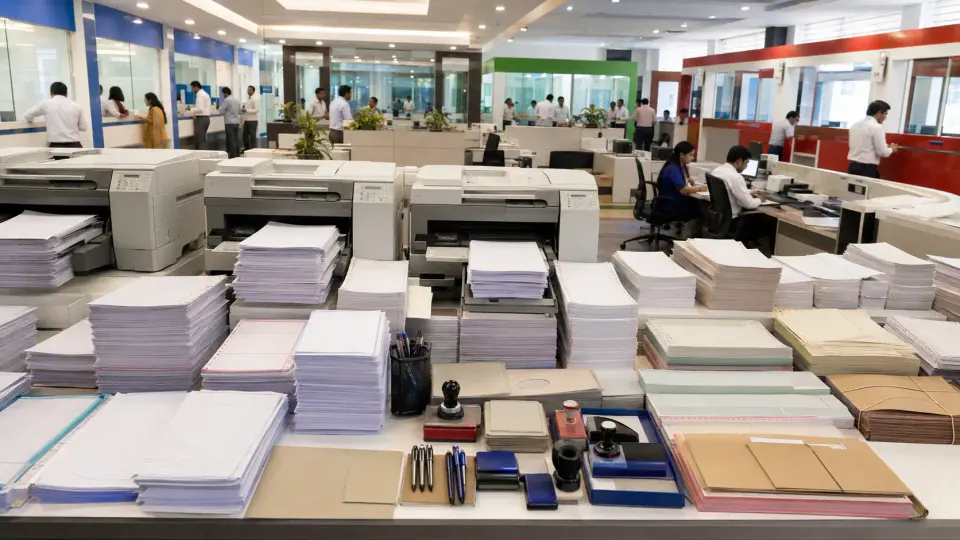
India’s top commercial banks spent a combined ₹3,878 crore on printing and stationery during the fiscal year 2025. According to compiled financial data referenced and drawn from the lenders' annual disclosures, the sheer scale of physical paper consumption remains massive despite a decade-long national push toward digital banking and the Unified Payments Interface (UPI).
The expenditure is heavily concentrated among the nation's largest branch-led institutions. State Bank of India (SBI) reported the highest outlay at ₹986.4 crore, closely followed by private sector giant HDFC Bank at ₹922.5 crore. Axis Bank and ICICI Bank recorded stationery expenses of ₹373.8 crore and ₹318.5 crore, respectively. Public sector entities, including Bank of Baroda (₹211.9 crore) and Punjab National Bank (₹173.8 crore), alongside private lenders like Kotak Mahindra Bank (₹167.0 crore) and IDFC First Bank (₹122.7 crore), made up the remainder of the aggregated total.
The figures gained viral traction across professional networks recently, with commentators noting that SBI’s near-₹1,000 crore stationery bill exceeds the annual operating revenue of many prominent Indian technology startups.
Why It Matters
This nearly ₹4,000 crore expenditure matters because it exposes the physical friction still embedded within India's financial system. While the consumer-facing payment layer has been hyper-digitised by UPI, the underlying infrastructure of asset creation—specifically lending, compliance, and wealth management—remains heavily tethered to paper.
The timing of this data circulating highlights a paradox in modern banking. Over the past three years, banks have invested tens of thousands of crores into cloud migrations, mobile applications, and artificial intelligence copilots. Yet, their physical printing costs have not collapsed.
This happens because banks are simultaneously executing two divergent strategies. They are pushing urban, affluent customers toward entirely digital journeys while aggressively expanding their physical branch networks deep into Tier-3 and Tier-4 geographies. HDFC Bank alone has added thousands of branches in recent years to mobilize rural deposits. A new physical branch requires physical materials. Furthermore, a vast segment of India's rural and senior demographic still demands physical passbooks as their primary source of financial trust.
The Strategic Read
The persistence of this massive stationery bill suggests that the "phygital" (physical plus digital) banking model is not a temporary transition phase; it is a permanent structural reality of the Indian financial sector. The underlying business mechanism here is the cost of trust and the cost of compliance.
For digital-only neobanks and pure-play fintechs, a near-zero stationery bill is a structural advantage, allowing them to boast vastly superior customer acquisition economics. However, this lack of physical infrastructure is precisely why neobanks struggle to build substantial, high-margin secured lending books. Legacy banks absorb the ₹3,878 crore paper bill because it is the operational tax required to execute high-value, legally binding secured loans—the exact product that drives the bulk of their net interest income (NII). The leverage point for SBI and HDFC Bank is not their digital app; it is their ability to deploy a physical, paper-backed trust network across the country to secure deposits and underwrite hard assets.
This creates significant competitive consequences for the broader ecosystem. While fintechs burn venture capital on performance marketing and cloud hosting to acquire customers, legacy banks allocate equivalent capital toward commercial real estate and physical supply chains. The banks are betting that the lifetime value of a customer secured through a physical branch—who takes a mortgage, opens a fixed deposit, and requires a printed cheque book—far exceeds the cost of the paper required to service them.
For daily, sharp analysis of the biggest moves in the Indian business and startup ecosystem, follow StartupFox.