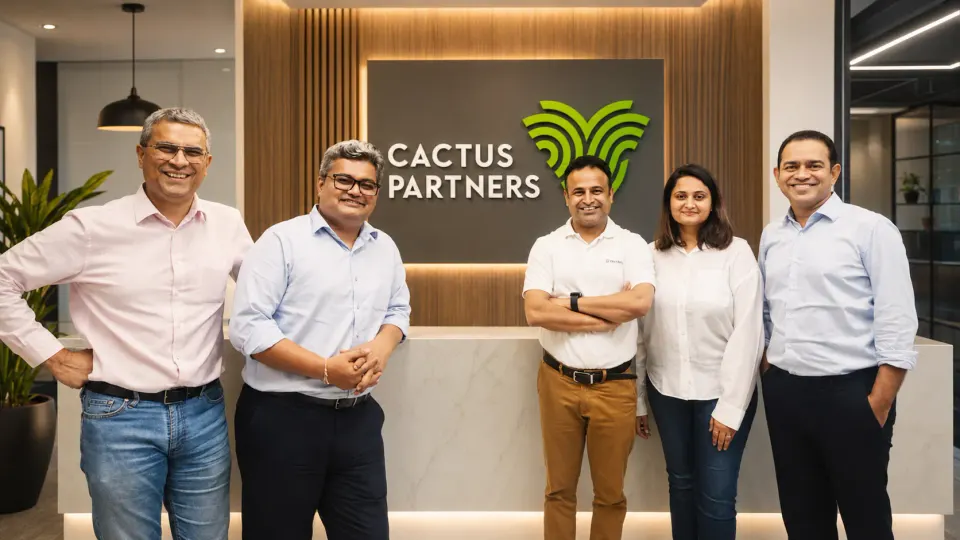

 Cactus Partners
The Story
Cactus Partners is targeting a corpus of ₹1,600 crore for its second fund and plans to back 13 to 15 startups from it. The plan was reported on 27 July 2026, drawn from an interview with the firm's general partner Amit Sharma.
The firm has not announced a first close, a target date for a final close, an anchor investor or any limited partner commitment for Fund II. Whether the ₹1,600 crore figure includes a green shoe option has not been stated. As reported, the raise sits at the intention stage: no capital has been confirmed as committed.
Sharma said the fund would write initial cheques of ₹60 crore to ₹100 crore and primarily back companies raising $10 million to $20 million. Cactus intends to lead those rounds with $6 million to $10 million of its own capital and syndicate the balance with other investors.
The firm invests across advanced manufacturing, enterprise technology and consumer technology. Stated focus areas include robotics, semiconductors, defence, spacetech, electronics manufacturing, AI, machine learning, cybersecurity, healthtech and vertical software. It is also evaluating opportunities in cybersecurity and quantum technologies.
Fund I closed at ₹630 crore in February 2024 and has been deployed across 13 companies, among them Lohum, Bellatrix Aerospace, Kapture CX, Indigrid Technologies and Brandworks. That fund made a first close of ₹350 crore in August 2022 against an original target of ₹750 crore including a ₹250 crore green shoe, and finished below it.
Over the past 15 months the firm has made new investments in Bellatrix Aerospace, Showroom B2B and Brandworks Technologies, and participated in follow-on rounds of existing portfolio companies. Realisations and returns from the first fund have not been disclosed.
Why It Matters
A venture fund's shape is set by three numbers: corpus, cheque size and investment count. Cactus has stated all three, and they sit awkwardly together.
Thirteen to fifteen initial cheques at the bottom of the stated range, ₹60 crore, comes to ₹780 crore to ₹900 crore. At the top of the range, ₹100 crore, the same count consumes ₹1,300 crore to ₹1,500 crore of a ₹1,600 crore corpus. Management fees come out of that corpus before anything is invested. The follow-on reserve — the capital an early-growth investor needs to hold its ownership when a portfolio company raises again — is comfortable only at the lower end of the cheque range.
The syndication model is where the firm buys its position. Leading a $10 million to $20 million round with $6 million to $10 million means writing roughly half of it and bringing co-investors in for the rest. That secures a board seat and control over entry pricing. It also concentrates the book. A portfolio of 13 to 15 names carries no slack for a construction error, and each cheque has to be underwritten as though it will be marked individually.
Three new investments over the past 15 months is the firm's demonstrated pace. Held at that rate, 13 to 15 investments imply a deployment period running well past the three to four years Cactus set for its first fund.
The Strategic Read
The market assumption behind Fund II is that India now produces enough post-product-market-fit companies in hard sectors — propulsion, semiconductors, defence electronics, industrial software — to fill a 15-name portfolio at entry prices that still leave room for a venture return.
Fund I was raised on a different description. In 2022 the firm presented itself as an investor in clean tech, health tech and enterprise software. The Fund II sector list leads with robotics, semiconductors, defence and spacetech. That is where Indian institutional and government capital is currently pointing, and it is also where entry valuations have moved fastest. A firm that repositions towards the sectors attracting the most capital is either reading a structural shift early or arriving at it late. The multiples on its next three deals will show which.
The fundraising history matters more here than the thesis. Cactus went to market in February 2022 for ₹750 crore, made its first close five months later, and finished at ₹630 crore two years after that. It is now asking for roughly 2.5 times that corpus as a firm with 13 portfolio companies and no publicly detailed realisations. Indian limited partners have grown considerably more insistent on distributions since 2022. A second fund raised without a track record of returned capital tends to depend on the same domestic family offices and institutions that wrote the first cheques, and those LPs are the ones now asking what came back.
Sharma has said the firm avoids chasing high-valuation sectors and looks instead for proven product-market fit and sustainable unit economics. Defence and spacetech in India in 2026 are not obviously where those conditions are cheapest to buy.
The largest execution risk is the close itself. Nothing in the reporting establishes that any Fund II capital has been committed, and a target announced in an interview is not a raise.
For daily, sharp analysis of the biggest moves in the Indian business and startup ecosystem, follow StartupFox.