
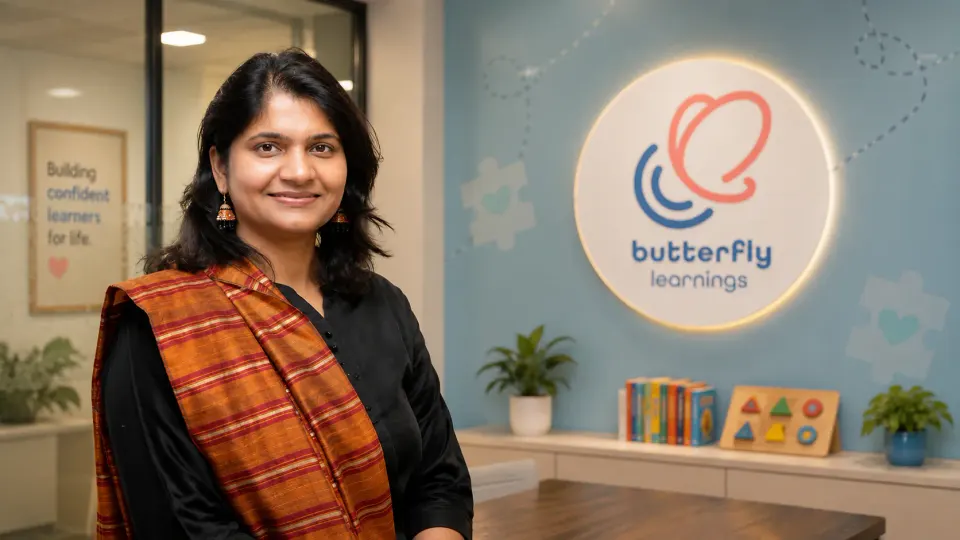

 Butterfly Learnings
The Story
Butterfly Learnings, a Mumbai-based paediatric behavioural health platform, has raised ₹65 crore ($6.7 million) in a Pre-Series B funding round led by Inflexor Ventures. The round was announced on 19 August 2026.
Existing investors Enzia Ventures, Insitor Impact Asia Fund and IIMA Ventures also participated. Butterfly Learnings and its backers have not disclosed the company's valuation, the equity dilution, the split between primary and secondary capital, or the board composition after the round.
The company said the fresh capital will be used to expand its centre network beyond Maharashtra, strengthen its technology and AI capabilities, and increase deployment of its Get SET Early autism screening solution through hospitals and paediatricians. It will also expand its therapist training programme.
The raise is structured as a Pre-Series B, an interim round rather than a full Series B, which typically signals a company raising to reach the milestones a larger priced round would require. It follows a ₹32 crore Series A in April 2024 and a roughly $2 million seed in 2022. At ₹65 crore, this round is roughly double the Series A and the company's largest to date.
Founded in 2021 by Dr Sonam Kothari and Dr Abhishek Sen, Butterfly Learnings provides care for children with autism, ADHD and learning disabilities. Its platform combines clinical therapy, inclusive schooling, diagnostics, digital therapeutics and technology-enabled interventions. The company currently operates 90 centres across 22 cities and runs a therapist training institute based on behavioural healthcare standards.
Why It Matters
Butterfly Learnings addresses a specific and underserved problem: structured, evidence-based therapy for children with autism, ADHD and learning disabilities, delivered somewhere other than a handful of big-city specialist clinics. In India the diagnosis often arrives late and the therapy that follows is fragmented across independent speech, occupational and behavioural practitioners with no shared standard or outcome measurement.
The company's answer is a network model. It runs physical centres staffed by in-house trained therapists, layers diagnostics and digital tools on top, and adds inclusive schooling for older children through a curriculum partnership. Therapy is built on applied behaviour analysis alongside consultations with paediatric neurologists and developmental specialists. The economic logic is that owning the centres and training the therapists produces more consistent outcomes than referring families out, and that consistency is what parents and, increasingly, institutional referrers will pay for.
The cost base is clinical and physical. Each centre carries rent, equipment and a roster of trained therapists, and the therapist training institute exists because the supply of qualified practitioners is the real bottleneck to opening new locations. This is a people-heavy model, and it scales with headcount rather than with code.
However, operating 90 centres across 22 cities demonstrates reach, not unit economics. The company has not disclosed centre-level utilisation, revenue or whether its existing locations are profitable, and a therapy network's margins live entirely in how full each centre's therapist schedule runs.
The Strategic Read
The market assumption changing behind this investment is that paediatric behavioural health can be built as a standardised, multi-city clinical network rather than a scatter of independent therapy clinics. Butterfly Learnings has gone from 30 centres in Maharashtra at its Series A to 90 across 22 cities now, and the Pre-Series B funds the next leg of that geographic push.
The bet rests on two things being true at once: that therapy quality can be held constant as centres multiply, and that the technology layer genuinely differentiates rather than decorates. Applied behaviour analysis depends on trained therapists, and the company's own emphasis on a training institute is a tell that talent, not real estate, is the binding constraint. Every new city needs clinicians trained to the same standard before it can open, which caps how fast the network can grow without diluting outcomes.
Get SET Early is the more interesting asset. An exclusive global licence to an eye-tracking autism screening tool with CDSCO approval to screen from age one is a genuine edge, because earlier diagnosis feeds directly into the therapy funnel that Butterfly Learnings then monetises. If the screening tool becomes a standard referral path through hospitals and paediatricians, it lowers customer acquisition cost for the core therapy business in a way competitors relying on parent-initiated search cannot easily match. That is the part of this round that could compound.
The competitive field is crowded and now well-capitalised. Lissun raised ₹48 crore days earlier for an overlapping child-development model, and Continua Kids, Hoola Health and Amaha's Children First all target the same families. A Pre-Series B buys centre count and a screening moat, not a settled category. The largest execution risk is the one every centre-led therapy business carries: fixed clinical cost lands in each new city before the patient volume does, and an interim round means the company will be back in the market before that maths has fully played out.
For daily, sharp analysis of the biggest moves in the Indian business and startup ecosystem, follow StartupFox.